Skip to content

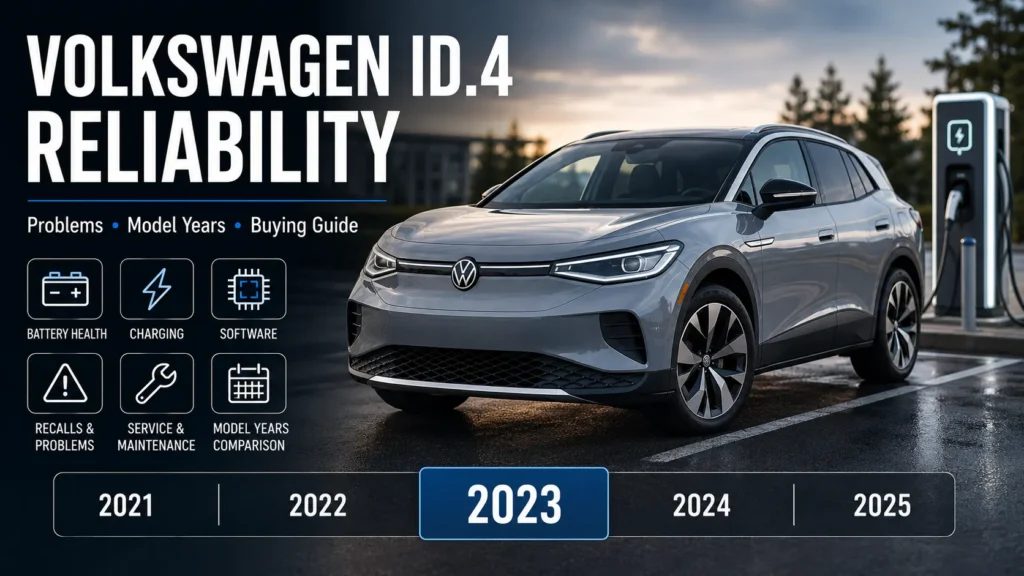
If you are thinking about buying a Volkswagen ID.4, reliability deserves a closer look. The ID.4 has a good electric drivetrain and a comfortable cabin, but its history also includes software, electrical, charging, and recall issues. I would not judge the ID.4 from one reliability score alone. The model year, service history, recall status, and condition of the specific car all matter.
Quick Answer
The Volkswagen ID.4 has a mixed reliability record. Early models, especially 2021 and 2023 examples, have more reported problems involving electronics, software, displays, and other electrical systems. Newer models may be a better choice, but they have less long-term data. If I were buying a used ID.4, I would check its recall history, software updates, charging system, 12-volt battery, warning lights, and service records before buying.
Is the Volkswagen ID.4 Reliable?
I would rate Volkswagen ID.4 reliability as mixed rather than clearly good or bad.
The ID.4 uses a fairly simple electric powertrain compared with a gas-powered vehicle. There is no traditional engine, transmission with many gears, spark plugs, fuel injectors, or engine oil to deal with. That can reduce some routine mechanical work.
The main concern is the amount of electronics and software used in the vehicle. Owner complaints and reliability data show recurring concerns around infotainment, electrical systems, charging, displays, and other electronic features.
So I would not call the ID.4 an unreliable EV across the board. I also would not buy one without checking its history.
For a used ID.4, I care more about the specific vehicle than a single reliability rating.
A car with complete recall work, updated software, good service records, and no repeated electrical faults can be a much better buy than another ID.4 of the same year with a long repair history.
Volkswagen ID.4 Reliability by Model Year

Model year matters with the ID.4 because Volkswagen made software, equipment, and powertrain changes over time.
Current third-party reliability data shows the 2023 model has a particularly high number of reported complaints, while newer models have fewer complaints so far. However, newer cars have had less time on the road, so lower complaint numbers do not automatically prove better long-term reliability.
| Model year | Reliability picture | What I would check |
| 2021 | More caution needed | Software, electrical system, recalls, 12V battery |
| 2022 | Mixed | Software, charging, electrical faults, recall work |
| 2023 | Higher concern | Electrical issues, battery recalls, door handles, software |
| 2024 | Mixed | Software, charging, recalls, service history |
| 2025 | Too early for a long-term verdict | Software, charging, recalls, battery history |
2021 Volkswagen ID.4 Reliability
The 2021 ID.4 was one of the first model years sold in the U.S., so it is worth giving this year extra attention.
Current data shows a relatively high level of complaints for the 2021 model. Electrical and software-related concerns appear often in owner complaint data.
I would not automatically reject a 2021 ID.4. But I would want to see a strong service history and proof that applicable recall work and software updates were completed.
If you are considering one, test every screen, camera, charging function, door, window, and driver-assistance feature before buying.
2022 Volkswagen ID.4 Reliability
The 2022 ID.4 still belongs to the early part of the model’s production run.
Current reliability data puts it in the mixed category. Reported issues include electrical and software concerns, although its complaint level is lower than the 2023 model in some current datasets.
I would treat a 2022 ID.4 as a vehicle that needs a proper inspection rather than a model year that should automatically be avoided.
A clean service record can make a big difference.
2023 Volkswagen ID.4 Reliability
The 2023 ID.4 deserves the most attention in this article.
Current complaint data ranks the 2023 model as one of the weaker ID.4 years, with electrical problems making up a large part of the reported issues. One current database lists 402 complaints and 14 recalls for the 2023 model.
That does not mean 402 vehicles had the same serious failure. Complaint totals are useful signals, but they do not equal failure rates.
I would pay close attention to the recall history on a used 2023 ID.4. I would also test the infotainment system, instrument display, charging system, door handles, cameras, and other electronic features.
2024 Volkswagen ID.4 Reliability
The 2024 ID.4 brought changes to the powertrain and infotainment system, so it is not exactly the same package as the earlier cars.
Current reliability data still rates the model year as mixed. However, some complaint databases show considerably fewer complaints than the 2023 model.
I would still check recall completion and service records.
A lower complaint count is encouraging, but it is too early to use that alone as proof of long-term reliability.
2025 Volkswagen ID.4 Reliability
The 2025 ID.4 is still too new for a strong long-term reliability verdict.
Current data shows fewer complaints than older model years, but that is partly because 2025 vehicles have had less time to accumulate owner reports.
So I would describe 2025 reliability as promising but not proven.
If I were buying one, I would still check the VIN, recalls, software version, charging behavior, warning lights, and service history.
Common Volkswagen ID.4 Reliability Problems

The biggest reliability concerns are not limited to one mechanical part.
The ID.4 uses many electronic systems, and problems with those systems can affect the driving experience even when the electric motor and main battery are working properly.
Software and Infotainment Problems

Software is one of the most common areas I would check.
Owners have reported issues such as:
- Frozen infotainment screens
- Slow system response
- Screens going blank
- System restarts
- Warning messages
- Connectivity problems
- Camera display problems
- Driver information display issues
This matters because the screen is tied to several vehicle functions. A software fault can be more than an annoying infotainment problem if it affects the instrument display or rearview camera.
If I test a used ID.4, I would spend several minutes using the screens instead of checking them for only a few seconds.
12-Volt Battery and Electrical Problems

The ID.4 has two different battery systems.
The large high-voltage battery powers the electric motor. A smaller 12-volt battery runs many of the vehicle’s normal electrical systems.
This distinction matters.
A problem with the 12-volt system can cause strange electrical behavior and warning messages even though the main EV battery is fine.
I would ask the seller whether the 12-volt battery has been replaced and whether the car has a history of electrical faults.
Repeated electrical problems are more concerning to me than one isolated issue that was properly repaired.
Charging Problems

Charging is another area worth checking on a used ID.4.
Potential concerns can involve:
- Charging interruptions
- Charging-port problems
- Software-related charging faults
- Slow or inconsistent charging
- Warning messages
- Problems starting a charging session
A charging problem does not automatically mean the high-voltage battery has failed.
The problem could come from the charging hardware, software, electrical system, charging station, or another part of the vehicle.
If possible, I would test both normal AC charging and DC fast charging before buying a used ID.4.
High-Voltage Battery Problems
The main battery deserves special attention because it is one of the most expensive parts of an EV.
There have been recalls involving certain ID.4 high-voltage battery systems. That makes recall verification especially important for buyers of affected model years.
At the same time, I would not assume every ID.4 has a battery defect.
A recall applies to specific vehicles, production ranges, or conditions. The right way to judge a used car is to check its VIN and repair history.
I would also ask whether the vehicle has ever had battery modules or other high-voltage components replaced.
Door Handle Problems
The electronic door handles are another area that has received attention.
Certain ID.4 vehicles have been subject to recalls involving door-handle electronics. This is one reason I would test every door before buying a used car.
Open and close each door several times.
Check both the front and rear doors.
If one handle feels different from the others or does not work consistently, I would have it checked before making a purchase.
Camera and Display Problems
The rearview camera and vehicle displays are also worth checking.
Some ID.4 complaints involve screens going blank or restarting. That can affect information such as vehicle speed and camera views.
During a test drive, I would check the instrument display and rearview camera more than once.
A screen that works when the car is parked may still have an intermittent problem.
Volkswagen ID.4 Battery Reliability

The ID.4 battery should not be judged only by whether the car can still reach its original range.
Battery health is a separate topic from general reliability.
A healthy EV battery can continue working for years, while other parts of the vehicle can still develop problems.
For this reason, I would check:
- Battery warning messages
- Charging behavior
- Service records
- Battery-related recall work
- Any history of battery-module replacement
- Remaining battery warranty
- Sudden changes in charging behavior
I would also avoid making a buying decision based on one battery-health number without knowing how it was measured.
If you want detailed information about battery capacity loss over time, that belongs in a separate Volkswagen ID.4 Battery Degradation guide.
Volkswagen ID.4 Recalls and Reliability

Recalls are a major part of the ID.4 reliability story.
But I would make one distinction clear:
A recall does not mean every vehicle is unreliable.
A recall means a manufacturer has identified a specific safety or compliance issue that needs a repair or other remedy.
The ID.4 has had recalls involving different systems, including electrical components, displays, cameras, door handles, software, and battery-related systems. Current data shows a particularly high recall count for some early model years.
This is why I would never buy a used ID.4 based only on the model year.
I would check the actual vehicle’s VIN and confirm that applicable recall repairs have been completed.
A car with several recalls that were properly repaired can be a better purchase than a car with fewer known issues but poor maintenance records.
How Long Does a Volkswagen ID.4 Last?
There is no reliable mileage number that can tell you exactly how long every ID.4 will last.
The electric motor and high-voltage drivetrain have fewer moving parts than a traditional gas engine, but the car still has many electronic, suspension, braking, cooling, charging, and interior systems.
The condition of the individual vehicle matters a lot.
For a used ID.4, I would look at:
- Mileage
- Service history
- Accident history
- Recall history
- Battery condition
- Charging behavior
- Software history
- 12-volt battery history
- Warning lights
- Previous repairs
A well-maintained ID.4 with a clean history can make more sense than a lower-mileage car with repeated electrical problems.
How Does ID.4 Reliability Compare With Other EVs?
The ID.4 competes with several popular electric SUVs.
| EV | Main reliability area to check |
| Volkswagen ID.4 | Software, electrical systems, charging and recalls |
| Tesla Model Y | Electronics, build quality and vehicle-specific issues |
| Hyundai Ioniq 5 | Charging system, electrical components and recalls |
| Kia EV6 | Charging system, electrical components and recalls |
| Ford Mustang Mach-E | Software, electrical systems and recalls |
I would not pick one of these vehicles based only on a reliability score.
The better approach is to compare the exact model year, recall, warranty, service history, battery condition, and repair history.
That matters even more with used EVs.
How to Check a Used Volkswagen ID.4 Before Buying

This is the part I would use as a practical checklist.
Check the VIN
Start here.
Use the vehicle identification number to check for open recalls and the vehicle’s history.
Do not rely only on what the seller tells you.
Check the Software
Ask whether the car has received its required software updates.
Then test the infotainment system yourself.
Look for freezing, slow response, blank screens, and unexpected restarts.
Test the Charging System
If possible, connect the ID.4 to a charger.
Check whether charging starts normally.
If you can test DC fast charging, do that as well.
A charging problem can be difficult to spot during a short test drive.
Check the 12-Volt Battery
Ask whether the 12-volt battery has been replaced.
Also ask about previous electrical faults or times when the car would not start normally.
Test Every Door
Open and close every door.
Check the electronic handles and locks.
Do not skip the rear doors.
Check the Screens
Test the:
- Instrument display
- Infotainment screen
- Rearview camera
- Climate controls
- Navigation
- Smartphone connection
Look for anything that freezes or restarts.
Check Warning Lights
Do not accept unexplained warning lights.
A seller may say that the warning is minor or caused by software.
I would still have the vehicle checked.
Check the Service Records
Look for repeated repairs.
One repair that solved a problem is very different from several visits for the same fault.
Repeated electrical repairs would make me more cautious.
Check Battery History
Ask whether the main battery has ever been repaired or had modules replaced.
Also check whether any battery-related recall work has been completed.
Check the Warranty
A remaining factory warranty can reduce your risk when buying a used ID.4.
Check what coverage remains and whether any previous repairs are documented.
Which Volkswagen ID.4 Is Most Reliable?
I would be careful about naming one model year as the clear winner.
Current third-party reliability data gives the 2025 ID.4 the highest score among the 2021 to 2025 models in one dataset, while the 2023 model ranks lowest. But newer cars have had less time to collect long-term complaint data, so these scores can change.
The 2023 model deserves more caution because current complaint data shows much more activity than several other years.
If I were buying a used ID.4, I would use this order:
- Check the exact VIN and recalls.
- Check the service history.
- Check software updates.
- Test the charging system.
- Check the 12-volt battery.
- Test all screens and electronic features.
- Check the battery history.
- Have the vehicle inspected before buying.
That gives me a better picture than simply choosing a model year from a ranking table.
Final Take
I see the Volkswagen ID.4 as a mixed-reliability electric SUV rather than a clear reliability winner or loser.
The basic EV layout has some advantages because it removes many parts found in a gas-powered vehicle. The bigger concerns are software, electrical systems, charging, displays, and recall history.
I would be most careful with early vehicles and with 2023 models that have a poor complaint record in current data. At the same time, I would not reject an ID.4 just because of its model year.
If I were buying one, I would focus on the individual car. I would check the VIN, recall status, software, charging system, 12-volt battery, battery history, warning lights, and service records before making a decision.
That is the best way to judge Volkswagen ID.4 reliability in real-world buying conditions.
Volkswagen ID.4 Reliability FAQs
Is the Volkswagen ID.4 reliable?
The ID.4 has a mixed reliability record. Software, electrical systems, charging, displays, and recalls are the main areas I would check. Early model years deserve extra attention.
What is the biggest problem with the Volkswagen ID.4?
Electrical and software problems are among the most common concerns in current owner complaint data. Infotainment, displays, charging systems, and other electronic components can cause problems.
Which Volkswagen ID.4 year is most reliable?
There is no model year I would call guaranteed reliable. Current data shows better results for some newer years, while the 2023 model has a higher level of reported problems. Newer years also have less long-term data.
Are Volkswagen ID.4 batteries reliable?
The main battery should be checked as part of any used ID.4 purchase. Some battery-related recalls affect specific vehicles, so I would check the VIN and service history rather than assuming every ID.4 has the same risk.
Does the ID.4 have many recalls?
Yes, some ID.4 model years have had a significant number of recalls. The number varies by year, so checking the exact vehicle is more useful than judging the whole ID.4 range from one number.
Is a used Volkswagen ID.4 worth buying?
It can be, especially if the car has complete recall work, good service records, updated software, healthy charging behavior, and no unresolved electrical faults. I would have any used ID.4 inspected before buying.
How long can a Volkswagen ID.4 last?
There is no fixed mileage limit that applies to every ID.4. Vehicle condition, battery health, service history, driving conditions, and repair history all affect how long the car can remain dependable.
Is the 2025 Volkswagen ID.4 more reliable than older models?
Early data looks better for the 2025 model than some older years, but it is too new for a strong long-term conclusion. I would call its reliability record promising but still developing.