Skip to content

Most people prepare for a car shipment the night before the truck shows up. They clear the junk out of the back seat, hand over a key, and figure the rest is the driver’s problem. Then something goes sideways at delivery and they find out that almost every protection they thought they had depended on something they were supposed to do a week earlier.
None of this is complicated. It is just that nobody tells you, because the person quoting you the price is paid to book the load, not to walk you through the parts that protect you. So here is the list, in roughly the order you will need it.
1. Find Out Who You Are Actually Hiring
The company you booked with is probably not the company that shows up. Most of the industry runs on brokers, who take your booking and then post the vehicle to a load board where independent carriers decide whether the job is worth driving. Thats normal and it is not a scam. But it means the insurance that matters is the carrier’s, not the broker’s.
Before your car goes anywhere, ask for the name and MC number of the carrier assigned to it. Then check it. You can look up any carrier’s operating authority and the insurance they have on file in about a minute, for free. If a broker will not tell you who is hauling your vehicle, that is the whole answer right there.
2. Do Not Take the Cheapest Quote
This is the single most expensive mistake people make, and it does not look like a mistake until week two.
A low quote isnt a discount. It is a number that has not been tested yet. When your car goes on the board at three hundred dollars under market, drivers running that lane look at it, skip it, and fill their trailer with loads that pay. Your car sits. Eventually somebody calls you and explains that the rate needs to go up to get it moving, which it does, and now you are behind schedule as well.
Rates on long distance and cross country car shipping settle where they settle because fuel, insurance, and driver time cost what they cost. A quote well below the others usually means the same final price, just later and with more phone calls.
3. Book a Window, Not a Day
Your car is one of nine or ten slots on a trailer that already has a route. Insisting on a specific Tuesday narrows the pool of drivers who can help you to almost nobody.
Tell the broker that any day in a three or four day window works. It costs you nothing and it is frequently worth more than haggling fifty dollars off the rate, because a flexible load is the one a dispatcher can actually place. If you are moving in October or November on a southbound lane, or March and April heading north, add another week on top. Those are the busy windows and trucks fill early.
4. Work Out Where the Truck Can Actually Reach You
A loaded car hauler is around seventy five to eighty feet long and needs roughly fourteen feet of overhead clearance. It does not fit down a residential street with cars parked both sides, it cannot turn in a cul de sac, and it will take a low branch clean off without the driver feeling it.

File name: car-hauler-clearance-requirements.jpg
What door to door auto transport actually means is as close to your door as an eighty foot vehicle can legally and safely get, which for a lot of addresses means a supermarket parking lot half a mile away. Work this out before pickup day rather than standing in the road arguing about it. If your street is tight, say so when you book and suggest a meeting point yourself.
5. Wash the Car First
This one sounds backwards. The car is about to spend three days on an open trailer, so why bother cleaning it.
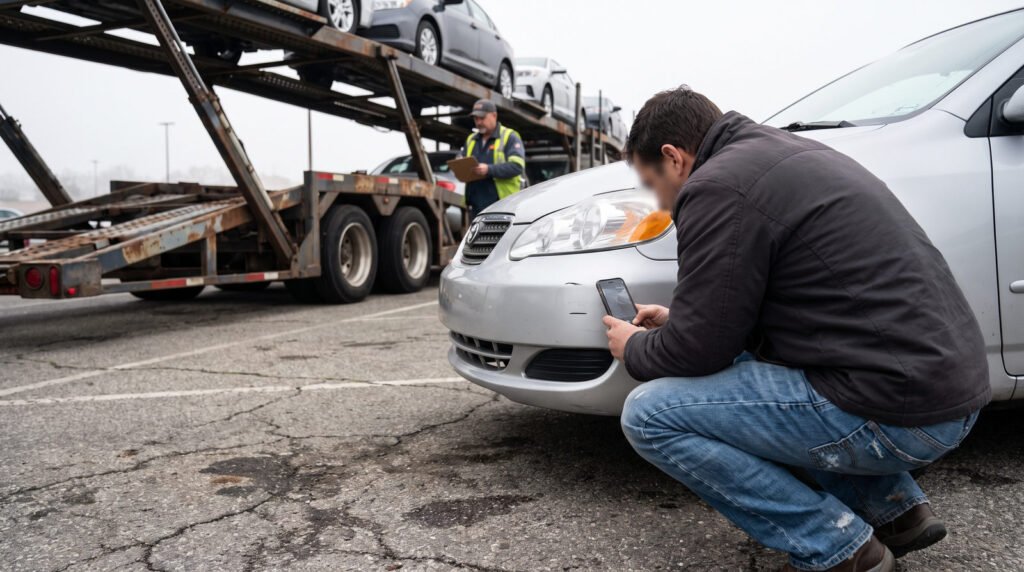
Because you cannot document damage you cannot see. The condition report the driver fills in at pickup is the baseline for any claim you might make later, and a layer of road film hides exactly the kind of small chips and scratches that turn into arguments. A clean car gets an accurate inspection. A dirty one gets a vague one, and the vague one is the one that costs you.
6. Photograph It Properly
Not three quick snaps.. walk the whole car in daylight, all four corners, both sides, the roof, the wheels and the windshield, then get close ups of every existing chip and scuff. Photograph the odometer too, because mileage disputes happen and that picture ends them instantly.
Make sure the timestamps are on. Do it the morning of pickup, not the week before. And keep them somewhere you can find them in a hurry, because the moment you need them is the moment youre standing in a driveway with a driver waiting.
7. Leave a Quarter Tank, Not a Full One
Fuel is weight and weight is the thing carriers fight all day.

File name: quarter-tank-rule-car-shipping.jpg
A gallon of gasoline runs about six pounds. On a large SUV with a twenty five gallon tank, the difference between full and a quarter is over a hundred pounds, and across nine or ten vehicles that is an extra thousand to fifteen hundred pounds the driver has to answer for at the scale house. Overweight means a fine or offloading a car. A quarter tank is plenty to drive on and off the trailer, and it keeps you off the list of customers who caused a problem.
8. Empty It Out
Carriers are licensed to move vehicles, not household goods, and their cargo insurance covers the car and nothing inside it. Not the laptop, not the tools, not the boxes in the trunk. Zero.
Most drivers will tolerate up to about a hundred pounds of soft items in the trunk below window level, but that is a courtesy, not a right, and a driver who opens the door to a car packed to the roof can refuse the load on the spot. Firearms, ammunition, and anything hazardous are flatly out. Take the toll transponder out as well, unless you fancy paying for someone else’s trip down I-95.
9. Handle the Small Stuff Nobody Mentions
Disable the alarm. A car that starts shrieking on a trailer at two in the morning in a truck stop is a genuine problem and the driver cannot get into it to stop it.
Fold the mirrors in. Lower or unscrew the antenna. Take off the roof rack, the cargo box and the bike rack, because they change the height of the vehicle and height is what decides whether your car fits on a lower deck or clears a bridge on the top one. Check tire pressure and make sure the battery actually holds a charge, because the car has to roll, brake and steer under its own power to load on a standard carrier. And if it leaks, say so. A slow oil seep is fine if the driver knows, because he will load you on the bottom deck where it drips on the road instead of onto somebody’s hood. Undisclosed, its grounds to refuse the car and reschedule you.
10. Read the Bill of Lading at Both Ends
The bill of lading is the whole ballgame. It is your contract, your receipt and your condition report, and it is the document any claim gets decided on.
At pickup, walk the car with the driver and make sure every existing mark is on the diagram. Never sign one with blank condition sections. At delivery, inspect before you sign, and do it properly.. not a glance in the dark while the driver waits with the engine running. Compare against the pickup diagram in decent light. If there is new damage, write it on the form before your name goes anywhere near it, because once you have signed a clean bill of lading you have stated in writing that the car arrived fine, and a claim after that is close to unwinnable no matter how good your photos are.
If the truck turns up after dark and you cant see the paintwork properly, you are allowed to say so. Take your time, use a flashlight, and write down what you find. Ten minutes at the curbside is worth more than every other precaution on this list put together.