Skip to content

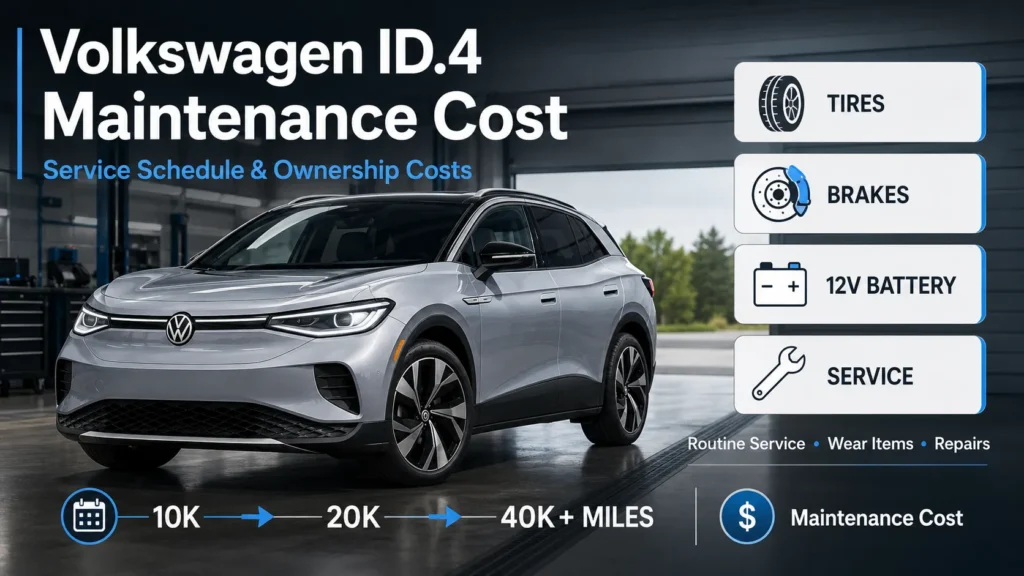
The Volkswagen ID.4 is an electric SUV, so its maintenance needs are different from a gas-powered SUV. There is no engine oil, spark plugs, or timing belt to service. Still, you will pay for tires, brake checks, brake fluid, filters, inspections, and repairs as the vehicle gets older.
I would not use one yearly number to judge the ID.4 maintenance cost. Published estimates can differ a lot because some include wear items and repairs, while others focus more on scheduled service.
Quick Answer
The Volkswagen ID.4 generally needs less routine mechanical maintenance than a gas SUV because it has no engine oil, spark plugs, or timing belt. You still need regular inspections, tires, brake service, brake fluid, filters, and other small items. Your actual ID.4 maintenance cost will depend on the model year, mileage, tires, location, and whether repairs are needed.
How Much Does a Volkswagen ID.4 Cost to Maintain?
There is no single maintenance cost that applies to every ID.4.
For example, current five-year estimates vary widely. One ownership estimate puts ID.4 maintenance and repairs at about $1,630 over five years. Another estimates about $5,435 for maintenance alone on a 2025 ID.4 Pro and about $5,985 for a 2025 AWD Pro S.
That big difference does not mean one source is automatically wrong.
The main reason is how each service estimate is counted. Some calculations include scheduled maintenance, wear items, and expected repairs. Others use a wider maintenance category that can include tires, brakes, wipers, and other costs.
So, I would look at the type of expense before looking at the final number.
| Cost type | What it includes |
| Scheduled maintenance | Inspections and planned service |
| Wear items | Tires, wipers, brake components |
| Repairs | Unexpected faults or failed parts |
| Warranty work | Covered repairs that may cost you nothing |
This is a better way to judge the Volkswagen ID.4 maintenance cost than using one five-year figure by itself.
Volkswagen ID.4 Maintenance Schedule

The ID.4 generally follows a mileage and time-based service plan. For many newer models, scheduled maintenance comes around every 10,000 miles or 12 months, whichever comes first, although the exact requirements can vary by model year.
The service is much lighter than what you would expect from a gas-powered vehicle.
A typical ID.4 maintenance plan can include checks of:
- Tires and tire pressure
- Brake system
- Brake fluid
- 12V battery
- High-voltage battery system
- Cooling system
- Suspension
- Steering
- Lights
- Wipers and washer system
- Vehicle diagnostic systems
- Cabin or dust filter
Always check the maintenance schedule for the exact model year you own.
10,000-Mile Service
The first scheduled service is usually fairly simple.
The technician can check the vehicle’s tires, 12V battery, diagnostic system, and other basic items. The goal is to find small problems before they become bigger repair bills.
This is also a good time to check tire wear and alignment.
20,000-Mile Service
The 20,000-mile visit can involve more checks than the first service.
Depending on the model year, the service may include inspections of the brake system, brake fluid, cooling system, suspension, steering, tires, battery systems, and other components.
The exact service list can vary by model year, so I would not treat one schedule as universal for every ID.4.
40,000 Miles and Beyond
As the ID.4 gets older, the cost can become less predictable.
Routine inspections still matter, but you may also start paying for wear items. Tires, wiper blades, filters, brake components, and the 12V battery can add to your ownership costs.
This is where a used ID.4 can have a different maintenance budget from a newer one.
What Maintenance Does the Volkswagen ID.4 Need?

The ID.4 has fewer engine-related maintenance jobs than a traditional SUV, but it still has many normal vehicle systems that need care.
Tires
Tires are one of the biggest costs to plan for.
The ID.4 is a fairly heavy electric SUV, and tire life depends on factors such as driving style, road conditions, tire type, wheel size, alignment, and tire pressure.
I would check tire pressure regularly and inspect the tread for uneven wear.
A tire that wears on one side may point to an alignment or suspension issue. Fixing that early can help prevent you from replacing tires sooner than expected.
Brakes and Brake Fluid
The ID.4 uses regenerative braking. The electric motor can slow the vehicle while sending some energy back to the battery.
This means the friction brakes may get less use during normal driving than they would in a traditional vehicle. That can help reduce brake-pad wear, but it does not remove the need for brake inspections.
The brake pads, discs, calipers, and brake fluid still need attention.
I would never assume that regenerative braking means the brakes can be ignored.
Cabin or Dust Filter
The cabin filter helps keep dust and other particles out of the passenger area.
It is a small maintenance item, but it can affect airflow and cabin comfort. Replacement timing depends on the service schedule and driving conditions.
If you drive in an area with a lot of dust, you may need to pay closer attention to filter condition.
12V Battery
The ID.4 has a separate 12V battery in addition to the high-voltage battery pack.
The 12V battery runs many of the vehicle’s low-voltage systems. Like other vehicle batteries, it can lose capacity as it gets older.
A 12V battery problem does not mean the main EV battery has failed.
That is an important difference for ID.4 owners.
Cooling System
Electric vehicles still use cooling systems.
The ID.4 uses thermal management to help control temperatures for important vehicle components. Cooling-system checks can form part of scheduled service.
This does not mean you need the same engine coolant maintenance routine as a gas vehicle. The exact service requirements depend on the vehicle and model year.
High-Voltage Battery System
The high-voltage battery does not need an oil change or the type of regular service found in a gas car.
The battery system and related components can still be inspected as part of vehicle service.
I would also keep battery health separate from routine maintenance. Battery degradation is a different ownership topic, and it depends on factors such as age, mileage, charging habits, and battery use.
What Maintenance Does the ID.4 Not Need?

This is one of the biggest differences between the ID.4 and a gas SUV.
You do not have the normal engine maintenance jobs associated with an internal-combustion engine.
The ID.4 does not need:
- Engine oil changes
- Engine oil filter changes
- Spark plug replacement
- Timing belt replacement
- Traditional engine air-filter service
- Engine tune-ups
- Engine oil leak repairs
That does not make the ID.4 maintenance-free.
It simply changes where your maintenance money goes.
Instead of paying for engine oil and spark plugs, you are more likely to spend money on tires, brakes, filters, inspections, and other vehicle systems.
Volkswagen ID.4 Maintenance Cost by Mileage

Your exact costs will depend on the model year and condition of the vehicle, so I would use the table below as a planning guide rather than a fixed price list.
| Mileage | What to expect |
| 10,000 miles | Basic inspection, tire checks, battery and system checks |
| 20,000 miles | More detailed inspection and scheduled service |
| 30,000 miles | Routine inspection and wear-item checks |
| 40,000 miles | More service checks and possible wear-item replacement |
| 50,000+ miles | Tires, brakes, filters, battery, suspension and other wear items may become more relevant |
The main point is that mileage does not automatically trigger a large repair bill.
Your driving conditions and vehicle condition matter just as much.
Why ID.4 Maintenance Estimates Can Be So Different
If you search for the Volkswagen ID.4 maintenance cost, you may see numbers that look completely different.
For example, a current five-year estimate for a 2026 ID.4 Pro lists about $5,648 in maintenance, while the AWD Pro estimate is about $6,201. A 2025 ID.4 Pro is listed at about $5,435, while the AWD Pro S is about $5,985.
Older ID.4 estimates can also be higher. A five-year estimate for a 2023 ID.4 AWD Pro S lists about $9,177 in maintenance, while a 2021 ID.4 Pro S estimate lists about $8,605.
I would not read those numbers as proof that an older ID.4 will definitely cost that much to maintain.
These are estimates based on specific ownership assumptions. Actual costs can change based on mileage, location, tire replacement, repairs, labor rates, and the condition of the vehicle.
This is why I prefer to look at what the estimate includes rather than choosing the lowest number.
Does Regenerative Braking Lower ID.4 Maintenance Costs?
It can help reduce friction-brake use.
When you lift off the accelerator or slow the vehicle, the electric motor can help slow the car. This is different from relying only on traditional brake pads and discs.
Less use of the friction brakes can reduce wear over time.
But the brakes still need inspections. Brake fluid and brake components can age even if you do not use the brake pedal heavily.
So I would think of regenerative braking as a way to reduce some brake wear, not as a reason to skip brake maintenance.
Is ID.4 Battery Maintenance Expensive?
Routine high-voltage battery maintenance is not the same as maintaining a gasoline engine.
You do not need to change battery oil or perform regular engine-style battery service.
The battery system can still require inspection and repair if a fault appears. That is where warranty coverage becomes important.
For newer ID.4 models, the high-voltage battery has an 8-year or 100,000-mile warranty, subject to the warranty terms.
I would also avoid mixing battery maintenance with battery degradation.
If you want to know how much battery capacity an ID.4 may lose over time, that is a separate question from routine maintenance.
Does Volkswagen Cover ID.4 Maintenance?
Some newer ID.4 models include complimentary scheduled maintenance for the first two scheduled services.
That generally covers the 10,000-mile and 20,000-mile services, or the first two years, whichever comes first, subject to the applicable coverage terms.
This can reduce your early ownership costs.
The key thing is to check the coverage that applies to the exact model year and vehicle you are buying.
A used ID.4 may also have different remaining coverage from a new one.
Does Maintenance Cost Change by ID.4 Model Year?
Yes, it can.
Your 2021, 2023, and 2025 ID.4 may have different maintenance requirements, warranty coverage, battery versions, equipment, and age-related costs.
Older vehicles also have more time for wear items and repairs to appear.
I would check the exact maintenance schedule for the vehicle before buying a used ID.4. This matters more than simply looking at a generic Volkswagen ID.4 maintenance cost estimate.
Is the Volkswagen ID.4 Cheaper to Maintain Than a Gas SUV?
For routine mechanical maintenance, the ID.4 has some clear advantages.
A gas SUV has an engine that needs regular oil service and other engine-related maintenance. The ID.4 removes many of those jobs.
The ID.4 can still have higher costs in other areas.
For example, tires can be expensive, especially with larger wheels. Electric vehicles can also be heavy, so tire wear deserves attention.
The best comparison is therefore not:
EV = cheap maintenance
It is:
EV = fewer engine-related services, but normal vehicle wear and repair costs still exist.
That is the more realistic way to look at ID.4 ownership.
How I Would Keep Volkswagen ID.4 Maintenance Costs Down

I would focus on the small things that can prevent bigger bills.
Check tire pressure regularly
Incorrect tire pressure can increase tire wear and affect efficiency.
Watch for uneven tire wear
If one side of a tire wears faster than the other, I would have the alignment and suspension checked.
Follow the service schedule
Skipping inspections can allow small problems to become larger repairs.
Keep service records
This matters even more if you plan to sell the ID.4 later.
A clear service history gives the next buyer a better picture of how the vehicle was cared for.
Check warranty coverage first
Before paying for an expensive repair, I would check whether the issue may fall under the vehicle’s warranty.
Compare service prices
Dealer labor rates can vary by location. For work outside warranty coverage, it can make sense to compare prices from qualified EV service shops.
Do not ignore small warning signs
A warning light, strange noise, unusual tire wear, or charging issue is easier to deal with before it becomes a larger problem.
Is the Volkswagen ID.4 Cheap to Maintain?
I would say the ID.4 is relatively simple to maintain compared with a gas SUV, but I would not call it maintenance-free.
The biggest benefit is the lack of traditional engine maintenance. You do not need oil changes, spark plugs, timing belt service, or other engine jobs.
Your regular costs are more likely to come from tires, brake-related service, filters, inspections, the 12V battery, and other normal vehicle wear.
The published cost estimates also show why you should be careful with a single five-year number. Current estimates vary widely depending on what each calculation counts as maintenance.
For me, the better way to judge the ID.4 maintenance cost is to look at the service schedule first, then plan for wear items and unexpected repairs separately.
Final Take
The Volkswagen ID.4 maintenance cost is easier to manage if you separate routine service from wear items and repairs.
The ID.4 removes many common gas-car expenses, such as oil changes, spark plugs, and timing belt service. But you still need to budget for tires, brakes, brake fluid, filters, inspections, the 12V battery, and unexpected repairs.
I would also check the exact model year before using any maintenance estimate. A 2021 ID.4 can have a different ownership cost from a newer model because of age, warranty coverage, service history, and wear.
For most buyers, the main advantage is simple: the ID.4 has fewer engine-related maintenance jobs, but it is still a normal vehicle that needs regular care.
Volkswagen ID.4 Maintenance Cost FAQs
Does a Volkswagen ID.4 need an oil change?
No. The ID.4 is fully electric and does not have a gasoline engine that needs engine oil or an oil filter.
How often does a Volkswagen ID.4 need service?
Many newer ID.4 models follow a schedule based around 10,000 miles or 12 months, whichever comes first. The exact schedule can vary by model year.
Are ID.4 brakes expensive to maintain?
They can be, but regenerative braking can reduce how much the friction brakes are used. Brake pads, discs, calipers, and brake fluid still need regular inspection.
Does the ID.4 need battery maintenance?
The high-voltage battery does not need routine engine-style service. The battery and related systems can still be checked during vehicle service, and repairs may be covered by warranty depending on the issue.
Are ID.4 tires expensive?
They can be one of the larger wear costs. The price depends on tire size, brand, type, driving conditions, and how quickly the tires wear.
Is an ID.4 cheaper to maintain than a gas SUV?
Routine mechanical maintenance can be lower because the ID.4 does not need oil changes, spark plugs, timing belt service, or other engine work. Tires, brakes, inspections, and repairs still add to ownership costs.
Does an older ID.4 cost more to maintain?
It can. As an ID.4 gets older and mileage increases, wear items and repairs can become more likely. The actual cost depends on the vehicle’s condition and service history.