Skip to content
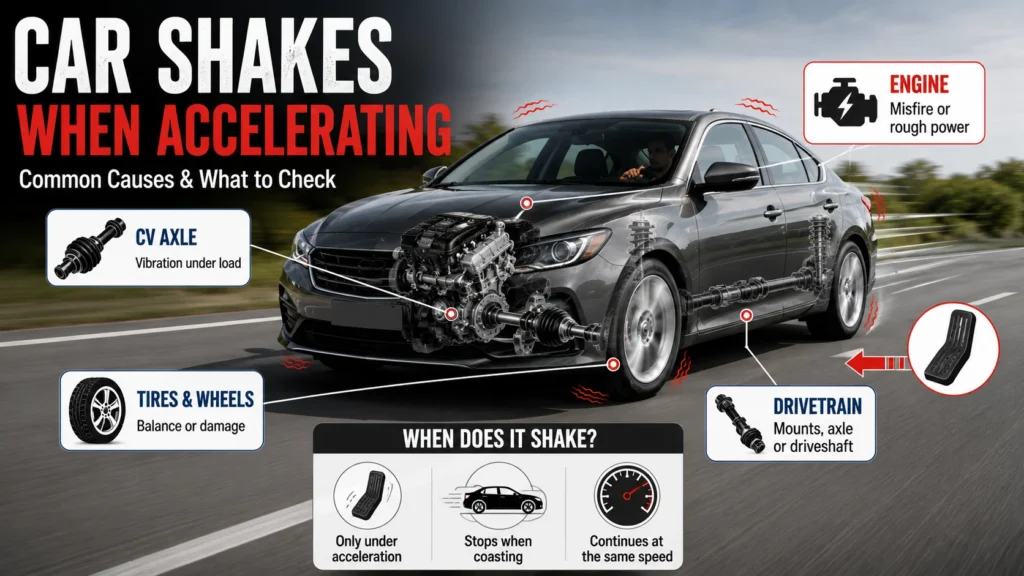
If your car shakes when accelerating, I would first pay attention to exactly when the vibration starts and what happens when you release the gas pedal. A shake that appears only under acceleration can point to the drivetrain, CV axle, engine mounts, or an engine problem. A vibration that continues at the same road speed while coasting may point more toward the tires or wheels.
Quick Answer
A car shaking when accelerating can be caused by a worn CV axle or CV joint, bad engine or transmission mounts, an engine misfire, damaged or unbalanced tires, a bent wheel, driveshaft problems, transmission issues, or suspension faults. The key clue is whether the shaking stops when you release the gas or continues while the car coasts.
Why Is My Car Shaking When I Accelerate?

If you are asking, why is my car shaking when i accelerate, the first thing I would check is whether the vibration is linked to the accelerator or simply to road speed.
Acceleration puts more load on the engine and drivetrain. A worn part may seem fine while cruising but start vibrating when engine torque is sent through the drivetrain.
Try to notice what happens when you lift your foot from the accelerator.
If the shake disappears while you continue moving at roughly the same speed, a load-related problem such as a CV joint, engine mount, or driveshaft becomes more likely.
If the vibration continues while coasting at the same speed, I would look more closely at the tires, wheels, wheel bearings, or other rotating components.
What Does the Shaking Pattern Tell You?
Before replacing anything, I would look at the pattern of the vibration.
| What you notice | Possible areas to check |
| Shakes only when pressing the gas | CV axle, drivetrain, engine mount, engine |
| Stops when you release the gas | CV joint, driveshaft, mount or drivetrain |
| Continues while coasting at the same speed | Tires, wheels or wheel bearing |
| Shakes with hesitation or power loss | Engine misfire, fuel or ignition problem |
| Shakes when accelerating uphill | Engine misfire or drivetrain |
| Shakes during hard acceleration | CV axle, mounts, driveshaft or engine |
| Shakes through the steering wheel | Front tire, wheel, axle or suspension |
| Shakes through the seat or floor | Drivetrain, rear wheel or mount |
| Clunks when shifting into Drive or Reverse | Engine or transmission mount |
| Clicks while turning | CV joint |
These are clues, not a final diagnosis. Several problems can create similar symptoms.
Common Causes of Car Shaking When Accelerating

1. Worn CV Axle or Inner CV Joint
A worn CV axle is one of the first things I would consider when the car shakes when accelerating, especially if the vibration appears under throttle and fades when you coast.
CV axles transfer engine power to the wheels while allowing the suspension and steering to move. The inner CV joint is especially relevant to a vibration that appears during straight-line acceleration.
You may notice:
- Shaking under acceleration
- Stronger vibration when you press the gas harder
- Vibration that decreases when you release the accelerator
- Clicking or popping during turns
- A torn CV boot
- Grease around the axle area
A clicking sound during tight turns can point more toward an outer CV joint, while straight-line acceleration vibration can make the inner joint more suspicious.
2. Engine Misfire
An engine misfire can make the car feel like it is shaking, jerking, or stuttering during acceleration.
The engine needs the right combination of air, fuel, and ignition to produce smooth power. A weak spark plug, failing ignition coil, fuel injector problem, or another engine fault can cause one or more cylinders to misfire.
The vibration may be more noticeable when you accelerate because the engine is working harder.
You may also notice:
- Hesitation
- Rough acceleration
- Loss of power
- Poor engine performance
- Rough idle
- Check engine light
A misfire often feels different from a steady drivetrain vibration. Instead of a smooth wobble, it may feel like the engine is repeatedly missing or stuttering.
If the check engine light is flashing while the vehicle is shaking badly, I would avoid continuing to drive it and have the problem checked promptly.
3. Bad Engine or Motor Mount
Engine mounts hold the engine and transmission in place while helping control normal vibration.
When a mount becomes worn, cracked, or damaged, the engine and transmission can move more than they should when you accelerate. That movement can be felt as a shake, shudder, or clunk inside the cabin.
Possible clues include:
- Vibration when accelerating
- A clunk when shifting into Drive or Reverse
- Excessive engine movement
- Increased vibration when starting or stopping
- A noticeable thud when changing from acceleration to deceleration
If the vehicle shakes when you apply the gas but feels much smoother when you release it, the mounts deserve attention.
4. Unbalanced or Damaged Tires
Tire problems can also cause vibration, but there is an important difference.
A tire or wheel imbalance is usually linked more closely to road speed than to throttle input. If your car shakes at a certain speed whether you are accelerating or coasting, I would check the tires and wheels.
Look for:
- Uneven tread wear
- Tire bulges
- Flat spots
- Damaged tread
- Low tire pressure
- Missing wheel balancing weights
- Tire separation
If the vibration began after installing new tires or hitting a pothole, mention that when the vehicle is inspected.
5. Bent Wheel or Rim
A bent wheel can create vibration as it rotates.
A hard pothole or curb impact can damage a wheel even if the damage is not obvious from a quick visual check.
A bent wheel may cause a vibration that gets stronger as road speed increases. If the shaking continues while coasting at the same speed, I would check the wheels along with the tires.
6. Driveshaft or U-Joint Problem
On vehicles that use a driveshaft, worn or damaged drivetrain components can cause vibration under acceleration.
Possible problem areas include:
- Driveshaft
- U-joints
- Carrier bearing
- Driveshaft balance
- Differential components
The vibration may be felt more through the floor or seat than through the steering wheel.
A clunk when accelerating or changing between acceleration and deceleration can provide another clue.
This is especially worth checking on rear-wheel-drive and some all-wheel-drive vehicles.
7. Transmission or Torque Converter Problem
Transmission problems can sometimes feel like an acceleration shake or shudder.
You may notice the vibration:
- During a gear change
- At a certain engine speed
- When the transmission is under load
- During light acceleration
- When the torque converter engages
Other clues can include harsh shifting, delayed engagement, slipping, or unusual transmission noises.
I would avoid assuming every acceleration vibration is a transmission problem. CV axles, mounts, tires, and engine problems can create similar sensations.
8. Suspension or Steering Problems
Worn suspension and steering components can also contribute to vibration.
Possible problem areas include:
- Tie rod ends
- Ball joints
- Control arms
- Bushings
- Wheel bearings
- Struts
- Other suspension components
A suspension problem may come with other symptoms such as:
- Clunking over bumps
- Uneven tire wear
- Pulling to one side
- Loose steering
- Poor handling
If the steering feels loose along with the shaking, I would have the front suspension and steering system inspected.
9. Sticking Brake Caliper
A brake caliper that does not release correctly can create drag and heat.
You may notice:
- One wheel becoming unusually hot
- Burning smell
- Vehicle pulling to one side
- Reduced fuel economy
- Vibration
- Uneven brake pad wear
This is less common than some of the causes above, but it is worth considering if the vibration comes with brake drag or unusual heat.
10. Fuel or Air Delivery Problem
An engine can also shake during acceleration if it cannot get the correct amount of fuel or air.
Possible causes include:
- Clogged fuel injector
- Weak fuel pump
- Airflow problem
- Dirty or faulty MAF sensor
- Vacuum leak
- Incorrect air-fuel mixture
These problems can cause hesitation and uneven engine power, especially when the engine is under heavier load.
If the shaking feels more like the engine is stumbling or losing power, I would look at engine performance rather than assuming the problem is a wheel or axle.
Car Shakes When Accelerating but Stops When Coasting
This is one of the most useful clues.
If the vehicle shakes when you press the gas but becomes smooth when you release the accelerator while staying at roughly the same road speed, I would focus first on parts affected by engine torque.
The main areas include:
- Inner CV joint or CV axle
- Engine or transmission mount
- Driveshaft or U-joint
- Other drivetrain components
- Engine problem that appears under load
This does not prove that one particular component has failed. It simply helps move the diagnosis away from a basic speed-related tire vibration.
Car Shakes When Accelerating at High Speed
If your car shaking when accelerating happens mainly at higher speeds, I would compare what happens when you stop accelerating.
Does the vibration disappear as soon as you lift off the gas?
If yes, I would still consider the drivetrain, CV axle, mounts, and engine.
If the vibration remains at the same speed while coasting, I would give more attention to the tires, wheels, wheel bearings, and other rotating components.
Car Shakes When Accelerating From a Stop
A shake that starts as you pull away from a stop can have several causes.
I would consider:
- CV axle
- Engine mount
- Transmission mount
- Engine misfire
- Transmission problem
- Tire or wheel issue
Pay attention to whether you feel a single thud or a repeated vibration.
A single clunk when power is applied can point toward a mount or drivetrain movement. A repeated shake or stutter may point toward an engine or rotating component.
Car Shakes When Accelerating Uphill
An uphill drive puts more demand on the engine and drivetrain.
If the vehicle is smooth on flat roads but begins shaking when climbing a hill, I would pay attention to whether the engine is also struggling.
A shake combined with hesitation or loss of power can point toward an engine misfire or fuel and ignition problem. A steady vibration that appears only while torque is being applied can also point toward a CV axle, mount, or other drivetrain component.
Where Do You Feel the Vibration?

The location of the shaking can give you another useful clue.
Steering Wheel
If the steering wheel is shaking, I would check the front tires and wheels first.
Other possibilities include:
- Front suspension
- Steering components
- Front wheel bearing
- CV axle
A steering wheel vibration does not automatically mean the front tires are the cause, but it is a useful starting point.
Seat or Floor
If you feel the vibration mainly through the seat or floor, I would give more attention to:
- Driveshaft
- CV axle
- Rear wheels
- Rear suspension
- Drivetrain
- Engine or transmission mounts
Whole Vehicle
If the whole car shakes, the cause could be in the engine, drivetrain, tires, wheels, suspension, or mounts.
The timing of the shake becomes even more important here.
How to Tell if It Is a Tire Problem or Drivetrain Problem

| Symptom | Tire/wheel issue more likely | Drivetrain issue more likely |
| Shakes at a certain road speed | Yes | Possible |
| Shakes only when pressing gas | Less likely | More likely |
| Stops when you release gas | Less likely | More likely |
| Continues while coasting | More likely | Less likely |
| Steering wheel vibration | More likely | Possible |
| Floor or seat vibration | Possible | More likely |
| Clicking during turns | Less likely | CV joint possible |
| Clunk when shifting | Less likely | Mount/drivetrain possible |
| Uneven tire wear | More likely | Less likely |
| Engine hesitation | Less likely | Engine-related problem possible |
This table should be treated as a starting point, not a replacement for a proper inspection.
What Should I Check First?
If my car started shaking during acceleration, I would work through the simplest clues first.
1. Check the Tire Pressure
Check all four tires and compare their pressure with the recommended vehicle specification.
If one tire is losing air, find out why rather than repeatedly adding air.
2. Inspect the Tires
Look for:
- Bulges
- Cuts
- Uneven tread
- Flat spots
- Damaged sidewalls
- Missing tread
- Signs of tread separation
Some internal tire damage may not be obvious from a quick look.
3. Check the Wheels
Look for dents or obvious damage.
If the vibration began after a pothole or curb impact, tell the technician.
4. Think About When the Shake Happens
Ask yourself:
Does it shake only when I press the gas?
Does it stop when I release the gas?
Does it continue while coasting?
Does it happen at one particular speed?
These answers can narrow the possible causes.
5. Check the Warning Lights
A check engine light combined with shaking can point toward an engine problem.
A flashing check engine light with severe shaking deserves prompt attention.
6. Listen for Other Sounds
Listen for:
- Clicking
- Clunking
- Grinding
- Humming
- Knocking
- Popping
A vibration with a clicking sound during turns can point in a different direction than a vibration with a humming wheel bearing noise.
7. Have the Vehicle Inspected
If the basic checks do not reveal the cause, a technician may need to inspect the tires, wheels, suspension, CV axles, drivetrain, engine mounts, and engine performance.
An OBD-II scan may also help if the vehicle has a check engine light or suspected misfire.
Is It Safe to Drive a Car That Shakes When Accelerating?
It depends on the cause and severity.
A mild vibration may come from something relatively simple, such as wheel balance. But severe or sudden shaking can signal a problem with an axle, drivetrain, tire, wheel, steering system, or engine.
I would be more concerned if the shaking comes with:
- Severe vibration
- Sudden loss of power
- Flashing check engine light
- Grinding
- Loud clunking
- Steering problems
- Tire damage
- Burning smell
- Smoke
- Overheating
- Strong pulling
If the vehicle feels difficult to control, I would stop driving when it is safe to do so and arrange for an inspection.
When Should I Stop Driving?
I would stop driving if the vibration becomes severe or suddenly gets much worse.
I would also take immediate action if you notice tire damage, major steering problems, smoke, a burning smell, serious loss of power, or a flashing check engine light.
A small vibration that stays unchanged is different from a violent shake that suddenly appears. The second situation deserves much more caution.
Final Takeaway
If your car shakes when accelerating, I would start by finding out whether the vibration follows the accelerator or the road speed.
If the shake appears when you press the gas and disappears when you coast, the CV axle, drivetrain, engine mounts, or an engine problem deserve attention. If the vibration continues at the same speed while coasting, I would look more closely at the tires, wheels, and wheel bearings.
The best diagnosis comes from the full pattern: when the shake happens, where you feel it, what sounds come with it, and whether the engine loses power.
That information can help avoid replacing the wrong part and give a technician better clues about the actual cause.
FAQs About Car Shaking When Accelerating
Can a dirty air filter cause a car to shake when accelerating?
A severely restricted air filter can affect engine performance, but it is not one of the first causes I would suspect for strong acceleration vibration. Engine misfires and fuel or ignition faults are more likely if the car also hesitates.
Can low engine oil cause shaking during acceleration?
Low engine oil can cause serious engine problems, but it is not a common direct cause of a normal acceleration vibration. I would check the oil level promptly and look for other symptoms such as engine noise or an oil warning light.
Can a bad alternator cause a car to shake when accelerating?
A failing alternator can cause electrical and engine-performance problems, but it is not a common direct cause of acceleration vibration. If the battery light, dim lights, or starting problems appear with the shaking, the charging system should be checked.
Can a bad battery cause shaking when accelerating?
A weak battery usually causes starting or electrical problems rather than shaking while driving. If the engine runs poorly after starting, I would look for an engine or charging-system problem instead.
Can low tire pressure make a car shake when accelerating?
Yes, an incorrect tire pressure can affect handling and may contribute to vibration, but strong acceleration-only shaking usually calls for a wider inspection. Check the tire pressure first because it is simple and quick.
Can alignment cause a car to shake when accelerating?
Poor alignment can cause pulling, uneven tire wear, and steering problems. It can contribute to vibration, but a shake that appears only when applying the gas may point more strongly to a drivetrain or engine-related issue.
Can a bad differential cause shaking during acceleration?
Yes. A worn differential or related drivetrain component can create vibration, clunking, or noise under load. This is more relevant on vehicles with rear-wheel drive or all-wheel drive.
Can a loose lug nut cause my car to shake when accelerating?
Yes. A loose wheel can create serious vibration and is a safety concern. If you suspect a loose lug nut, avoid driving the vehicle until the wheel is properly inspected and secured.
Why does my car shake only after it warms up?
A problem that appears after the engine reaches operating temperature can point toward an engine, transmission, fluid, or component that changes behavior with heat. The exact cause depends on what else happens when the shaking starts.
Can a bad wheel alignment make the car shake only at certain speeds?
It can contribute to vibration and uneven tire wear, but wheel imbalance or tire problems are often stronger suspects for vibration at a particular road speed. An alignment check may still be useful if the vehicle pulls or the tires wear unevenly.
Why does my car shake after sitting for a long time?
If the shaking starts after the vehicle has been parked for an extended period, check the tires for flat spots, tire pressure changes, and visible damage. If the engine itself runs roughly, an engine-related issue may also be involved.
Can snow or mud inside a wheel cause shaking?
Yes. Packed snow, mud, or debris inside a wheel can affect wheel balance and create vibration, especially at higher speeds. Cleaning the wheel can solve the issue if buildup is the cause.
Can a car shake when accelerating because of a bad fuel injector?
Yes. A faulty fuel injector can cause uneven combustion, hesitation, and an engine misfire. If the shaking feels like the engine is stumbling rather than a steady vibration, the fuel and ignition systems deserve attention.
Can a loose engine component cause shaking when accelerating?
Yes. A loose or damaged component can move more when the engine produces torque. This may create vibration, rattling, or clunking during acceleration and should be inspected rather than ignored.