Skip to content
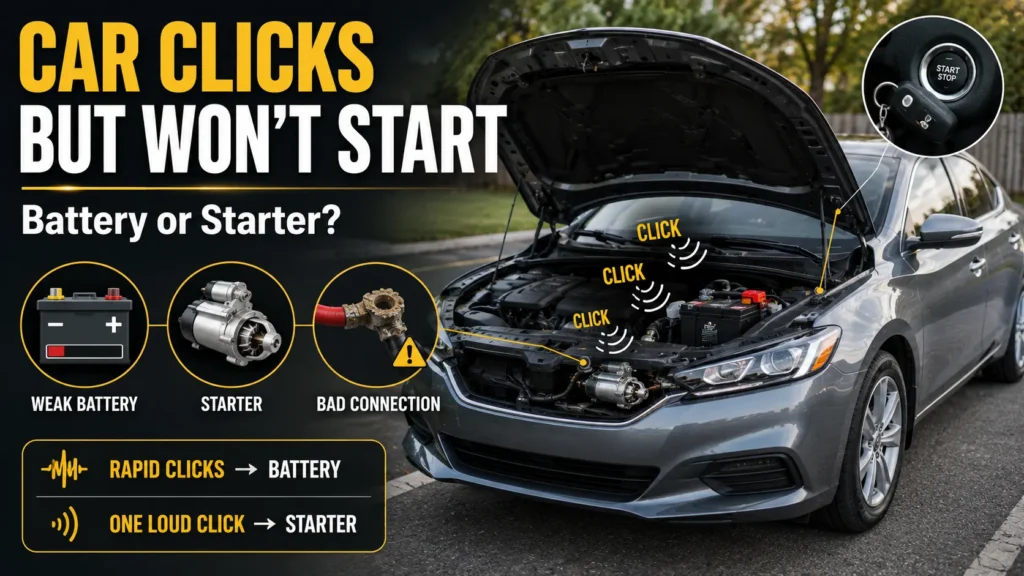
If your car is clicking when trying to start, the battery is often the first thing I would check. Rapid clicking usually points to a weak battery or poor battery connection. One loud click can point to the starter, solenoid, cable, or another starting-system problem. The sound pattern gives you a useful place to start.
What Does It Mean When Your Car Clicks but Won’t Start?

When you turn the key or press the start button, the starter motor needs a strong flow of electrical current to turn the engine. If that current is too weak or cannot reach the starter properly, you may hear a click instead of the engine cranking.
The click often comes from the starter solenoid. This part acts like an electrical switch and helps send battery power to the starter motor.
The first thing I would do is listen closely to the sound. Rapid clicking and one loud click can point to different problems.
Rapid Clicking vs. One Loud Click

The number and speed of the clicks can help narrow down the problem.
| What you hear | What it may mean | What I would check first |
| Rapid clicking | Weak or dead battery | Battery and terminals |
| One loud click | Starter, solenoid, or connection problem | Battery, cables, and starter |
| Click with very dim lights | Weak battery or poor connection | Battery and terminals |
| Click with bright lights | Starter or starting circuit | Starter and cables |
| Clicking stops after a jump-start | Low battery charge | Battery and charging system |
| Still clicking after a jump | Starter, cable, ground, or battery issue | Starting circuit |
This is a starting point, not a guaranteed diagnosis. A weak battery can sometimes cause a single click, while a poor connection can create symptoms that look like a bad starter.
What Does Rapid Clicking Mean?
Rapid clicking often means the battery cannot provide enough current to keep the starter engaged.
You may hear something like:
click-click-click-click-click
The dashboard lights may also flicker or become much dimmer when you try to start the car.
A weak battery is a common cause. Corroded terminals, loose cables, a poor ground connection, or a charging problem can also leave the battery without enough usable charge.
What Does One Loud Click Mean?
A single loud click followed by silence can point to the starter motor or starter solenoid.
However, I would still check the battery and battery connections first. A battery can have enough voltage to activate the solenoid but still lack the current needed to turn the starter motor.
A bad cable or ground connection can create the same problem by limiting current flow.
If the battery and connections check out, the starter becomes a stronger suspect.
Battery or Starter? Use This Quick Comparison

One of the biggest questions is whether you need a battery or a starter.
Here is the simple way I would narrow it down:
| Symptom | More likely problem |
| Rapid clicking and dim lights | Weak or dead battery |
| Rapid clicking after the battery sat unused | Low battery charge |
| Corrosion around battery terminals | Poor electrical connection |
| One loud click and bright lights | Starter or solenoid |
| Car starts after a jump | Battery or charging problem |
| Car still clicks after a proper jump | Starter, cables, ground, or another starting fault |
| Battery keeps going flat | Battery, alternator, or electrical drain |
Do not replace the starter just because you hear one click. Check the battery and connections first. This can save you from replacing an expensive part that is still working.
Common Reasons a Car Clicks When Trying to Start

1. Weak or Dead Battery
A weak battery is one of the first things I would check.
Your car battery supplies the large burst of current needed to crank the engine. If the battery is discharged or worn out, it may still turn on some lights and electronics but fail when you try to start the engine.
You may notice:
- Rapid clicking
- Dim headlights
- Flickering dashboard lights
- Slow electrical accessories
- No engine cranking
- A battery that has recently gone flat
A battery can also lose charge because you left the lights on, the car sat unused for a long time, or the charging system is not working correctly.
2. Corroded Battery Terminals
Look at the battery terminals if you can safely access them.
White, blue, or green buildup around the terminals can increase electrical resistance. That can reduce the amount of current reaching the starter.
A loose terminal can cause a similar problem.
If the battery itself is good but the connection is poor, the car may still click and refuse to start.
3. Loose Battery Cables
The battery cables carry current from the battery to the starter and provide the return path through the ground side of the electrical system.
If a cable is loose, damaged, or badly corroded, the starter may not receive enough current.
I would check both battery terminals and the visible cable connections before blaming the starter.
4. Bad Ground Connection
The negative side of the starting circuit matters just as much as the positive side.
A damaged or loose ground cable can create high resistance. The battery may test well, yet the starter may still fail to crank the engine.
A poor engine ground can also create intermittent starting problems.
This is one reason a battery test alone does not always find the fault.
5. Failing Starter Motor
The starter motor turns the engine when you start the car.
If the battery has enough charge and the main connections are good, but you hear one strong click without engine cranking, the starter may be failing.
Starter problems can also cause intermittent no-start conditions. The car may start normally one time and then click without cranking the next time.
6. Bad Starter Solenoid
The starter solenoid helps connect battery power to the starter motor.
You may hear the solenoid click even when the starter motor does not turn.
That means hearing a click does not automatically prove that the starter motor itself is good. The battery, cables, solenoid, and starter all work as part of the same starting circuit.
7. Alternator or Charging Problem
The alternator normally recharges the battery while the engine runs.
A bad alternator may leave the battery undercharged. The car can then work normally for a while before the battery becomes too weak to start the engine.
This is why a jump-start can sometimes solve the problem temporarily.
If the car starts after a jump but the battery becomes weak again soon after, I would have both the battery and charging system checked.
8. Starter Relay, Fuse, or Wiring Problem
The starting system contains several electrical connections and control parts.
A problem with a starter relay, fuse, ignition circuit, wiring, or connector can prevent the starter from receiving the power or signal it needs.
These faults are less obvious than a dead battery, so they often need electrical testing.
9. Engine Mechanical Problem
In less common cases, the starter may be working but the engine itself may not turn.
A serious mechanical fault can prevent the engine from cranking.
I would not try to diagnose this by repeatedly turning the key. If the battery, cables, and starter check out but the engine still will not crank, a qualified technician should inspect the vehicle.
Why Does My Car Click but the Lights Still Work?
This confuses many drivers.
Your headlights and dashboard electronics need much less current than the starter motor. So a battery can have enough charge to turn on the lights but still fail to provide the large current needed to crank the engine.
That is why working headlights do not automatically mean the battery is good.
Watch what happens to the lights when you try to start the car.
If they become very dim or flicker: the battery or its connections become stronger suspects.
If they stay bright: the starter, solenoid, cables, ground, or another part of the starting circuit may need attention.
This test is useful, but it cannot replace a proper battery and starting-system test.
How to Check Why Your Car Is Clicking

If your car is clicking when trying to start, I would work through the easiest checks first.
1. Listen to the Clicking Pattern
Pay attention to whether you hear:
- Rapid clicking
- One loud click
- A few slow clicks
- A click followed by silence
This helps narrow the problem before you start replacing parts.
2. Check the Dashboard and Headlights
Turn on the headlights or check the dashboard.
Then try to start the car.
If the lights become very dim, the battery may not have enough starting power.
If the lights stay bright but you hear one strong click, the starter or starting circuit deserves more attention.
3. Inspect the Battery Terminals
With the engine off, look for obvious corrosion or loose connections.
Do not touch or remove battery connections if you are unsure how to do so safely. Battery systems can produce high current, and some vehicles have additional electrical components around the battery.
If you see heavy corrosion or damaged cables, have them checked.
4. Check the Battery
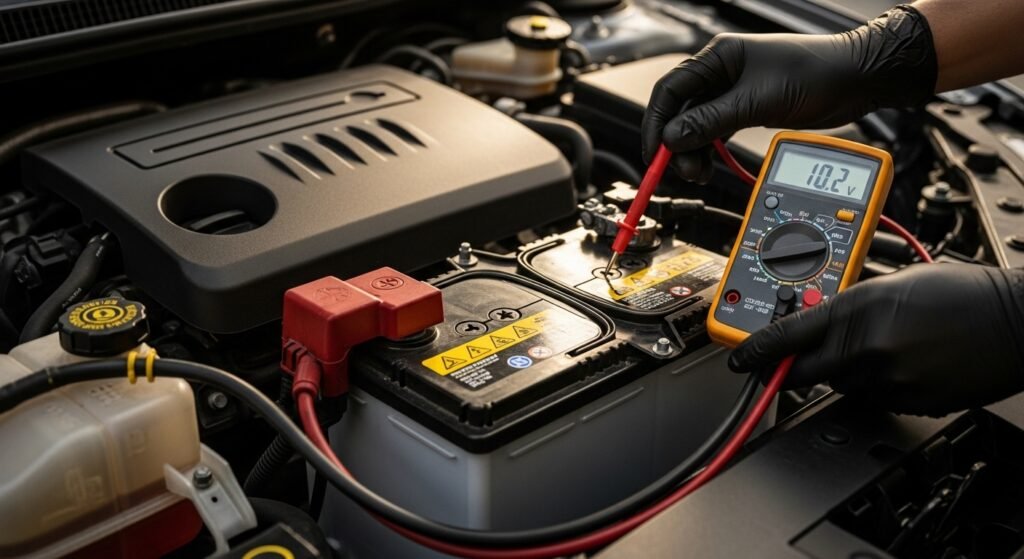
A voltage check can give you useful information, but it does not tell the whole story.
A battery may show a reasonable voltage while still failing under the heavy load required to start the engine.
A proper battery load or conductance test can give a better picture of its condition.
5. Try a Jump-Start if Appropriate
If the battery appears weak and you have the correct equipment, a jump-start may help.
Follow the vehicle manufacturer’s instructions for connecting jumper cables or a jump starter. Some modern vehicles have specific connection points and procedures.
Do not attempt a jump-start if the battery is visibly damaged, leaking, frozen, or otherwise unsafe.
6. Check What Happens After the Jump
The result of the jump-start can give you another useful clue.
If the car starts: the battery may have been discharged or weak. The next step is to find out why it lost its charge.
If the car starts but later becomes difficult to start again: the battery or charging system may need testing.
If the car still clicks: check the battery connections, ground, starter, and starting circuit.
A successful jump-start does not automatically prove that the battery itself is the only problem.
7. Test the Starter if the Battery Is Good
If the battery passes a proper test and the connections are clean and secure, the starter becomes a stronger suspect.
A technician can test voltage and current in the starting circuit to find out whether the starter is receiving what it needs.
This is better than replacing the starter based on the sound alone.
What If My Car Still Clicks After a Jump?

If the car still clicks after a proper jump-start, do not assume that the starter is automatically bad.
I would look at these areas:
- Battery terminals
- Battery cables
- Ground connection
- Battery condition
- Starter solenoid
- Starter motor
- Starter relay or wiring
- Charging system
A battery that is extremely discharged may also need more than a quick jump to start. If the connections are correct and the vehicle still will not crank, further testing can identify the real fault.
How Do I Know If It Is the Battery or Starter?
Here is the easiest way to think about it.
The battery is more likely if:
- You hear rapid clicking.
- Headlights become very dim.
- Dashboard lights flicker.
- The battery has been weak recently.
- The car starts after a jump.
- The vehicle has been sitting for a long time.
The starter is more likely if:
- You hear one strong click.
- The headlights remain bright.
- The battery passes a proper test.
- Battery connections are clean and secure.
- A jump-start does not change the symptom.
- The car has had intermittent starting problems.
These clues can point you in the right direction, but they do not confirm a diagnosis by themselves.
Can an Alternator Cause a Clicking Car?
Yes, but usually in an indirect way.
The alternator charges the battery while the engine runs. If the alternator does not charge correctly, the battery can gradually lose its charge.
Eventually, the battery may not have enough energy to start the car. You may then hear clicking when you try to start it.
This is why I would not simply replace a dead battery and stop there if the battery keeps going flat. The charging system may need to be tested too.
Is It Safe to Keep Trying to Start a Clicking Car?
I would avoid repeatedly trying to start the vehicle.
If the battery is weak, repeated attempts can drain it even further. If the problem is a starter, cable, or another electrical fault, repeated attempts will not fix the underlying problem.
Stop and get help if you notice:
- Burning electrical smells
- Smoke
- Damaged battery cables
- A leaking or damaged battery
- Strong sparks
- Severe engine noise
- Overheating
- Warning lights that indicate a serious problem
Do not work around moving engine parts, belts, or fans while the engine is running.
When Should I Call a Mechanic or Roadside Assistance?
I would get professional help if:
- A jump-start does not work.
- The battery tests good but the car still clicks.
- You hear one loud click every time you try to start.
- Battery cables look damaged.
- The battery keeps dying.
- The vehicle starts and then quickly dies.
- You smell burning wiring.
- You are unsure how to test the starting system safely.
A professional can test the battery, charging system, cables, ground connections, and starter instead of guessing which part needs replacement.
Final Takeaway
If your car is clicking when trying to start, start by listening to the sound. Rapid clicking usually makes me look at the battery and its connections first, while one loud click makes the starter and starting circuit more likely.
Before buying a new starter or battery, check the simple things first: battery condition, terminals, cables, ground connection, and what happens during a jump-start. Those checks can narrow down the problem and help you avoid replacing parts you do not need.
Frequently Asked Questions
Why is my car clicking rapidly when I try to start it?
Rapid clicking usually points to a weak or discharged battery. Poor battery connections, corroded terminals, a bad ground, or a charging problem can also cause similar symptoms.
Why does my car make one click but not start?
One loud click can point to the starter motor or solenoid, but check the battery and battery connections first. A weak battery or poor cable connection can also cause a single click.
Can a bad battery make a clicking sound?
Yes. A weak battery may have enough energy to activate the starter solenoid but not enough to keep the starter motor turning. This can create rapid clicking.
Why does my car click but the lights still work?
The lights need much less electrical current than the starter. So the lights can work even when the battery cannot deliver enough current to crank the engine.
Will a jump-start fix a car that only clicks?
It can if the battery is discharged or weak. If the car still clicks after a proper jump-start, the problem may involve the battery connection, ground, starter, solenoid, or another part of the starting circuit.
Can corroded battery terminals cause clicking?
Yes. Corrosion can increase resistance at the battery connection and reduce the current available to the starter.
Can an alternator cause my car to click when starting?
An alternator can contribute to the problem if it fails to recharge the battery. The weak battery can then cause a clicking no-start condition.
Should I replace the battery or starter first?
I would test the battery and inspect the battery connections before replacing either part. A proper diagnosis can prevent you from replacing a good starter or battery unnecessarily.