Skip to content
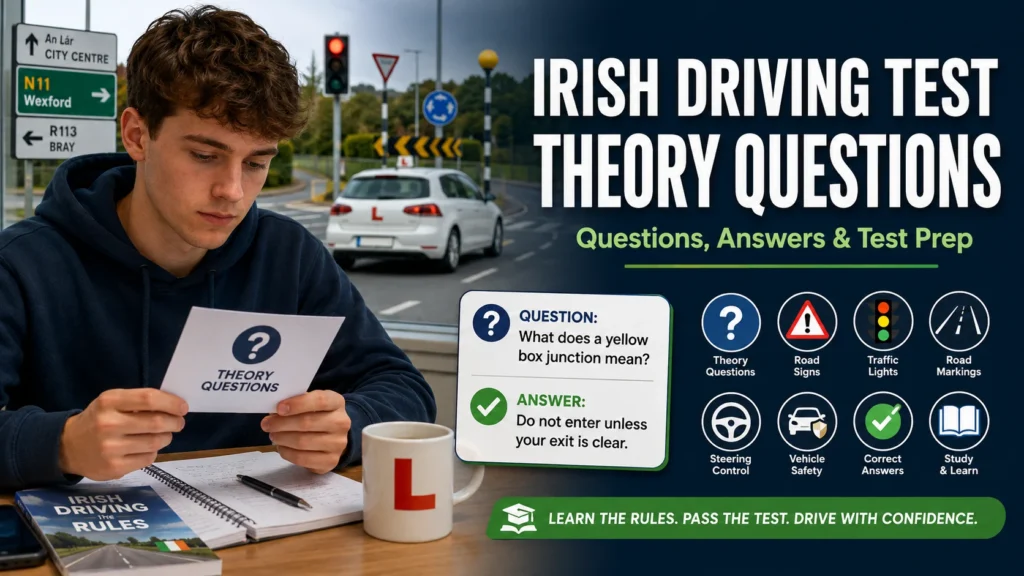
If you have an Irish driving test coming up, you need to know more than how to control the car. You may also be asked verbal questions about road rules, road signs, safe driving, and your vehicle.
I find that the best way to prepare is to learn the rule behind each answer instead of trying to memorise a long list. This makes it easier to answer when the examiner asks the question in a slightly different way.
Quick Answer: What Are the Irish Driving Test Theory Questions?
Irish driving test theory questions cover areas such as the Rules of the Road, road signs, road markings, traffic lights, parking, overtaking, junctions, speed limits, and basic vehicle knowledge. The practical driving test also checks areas such as vehicle safety, controls, and safe driving.
The questions asked during the practical driving test are different from the separate Driver Theory Test that you take before getting your learner permit. The Driver Theory Test was updated in July 2024, so make sure you use current study material for that test.
Driving Test Theory Questions vs Driver Theory Test Questions

This causes a lot of confusion for new learners.
What Is the Driver Theory Test?
The Driver Theory Test is the computer-based test you take before applying for your learner permit.
It covers a wide range of road safety and driving topics. The questions are presented as a formal theory test.
What Are the Theory Questions in the Practical Driving Test?
These are verbal questions connected to your practical driving test.
You may be asked about road rules, road signs, road markings, hand signals, and basic vehicle checks. The questions are intended to check that you know the rules you need to drive safely.
The practical test also checks how you apply those rules while driving.
So, if you search for Irish driving test questions and answers, make sure you know which test you are preparing for.
Irish Driving Test Theory Questions and Answers
Here are common areas I would revise before taking the practical driving test.
Road Rules Questions
When Should You Use the Car Horn?
Use the horn to warn another road user of your presence when needed.
It should not be used to show anger or impatience.
What Should You Check Before Starting the Engine?
Before starting, make sure the car is secure and that you can safely operate the controls.
Check your seating position, mirrors, seat belt, and surroundings before moving away.
What Should You Do Before Moving Off?
Check your mirrors and blind spot, signal when needed, and make sure it is safe to move.
Your final observation should take place just before you move.
What Should You Do When Another Vehicle Is Overtaking You?
Keep your speed steady and your position safe.
Do not speed up while another driver is passing you.
When Can You Overtake on the Left?
Overtaking on the left is allowed only in certain situations.
For example, you may pass on the left when the vehicle ahead is turning right and there is enough room to do so safely. Do not treat this as a general rule that allows you to undertake traffic whenever you want.
Junction Questions
Who Has Priority at a Junction?
Priority depends on the road signs, road markings, traffic lights, and the situation at the junction.
Never assume you have priority simply because you are travelling on a larger road.
What Should You Do at a Junction Without Traffic Lights?
Slow down and look carefully in all directions.
Give way where required and only proceed when you can do so safely.
What Should You Do If Traffic Lights Are Not Working?
Treat the junction with great care.
Do not assume that you automatically have priority. Look for other traffic, road signs, markings, and instructions from people directing traffic.
What Should You Do at a Yellow Box Junction?
Do not enter the yellow box unless your exit is clear.
There are exceptions for certain right-turn situations where you are waiting for a gap in oncoming traffic, but you must still make sure you do not block traffic unnecessarily.
Yellow box junctions are worth revising because they combine road markings, junction rules, and traffic flow.
Roundabout Questions
Which Direction Should You Look Before Entering a Roundabout?
Look to the right and check the traffic already on the roundabout.
You should also check your mirrors and make sure your intended path is clear.
Who Normally Has Priority at a Roundabout?
Traffic already on the roundabout normally has priority over traffic entering it.
Road signs and markings can change how you should proceed, so always check them.
Which Lane Should You Use at a Roundabout?
Your lane depends on the exit you want to take and the road markings.
Choose the correct lane early, follow the signs and markings, and signal at the right time.
Do not move across another vehicle’s path just because you are approaching your exit.
Road Marking Questions

Road markings are a common area for Irish driving test questions.
I recommend learning what each marking means rather than trying to remember its appearance alone.
What Does a Broken White Line Mean?
A broken white line can separate lanes or show the centre of a road.
You may cross a broken white line when it is safe and permitted to do so.
Always check for traffic, road signs, and other restrictions before crossing it.
What Does a Continuous White Line Mean?
A continuous white line places a restriction on crossing it.
You should not cross it unless the road rules allow you to do so in the situation.
Pay close attention to the road layout because a solid line can have a different purpose depending on where it appears.
What Do Yellow Lines Mean?
Yellow lines are used to show parking restrictions.
The type and location of the marking tell you what restriction applies.
If you see yellow lines near the kerb, do not assume you can park there just because there is an empty space.
What Is a Yellow Box Junction?
A yellow box marks an area that vehicles should not enter unless they can clear it.
The aim is to stop vehicles from blocking the junction and holding up traffic.
Before entering, look beyond the box and make sure you have enough space to continue.
What Is a Clearway?
A clearway is a road or area where stopping or parking is restricted during the times shown on the sign.
Check the sign carefully before stopping.
This is a good example of why knowing road signs and road markings together is useful.
Traffic Light Questions

What Does a Red Traffic Light Mean?
Stop.
Do not cross the stop line while the red light is showing.
What Does an Amber Traffic Light Mean?
You should stop unless you are so close to the stop line that stopping would be dangerous.
Amber does not mean you should speed up to get through the junction.
What Does a Green Traffic Light Mean?
You may proceed if the road is clear and it is safe to do so.
A green light does not remove your need to watch for pedestrians, cyclists, or other road users.
What Should You Do at a Pedestrian Crossing?
Slow down and be ready to stop.
Give pedestrians the required priority and make sure the crossing is clear before continuing.
Parking Questions
Where Should You Not Park?
There are many places where parking or stopping can be restricted.
These include areas such as:
- Near certain junctions
- On or near pedestrian crossings
- Where signs prohibit parking
- On clearways during restricted times
- Where your vehicle would block traffic
- Where your vehicle would create a safety risk
Always check road signs and markings before leaving your car.
How Close Can You Park to a Junction?
The exact rule depends on the type of junction and the road layout.
For test preparation, learn the parking restrictions around junctions rather than relying on a rough guess.
Can You Park on Yellow Lines?
It depends on the type of yellow line and the restriction shown.
Learn the difference between single and double yellow-line restrictions.
Overtaking Questions
What Should You Check Before Overtaking?
I would check:
- Mirrors
- Blind spot
- Road ahead
- Oncoming traffic
- Road markings
- Speed of other vehicles
- Available space
You also need to ask yourself whether overtaking is necessary.
A clear road does not always mean overtaking is safe.
When Should You Not Overtake?
Avoid overtaking when you cannot see far enough ahead, when road markings prohibit it, or when another road user could be put at risk.
Be especially careful near bends, junctions, crossings, hills, and other areas where your view is limited.
What Should You Do After Overtaking?
Return to your normal position when it is safe.
Do not cut in too closely in front of the vehicle you have passed.
Speed Limit Questions
Why Do Speed Limits Matter?
A speed limit gives you the maximum legal speed for that road under the conditions shown.
It does not mean you must drive at that speed.
You may need to drive slower because of rain, traffic, poor visibility, pedestrians, cyclists, roadworks, or other hazards.
Should You Always Drive at the Speed Limit?
No.
The correct speed depends on the road, traffic, weather, visibility, and hazards around you.
A safe driver adjusts speed instead of treating the speed limit as a target.
Following Distance Questions
How Much Space Should You Leave Behind Another Vehicle?
Leave enough space to stop safely if the vehicle ahead brakes suddenly.
The two-second rule is a useful guide in normal conditions.
Increase the gap when roads are wet, icy, slippery, or visibility is poor.
Why Should You Increase Your Following Distance in Rain?
Wet roads can increase your stopping distance.
Leaving more space gives you more time to react and stop safely.
Motorway and Dual Carriageway Questions
Which Lane Should You Normally Use on a Motorway?
Keep to the left unless you need to use another lane for a valid reason, such as overtaking.
After overtaking, return to the appropriate lane when it is safe.
Can You Use the Hard Shoulder as a Normal Driving Lane?
No.
The hard shoulder is not a normal lane for general driving.
Follow the road signs and rules that apply to the road you are using.
What Should You Do If Your Vehicle Breaks Down?
Move to a safe place if you can do so safely.
Use your hazard lights and take suitable steps to warn other road users. If you are on a motorway, take extra care because vehicles may be travelling at high speed.
Road Sign Questions
Road signs are another part of your practical test preparation.
You should be able to recognise common signs without needing a long pause.
Revise signs for:
- Stop
- Yield
- No entry
- Speed limits
- No overtaking
- Motorway
- One-way traffic
- Roundabouts
- Roadworks
- Parking restrictions
- Pedestrian crossings
- Warning hazards
I prefer to study road signs by group. Learn what each group looks like, then learn the meaning of individual signs.
This makes revision easier than trying to memorise a random list.
Hand Signal Questions

You should also revise hand signals.
The examiner may ask you to demonstrate or explain signals used by drivers or other road users.
Common signals include signals for:
- Turning right
- Turning left
- Slowing down or stopping
Do not just learn the direction of the arm. Make sure you know what the signal tells other road users.
A simple visual guide can help here because hand signals are much easier to remember when you can see them.
Vehicle Safety Questions

The driving test is also about basic vehicle knowledge.
You should know how to carry out simple checks on the car you are using.
How Do You Check Your Tyres?
Know how to check the tyre condition and make sure the tyres are suitable and safe.
You should also know where to find the recommended tyre pressure for your vehicle.
How Do You Check the Engine Oil?
Know where the oil level is checked and how to check it safely.
Your car’s handbook can help you find the correct procedure for your vehicle.
How Do You Check the Coolant?
Know where the coolant reservoir is and how to identify the correct level.
Never open a hot cooling system because hot coolant can cause serious burns.
How Do You Check the Brake Lights?
You need to know a safe way to check that your brake lights are working.
If you are alone, use a safe method that lets you see the reflection of the lights without putting yourself or anyone else at risk.
How Do You Operate the Windscreen Washers?
You should know how to use the front and rear washers and wipers in your own car.
The controls can differ between vehicles, so practise before test day.
What Are Secondary Controls?
Secondary controls are controls that help you operate features such as:
- Windscreen wipers
- Washers
- Lights
- Demisters
- Heating
- Other vehicle functions
You should know where the main controls are and how they work.
Questions About Your Own Car
One part of preparation that learners often overlook is their own vehicle.
I would spend some time sitting in the driver’s seat and checking every important control.
Make sure you know:
- How to operate the indicators
- How to use the hazard lights
- How to operate the headlights
- How to use the front and rear demisters
- How to operate the windscreen washers
- Where the horn is
- How to adjust the mirrors
- How to adjust the seat
- Where the handbrake is
- Where to find important fluid levels
You do not want to search for a control during the test.
How to Prepare for Irish Driving Test Questions

I find that a simple revision plan works better than trying to learn everything in one sitting.
1. Learn the Rules of the Road
Start with the basic rules.
Focus on right of way, junctions, roundabouts, road markings, traffic lights, parking, overtaking, and speed.
2. Study Road Signs Separately
Spend a separate study session on road signs.
Test yourself by looking at a sign and saying what it means before checking the answer.
3. Practise Questions by Topic
Group your Irish driving test questions into topics.
For example:
Day 1: Road markings and signs
Day 2: Junctions and roundabouts
Day 3: Parking and overtaking
Day 4: Traffic lights and speed
Day 5: Vehicle checks and controls
This makes it easier to spot the areas you still need to work on.
4. Learn the Reason Behind Each Answer
Do not memorise an answer without knowing the rule.
If the examiner changes the wording, you will still know what to say.
5. Practise Speaking Your Answers
The questions in the practical test are verbal, so practise answering out loud.
This can help you give a clear answer instead of freezing when someone asks you a question.
6. Take Driving Lessons
Regular driving lessons give you time to work on both your driving and your knowledge of road rules.
A good instructor can also point out areas where your knowledge needs more work.
7. Take a Pre-Test Lesson
A pre-test lesson can help you check your readiness before the actual test.
Use it to review common mistakes, vehicle controls, road positioning, manoeuvres, and questions you may be asked.
Common Mistakes Learners Make
Memorising Answers Without Learning the Rule
This is one of the easiest mistakes to make.
If you only remember one sentence, a differently worded question can confuse you.
Learn what the rule means and when it applies.
Ignoring Road Markings
Some learners focus heavily on road signs and forget road markings.
Make sure you can recognise white lines, yellow lines, yellow boxes, and other common markings.
Forgetting About Vehicle Controls
Knowing the road rules is only part of your preparation.
You should also know how your own car works.
Studying Old Information
Driving rules and test information can change.
Check that your study material is current before relying on it.
Focusing Only on the Questions
The questions matter, but the practical test also checks how safely and competently you drive.
Your preparation should include both theory and practical driving.
Quick Irish Driving Test Practice Questions

Try answering these without looking at the answers first.
- What should you do at a red traffic light?
- What does a yellow box junction mean?
- What should you check before overtaking?
- What does a continuous white line mean?
- What should you do if traffic lights are not working?
- Who normally has priority on a roundabout?
- Why should you leave more space behind another vehicle in wet weather?
- What does a clearway mean?
- Which lane should you normally use on a motorway?
- What vehicle checks should you know before your test?
- What hand signals should you be able to identify?
- What should you check before moving away from the kerb?
- When should you use the car horn?
- What should you do when another vehicle is overtaking you?
- Why is it important to know your vehicle’s secondary controls?
If you can answer these clearly, move on to harder questions and practical examples.
Final Tips Before Your Irish Driving Test
Give yourself enough time to prepare.
Revise the Rules of the Road, road signs, road markings, traffic lights, junctions, roundabouts, parking, overtaking, hand signals, and your vehicle controls.
Most of all, do not treat the theory questions as a separate task from driving. The same rules you revise are the rules you need to apply on the road.
If you know why a rule exists and can apply it safely, you will be in a much better position than someone who has simply memorised a list of answers.
Frequently Asked Questions
What Questions Are Asked in the Irish Driving Test?
Questions can cover the Rules of the Road, road signs, road markings, traffic lights, junctions, parking, overtaking, safe driving, hand signals, and basic vehicle knowledge.
The exact questions you receive can vary, so it is better to study the wider rules rather than rely on a fixed list.
Are Irish Driving Test Questions Multiple Choice?
The theory questions asked as part of the practical driving test are verbal questions rather than the multiple-choice format used in the separate Driver Theory Test.
You should be able to explain the answer in your own words.
Are Driving Test Theory Questions the Same as the Driver Theory Test?
No.
The Driver Theory Test is a separate test taken before getting a learner permit. The questions asked during the practical driving test are part of your preparation and assessment for the practical test.
How Should I Prepare for Irish Driving Test Questions?
Study the Rules of the Road, road signs, road markings, traffic lights, junctions, parking, overtaking, hand signals, and basic vehicle checks.
I would also practise answering questions out loud so you are comfortable speaking to the examiner.
Do I Need to Know Hand Signals for the Driving Test?
Yes, hand signals are worth revising as part of your practical test preparation.
Make sure you know what each signal means and can demonstrate the relevant signals correctly.
What Vehicle Questions Can I Be Asked?
You should know basic checks and controls for the vehicle you use.
These can include tyres, lights, oil, vehicle controls, mirrors, seat adjustments, washers, wipers, demisters, and other secondary controls.
Are Driving Lessons Useful Before the Test?
Yes.
Driving lessons give you time to improve your road skills and fix mistakes before the test. A pre-test lesson can also help you check whether you are ready.
Should I Learn a List of Exact Questions?
Use question lists for practice, but do not depend on memorising exact wording.
I prefer learning the rule behind each answer. That way, you can deal with a question even if the examiner phrases it differently.