Skip to content
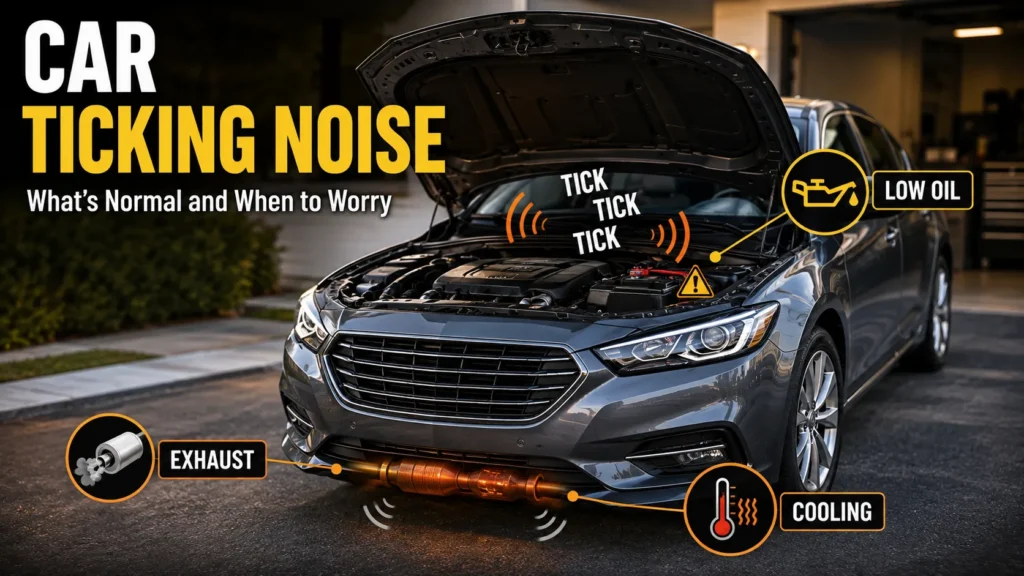
A car ticking noise can be harmless or a sign that something needs attention. A light tick after you turn the engine off is often caused by hot exhaust parts cooling down. A ticking sound from the engine while it is running can come from low oil, valve train parts, fuel injectors, an exhaust leak, or belt-driven components.
Quick Answer
If your car makes a light ticking sound for a short time after you turn it off, it is often normal. Hot exhaust parts cool and contract, which can create small ticking or clicking sounds. If the tick happens while the engine runs, gets louder, follows engine speed, or comes with low oil, warning lights, leaks, rough running, or overheating, have it checked.
Is a Ticking Noise From Your Car Normal?

It depends on when you hear it, where it comes from, and what else the car is doing.
A few light ticks after parking are usually less concerning than a loud ticking sound that continues while the engine is running. The same word, ticking, can describe several different noises, so I would start by finding out exactly when the sound occurs.
| When you hear the tick | Possible cause | What I would do |
| Only after shutting off | Hot exhaust cooling | Usually monitor it |
| During idle | Oil, lifters, injectors, exhaust | Check oil and listen closely |
| During acceleration | Engine, exhaust, or accessory | Have it checked if new or loud |
| Gets faster with RPM | Engine or rotating component | Inspect the source |
| With low oil | Lubrication or valve train issue | Check oil promptly |
| With exhaust smell | Exhaust leak | Arrange an inspection |
| With overheating | Cooling system problem | Stop driving if overheating |
| With rough running | Engine or ignition problem | Get the car checked |
The timing of the noise gives me one of the best clues.
Car Making Noise After Engine Turned Off

If your car is making noise after the engine is turned off, do not assume something is broken.
The exhaust system becomes extremely hot while the vehicle is running. After shutdown, those metal parts begin to cool and contract. Different parts cool at different rates, which can create small ticks, clicks, or pings.
This is especially easy to notice after:
- A long drive
- Highway driving
- Heavy traffic
- Hot weather
- Hard acceleration
- Driving uphill
A light ticking sound that gradually fades as the car cools is usually much less concerning than a new, loud, or continuous ticking noise.
Why Hot Exhaust Components Tick as They Cool
The exhaust manifold, catalytic converter, exhaust pipes, and other metal parts can remain very hot after you park.
As they cool, the metal changes size slightly. Small movements between metal surfaces, brackets, and heat shields can create the ticking sound you hear.
Can a Heat Shield Cause Ticking?
Yes.
A heat shield sits around hot exhaust parts and helps protect nearby components from heat. As the shield heats and cools, it can move slightly and make a metallic ticking or rattling sound.
A loose heat shield can also make the noise more noticeable.
If the sound seems to come from underneath the car, I would consider the exhaust system and heat shields before assuming the engine itself is the problem.
Can the Cooling Fan Make Noise After Shutdown?
Some vehicles can keep an electric cooling fan running briefly after the engine is turned off.
This can sound like a hum or whir rather than a sharp tick. The fan may continue operating because the engine and under-hood area are still hot.
A fan that runs briefly is not automatically a problem. If it runs for an unusually long time, drains the battery, or comes with overheating, the cooling system should be checked.
Can the EVAP System Make a Clicking Sound?
The EVAP system controls fuel vapors and can operate after the engine is switched off.
Solenoids and valves in this system can create faint clicking sounds as the vehicle completes certain checks or controls fuel vapor pressure.
This type of sound is usually quieter than an engine tick and may seem to come from the engine bay or near the fuel tank.
What About Turbocharged Engines?
Turbocharged vehicles can also make sounds after shutdown as hot components cool.
If the sound is new, unusually loud, or comes with loss of power, smoke, warning lights, or other symptoms, I would have the vehicle inspected rather than assuming it is normal cooling noise.
Ticking Sound From Engine While Running
A ticking sound from the engine deserves more attention than a few light ticks after shutdown.
If the engine is running while you hear the noise, I would check the oil level first. Then I would consider the location and rhythm of the sound.
Common causes include:
- Low engine oil
- Poor lubrication
- Hydraulic lifters
- Valve train components
- Fuel injectors
- Exhaust leaks
- Spark plugs
- Serpentine-belt accessories
- Pulleys
- Alternator problems
Low or Dirty Engine Oil
Low engine oil is one of the easiest things to check.
Your engine needs enough oil to lubricate its moving parts. If the oil level is too low, some engine components may not receive the lubrication and oil pressure they need.
This can create ticking or tapping sounds.
If your car has an oil-pressure warning light, do not ignore it. A low oil-pressure warning can indicate a serious lubrication problem.
I would park the car safely, turn the engine off, and check the oil level according to the vehicle’s recommended procedure.
Do not keep driving simply because the engine still runs.
Can Dirty Oil Cause Ticking?
It can contribute to some engine noises, especially in engines that use hydraulic lifters.
Hydraulic lifters depend on engine oil to maintain proper clearance in parts of the valve train. Oil that is old, contaminated, or unsuitable for the engine can affect how these parts operate.
If the ticking started around the time an oil service was due, checking the oil level, oil condition, oil filter, and correct oil specification is a sensible starting point.
Hydraulic Lifter or Valve Train Noise
A hydraulic lifter helps maintain the correct clearance between moving valve train parts.
A worn or malfunctioning lifter can create a repeated ticking sound near the top of the engine. Low oil pressure, low oil level, restricted oil flow, or internal wear can contribute to lifter noise.
If the tick remains after the engine warms up, I would have the valve train inspected instead of assuming it will disappear on its own.
Fuel Injector Ticking
Fuel injectors can produce a regular clicking sound as they open and close.
Some engines, especially engines with direct fuel injection, can have a noticeable injector tick as part of normal operation.
The key is whether the sound is normal for that particular engine and whether it is accompanied by other symptoms.
A sudden change in injector noise along with rough running, a check engine light, poor acceleration, or a misfire deserves inspection.
Exhaust Manifold or Exhaust Leak
An exhaust leak near the engine can sound like a ticking or tapping noise.
The sound may be more noticeable during cold starts and can sometimes change as the engine warms up.
An exhaust leak may also cause an exhaust smell, especially around the engine bay.
If you suspect an exhaust leak, I would not put my hands near the exhaust system while it is hot. Have the system inspected safely.
Spark Plug or Ignition Problem
A damaged or loose spark plug can sometimes create a ticking or clicking sound.
Ignition-related problems may also cause:
- Rough idle
- Engine misfire
- Poor acceleration
- Check engine light
- Reduced fuel economy
A ticking sound combined with these symptoms needs more attention than a quiet, regular engine tick.
Serpentine Belt, Alternator, or Pulley
Several components rotate when the engine is running.
These include the alternator and other belt-driven accessories. A worn bearing, pulley, belt, or accessory can create a repetitive ticking, clicking, or other mechanical noise.
The sound may change as engine speed changes.
I would avoid putting my hands or loose clothing near a running belt system. If the source is not obvious, a technician can inspect it safely.
What Does the Location of the Ticking Sound Tell You?

The location can help narrow down the cause.
Ticking From the Top of the Engine
A sound near the top of the engine may point toward:
- Valve train components
- Hydraulic lifters
- Camshaft-related parts
- Fuel injectors
This does not confirm the source, but it gives you a useful area to inspect.
Ticking From the Front of the Engine
A tick from the front may be related to:
- Serpentine belt
- Belt tensioner
- Alternator
- Pulley
- Other belt-driven accessories
If the noise changes with RPM, these components become worth checking.
Ticking From Under the Car
A noise under the vehicle may come from:
- Exhaust pipes
- Heat shields
- Catalytic converter
- Exhaust connections
This is also a common area for normal cooling ticks after shutdown.
Ticking Near the Fuel Tank
A faint clicking near the rear of the vehicle may come from fuel-system or EVAP components.
If the sound is accompanied by a fuel smell, however, I would have the vehicle checked rather than treating it as normal.
Does the Ticking Get Faster When You Accelerate?

This is a useful clue.
If the ticking becomes faster as engine RPM increases, the source may be connected to a component that rotates or operates with engine speed.
Possible areas include:
- Valve train
- Lifters
- Belt-driven accessories
- Pulleys
- Exhaust-related components
- Other engine components
If the ticking is only heard after the engine is switched off, RPM is no longer driving the sound. In that case, cooling metal and post-shutdown systems become more likely.
Ticking Noise vs. Clicking, Rattling, and Knocking
Drivers often use these words to describe similar sounds.
| Sound | What it may suggest |
| Light tick | Normal cooling, injector, lifter, or exhaust |
| Repeated click | Electrical component, injector, or mechanical part |
| Metallic rattle | Loose shield, exhaust part, or another loose component |
| Deep knock | Possible internal engine problem |
| Sharp tap | Valve train, exhaust, or other mechanical source |
| Hissing | Exhaust leak, coolant, or another pressure-related issue |
The sound alone cannot confirm the failed part. I would use the sound along with timing, location, RPM, warning lights, and other symptoms.
How to Check Where the Ticking Noise Is Coming From
You can gather useful information without taking the engine apart.
Listen to When It Happens
Ask yourself:
- Does it happen only after shutdown?
- Does it happen at idle?
- Does it start during acceleration?
- Does it happen during a cold start?
- Does it continue after the engine warms up?
Write down what you notice.
This can make a later inspection much easier.
Note How Long It Lasts
A few light ticks that slowly fade after parking are very different from a ticking sound that continues while the engine runs.
Pay attention to whether the sound:
- Starts immediately
- Fades gradually
- Stops after warming up
- Continues all the time
- Gets louder over time
Check the Oil Level
If the engine has an oil dipstick, check the oil level using the procedure recommended for your vehicle.
If the level is low, use the correct oil specified for your vehicle. Do not overfill it.
If the oil level is normal but the oil warning light is on, do not assume adding oil will solve the problem. A low oil-pressure condition needs proper diagnosis.
Look for Warning Lights
Check the dashboard for:
- Oil-pressure warning
- Check engine light
- Temperature warning
- Battery warning
- Other new warning indicators
A ticking noise combined with a warning light deserves more attention than a normal post-shutdown tick.
Look for Leaks or Smells
Look for obvious signs of:
- Engine oil
- Coolant
- Fuel
- Exhaust fumes
A burning smell or exhaust smell combined with a new ticking sound is a good reason to stop guessing and have the vehicle inspected.
Check Whether the Engine Runs Normally
Pay attention to how the car behaves.
Does it:
- Idle smoothly?
- Accelerate normally?
- Misfire?
- Shake?
- Lose power?
- Overheat?
A ticking sound with normal operation is different from ticking combined with several performance problems.
When Is Engine Ticking Serious?
I would take the noise more seriously if it is:
- New
- Loud
- Getting worse
- Present while driving
- Increasing with RPM
- Combined with an oil warning light
- Combined with a check engine light
- Combined with rough running
- Combined with loss of power
- Combined with overheating
- Combined with smoke
- Combined with an unusual smell
- Combined with an oil or coolant leak
These signs can point to a problem that should be diagnosed before continued driving.
Can You Drive With a Ticking Engine?
There is no single answer because the cause matters.
A light tick that occurs briefly after shutdown may be normal. A new ticking sound from the engine while driving is different.
If the car has an oil warning light, overheating, severe ticking, smoke, poor engine performance, or a deep knocking sound, I would stop driving and arrange an inspection.
If the vehicle runs normally and the sound is mild, you can still arrange a diagnosis soon, especially if the noise is new.
When Should You Have the Car Inspected?

I would arrange an inspection if you cannot identify the source or if the noise continues.
You should seek help sooner if:
- The ticking suddenly became loud.
- The sound is getting worse.
- The oil warning light is on.
- The engine is overheating.
- The car is losing power.
- The engine is running roughly.
- You smell exhaust inside or around the vehicle.
- You see oil or coolant leaking.
- The check engine light is flashing.
- You hear a deep knock instead of a light tick.
A technician can listen to the noise and check the oil, exhaust, valve train, accessories, and other possible sources.
Final Takeaway
A car ticking noise does not always mean the engine is failing. If you hear a few light ticks after parking, hot exhaust components cooling down are often the reason.
A ticking sound from the engine while it is running deserves a closer look. I would start with the oil level, then pay attention to where the sound comes from, whether it changes with RPM, and whether the car has warning lights, leaks, smells, rough running, or overheating.
The main clue is not just the sound itself. When it happens, where you hear it, and what the car does at the same time can tell you much more.
Frequently Asked Questions
Why does my car tick after I turn it off?
A light ticking sound after shutdown is often caused by hot metal parts cooling and contracting. Exhaust components such as the manifold, catalytic converter, and pipes can make these sounds as they cool.
Is a ticking sound from the engine normal?
It can be normal in some cases, especially with certain fuel injectors or during a short cold-start period. A new, loud, or persistent engine tick should be checked because oil, lifters, exhaust leaks, and other components can also cause ticking.
Can low oil cause a ticking noise?
Yes. Low oil can reduce lubrication and oil pressure, which may cause noise from valve train components such as hydraulic lifters. Check the oil level if you hear a new engine tick.
Can an exhaust leak sound like ticking?
Yes. An exhaust leak near the engine can create a repetitive ticking or tapping sound. An exhaust smell can be another clue.
Why does my car ticking noise get faster when I accelerate?
If the ticking speed increases with engine RPM, the source may be connected to a rotating or engine-driven component. Possible sources include valve train parts, belt-driven accessories, pulleys, or exhaust-related components.
Can fuel injectors make a ticking sound?
Yes. Fuel injectors open and close rapidly, and some engines have a noticeable injector clicking or ticking sound during normal operation.
Why does my car make noise after the engine is turned off?
The exhaust and other hot components continue cooling after shutdown. Their contraction can create ticking, clicking, or pinging sounds. Some vehicles can also run cooling fans or perform EVAP system operations after shutdown.
When should I worry about engine ticking?
I would worry more if the ticking is new, loud, persistent, gets faster with RPM, or appears with an oil warning, check engine light, overheating, rough running, smoke, leaks, or unusual smells.