Skip to content

If your diesel engine has a rough idle, poor acceleration, extra smoke, or worse fuel economy, a diesel injector cleaner may be worth trying. I see it as a simple first step when deposits may be affecting the fuel system.
But I would not treat injector cleaner as a repair in a bottle. It can help with certain deposit problems, but it cannot fix a worn injector, electrical fault, fuel-pressure problem, or another engine fault.
Quick Answer
A diesel injector cleaner is a fuel additive made to help remove deposits from diesel fuel injectors and parts of the fuel system. I would consider one for mild injector-related symptoms or routine maintenance. Choose a product made for diesel engines, follow its dosage exactly, and stop relying on additives if serious symptoms remain.
What Is Diesel Injector Cleaner?
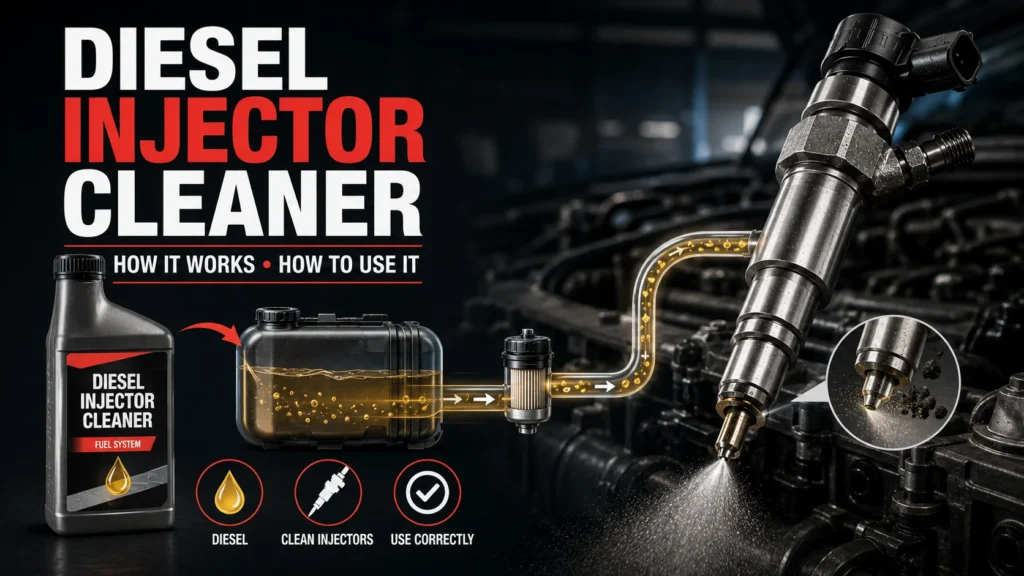
Diesel injector cleaner is a fuel additive that you pour into the diesel fuel tank. Its job is to help clean deposits that can build up in the fuel injection system.
Diesel injectors need to deliver fuel in a fine and controlled spray. Deposits around the injector can affect this spray and may lead to rough running or poor engine response.
Modern common-rail diesel engines need very precise fuel delivery. That makes clean injectors important for smooth combustion and normal engine performance.
I would think of injector cleaner as a maintenance and deposit-cleaning product, rather than a repair product.
What Does Diesel Injector Cleaner Do?

A suitable diesel fuel injector cleaner may help dissolve or control deposits in the fuel injection system.
Depending on the product, it may also be made to help with:
- Rough idle
- Poor acceleration
- Hesitation
- Reduced engine performance
- Increased fuel consumption
- Exhaust smoke linked to deposits
- Dirty fuel injectors
- Fuel-system deposits
Some products are made specifically for injectors, while others clean a wider part of the fuel system.
That difference matters when choosing a product.
Does Diesel Injector Cleaner Actually Work?
Yes, it can help in the right situation.
I would expect the best chance of seeing a benefit when deposits are affecting injector performance but the injector and the rest of the engine are still mechanically sound.
A cleaner may help restore smoother fuel delivery when deposits are part of the problem. Some products are also made to support fuel-system cleanliness during regular maintenance.
The key point is that not every diesel problem comes from dirty injectors.
If an injector has internal wear, an electrical fault, serious leakage, or another mechanical problem, adding more cleaner will not repair it.
The same applies to problems caused by low compression, fuel-pressure faults, sensors, the fuel pump, or a blocked DPF.
So I would ask one simple question before buying another bottle:
Is there a good reason to think deposits are causing the problem?
If the answer is no, diagnosis may be a better first step.
Best Diesel Injector Cleaner: What Should You Look For?

I would not choose a diesel injector cleaner simply because a bottle says it is the strongest or best.
The right product depends on your vehicle and why you want to use it.
Here are the main things I would check.
1. Make sure it is for diesel engines
Do not assume a petrol injector cleaner will work in a diesel.
Look for a product clearly made for diesel fuel systems.
2. Check common-rail compatibility
Many modern diesel cars use common-rail injection.
If your car has a common-rail diesel engine, check the product label before using it. Some diesel injector cleaners specifically state that they are suitable for DI, IDI and common-rail diesel engines.
3. Check the treatment size
One bottle may treat a specific amount of fuel.
For example, some products are made for around 50–60 litres of diesel.
Do not assume every bottle uses the same ratio.
4. Check the purpose
Some products focus on injector deposits.
Others are made to clean more of the diesel fuel system.
There are also products aimed at high-mileage vehicles or routine fuel-system maintenance.
5. Follow the product instructions
This is one area where I would not guess.
Use the dosage and treatment interval printed for that product. Do not add extra cleaner because you think more will give a better result.
Best Diesel Injector Cleaner for Different Needs

There is no single product that makes sense for every diesel car.
I prefer to match the product to the reason for using it.
| Your situation | What I would look for |
| Routine maintenance | Mild diesel injector or fuel treatment |
| Mild rough idle | Dedicated diesel injector cleaner |
| Suspected injector deposits | Injector cleaner with a clear cleaning purpose |
| High-mileage diesel | Product made for high-mileage vehicles |
| Wider fuel-system cleaning | Complete diesel fuel system cleaner |
| Serious engine symptoms | Diagnosis before buying more additives |
| Suspected injector damage | Injector testing or professional repair |
This approach is more useful than simply picking the bottle with the biggest list of claims.
Diesel Injector Cleaner vs Diesel System Cleaner
These terms can sound like they mean the same thing, but I would not assume they do.
A diesel injector cleaner mainly focuses on deposits affecting fuel injectors and fuel delivery.
A diesel system cleaner may target a wider part of the fuel system.
The exact coverage depends on the product.
This is also why I would read the product label instead of choosing based only on the name.
How to Use Diesel Injector Cleaner
Most in-tank diesel injector cleaners are simple to use.
The exact process depends on the product, so I always recommend following its instructions.
In general:
- Check that the product is suitable for your diesel engine.
- Check the required fuel volume.
- Add the correct amount of cleaner.
- Follow the product’s recommended driving or treatment instructions.
- Monitor the engine after treatment.
- Do not exceed the stated dosage.
Some products tell you to add the full bottle to a full tank. Others use a different treatment ratio.
That is why I would never give one universal dosage for every diesel injector cleaner.
When Should You Add Diesel Injector Cleaner?
For an in-tank product, the normal method is to add it to the fuel tank according to the product instructions.
Some products are intended for regular maintenance. Others are made for a specific cleaning treatment.
The correct interval can vary a lot between products.
So I would follow the instructions for the exact product you are using rather than applying a general mileage rule.
How Often Should You Use Diesel Injector Cleaner?
There is no single interval that applies to every product.
The treatment schedule depends on:
- The product formula
- Treatment concentration
- Your vehicle
- Your driving conditions
- Whether you are using it for cleaning or maintenance
Short trips, lots of stop-start driving, and high mileage can affect how your diesel fuel system behaves. But that does not mean you should automatically use an injector cleaner more often.
I would stick to the product instructions.
Using more additive than recommended does not automatically mean better cleaning.
Can Diesel Injector Cleaner Help a Rough Idle?
It can, if deposits are part of the cause.
Dirty injectors can affect fuel delivery and spray quality. Some diesel injector cleaners are specifically marketed to help smooth rough idling by removing deposits.
But rough idle has many possible causes.
It can also come from:
- Injector wear
- Fuel-pressure problems
- Air entering the fuel system
- Sensor faults
- EGR problems
- Low compression
- Other engine faults
So I would try an appropriate cleaner only when the symptoms fit a possible deposit problem.
If the rough idle continues, I would move on to proper diagnosis instead of repeatedly using additives.
Can Diesel Injector Cleaner Improve Fuel Economy?
It may help if dirty injectors are contributing to poor fuel delivery.
Some products claim to help reduce fuel consumption by removing deposits or keeping the fuel system clean.
But I would not expect a fixed MPG improvement from every treatment.
If your vehicle suddenly starts using much more fuel, I would look for the cause rather than assuming the injectors need cleaner.
Tyre pressure, driving habits, engine faults, fuel-pressure problems and other issues can also affect fuel consumption.
Can Diesel Injector Cleaner Reduce Black Smoke?
It can help when injector deposits are affecting fuel delivery and combustion.
But black smoke does not automatically mean dirty injectors.
Other faults can cause excessive smoke too.
For that reason, I would treat injector cleaner as one possible step, not a guaranteed smoke fix.
If smoke remains heavy after a suitable treatment, the vehicle needs further checks.
Can Diesel Injector Cleaner Fix a Bad Injector?

No, not every bad injector can be fixed with cleaner.
This is one of the most important points in this article.
A cleaner may help an injector affected by deposits. It cannot repair serious mechanical wear, an electrical fault, or a physically damaged injector.
A useful way to look at it is:
Deposits: cleaner may help.
Mechanical damage: cleaner will not repair it.
Electrical fault: cleaner will not repair it.
Fuel-pressure fault: cleaner will not repair it.
Unknown cause: diagnose the problem first.
This can save you money because repeatedly buying additives will not solve a fault that needs mechanical work.
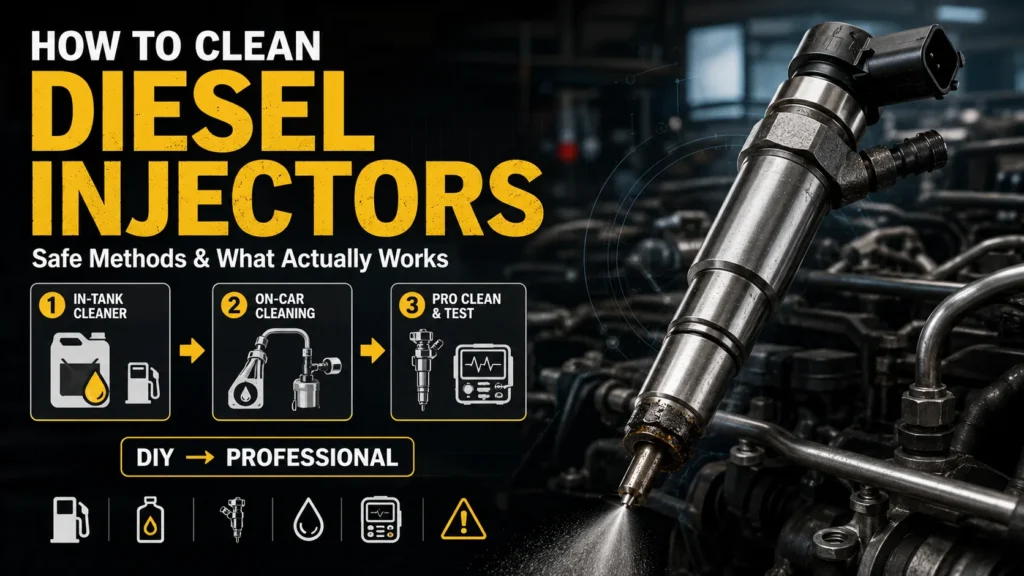
Diesel Injector Cleaner vs Professional Injector Cleaning

An in-tank diesel injector cleaner is the simple option.
It does not require you to remove the injectors, and it can make sense for mild deposit problems or routine maintenance.
Professional cleaning is different.
A specialist can remove and test the injector and check its operation. This gives you more information than simply adding a bottle to the fuel tank.
I would consider professional testing when:
- The engine has serious symptoms
- The cleaner makes no difference
- An injector fault is suspected
- Fuel leakage is present
- The engine has major power loss
- The problem keeps returning
The main benefit is diagnosis. You can find out whether the injector actually has a problem before spending money on replacement parts.
Diesel Injector Cleaner vs Fuel System Cleaner

These products overlap, but they are not always the same.
A diesel injector cleaner is usually more focused on the fuel injectors.
A complete diesel fuel system cleaner may cover more components.
I would choose based on the job you want the product to do.
If your main concern is injector deposits, a dedicated diesel injector cleaner may make more sense.
If you want broader fuel-system cleaning, a complete diesel fuel system cleaner may be a better fit.
Can Diesel Injector Cleaner Clean a DPF?
I would not use a diesel injector cleaner as a DPF cleaner.
The diesel particulate filter is part of the exhaust system, while the fuel injectors are part of the fuel system.
They perform different jobs.
Some products are specifically made for DPF cleaning and have different instructions and treatment rates.
So if your main problem is a DPF warning light, use a product made for that purpose or have the system checked.
Do not assume an injector cleaner will solve a DPF fault.
What About a Diesel Injector Cleaner for High-Mileage Cars?
A high-mileage diesel can have more deposits and wear simply because it has covered more miles.
Some products are made specifically for high-mileage diesel vehicles.
I would still check the condition of the vehicle before choosing a stronger additive.
High mileage does not automatically mean the injectors need cleaning.
If the car runs well, follow normal maintenance rather than trying to fix a problem that is not there.
When Should You Stop Using Diesel Injector Cleaner?
I would stop relying on injector cleaner when the symptoms point to a fault rather than simple deposits.
For example, I would want the vehicle checked if you have:
- Severe power loss
- Heavy or persistent smoke
- Fuel leaks
- Hard starting that keeps getting worse
- Repeated warning lights
- Injector fault codes
- Strong knocking
- A rough idle that does not improve
- Poor performance after correct treatment
At that point, another bottle is unlikely to give you the answer.
A mechanic can test the fuel system and injectors and find the actual cause.
Common Mistakes to Avoid
Using petrol injector cleaner in a diesel
Always check the label.
Use a product made for your fuel type.
Adding too much cleaner
More is not automatically better.
Follow the stated treatment ratio.
Mixing different additives
I would avoid combining several fuel additives unless the manufacturers specifically say they are compatible.
Expecting a cleaner to repair a damaged injector
A cleaner can deal with deposits. It cannot repair every mechanical or electrical fault.
Ignoring serious symptoms
If the vehicle has a major fault, do not keep treating it with additives and hope it disappears.
Choosing a product only because it says best
A product that suits one diesel may not be the right choice for another.
Look at compatibility, treatment size, purpose and instructions.
Is Diesel Injector Cleaner Worth It?
I think it can be worth trying when you have a sensible reason to suspect injector deposits.
It is relatively simple to use, and an appropriate product can be a reasonable part of diesel fuel-system maintenance.
But I would keep expectations realistic.
If the problem comes from dirty injectors, you may notice smoother running or better response after treatment. If the problem comes from a damaged injector or another engine component, the cleaner will not solve it.
That is the line I would keep in mind before spending money on additives.
Final Take
I see diesel injector cleaner as a useful first step for possible deposit problems, not a cure for every diesel engine fault.
Choose a product made for your diesel engine, check common-rail compatibility if needed, follow the dosage, and give it a fair chance to work.
If the symptoms remain, I would stop buying more bottles and find the actual fault. That approach gives you a much better chance of fixing the problem instead of treating the symptoms again and again.
FAQs
Can I put diesel injector cleaner straight into the fuel tank?
Yes, many in-tank products are made for this. Check the product instructions for the correct dose and fuel volume before adding it.
Can I use diesel injector cleaner in a common-rail engine?
Many products are made for common-rail diesel engines, but you should check the label before use. Product compatibility varies.
How long does diesel injector cleaner take to work?
There is no single time for every product. Some products may show a difference after a certain amount of driving, but results depend on the vehicle and the condition of the fuel system.
Can diesel injector cleaner improve acceleration?
It may help if injector deposits are affecting fuel delivery. It will not repair an engine or injector fault that has another cause.
Can I use an injector cleaner every time I fill up?
Do not assume you can. Different products have different treatment intervals. Follow the instructions for the product you buy.
Is diesel injector cleaner the same as diesel fuel treatment?
No. The products can overlap, but their purpose and treatment schedule can differ. A diesel treatment may focus more on regular fuel-system maintenance, while an injector cleaner is more focused on injector deposits.
Should I use an injector cleaner before replacing an injector?
If deposits are a possible cause and the vehicle has no clear evidence of injector damage, a suitable cleaner may be worth trying. If the injector has a confirmed mechanical or electrical fault, a cleaning additive is unlikely to replace the need for repair.