Skip to content

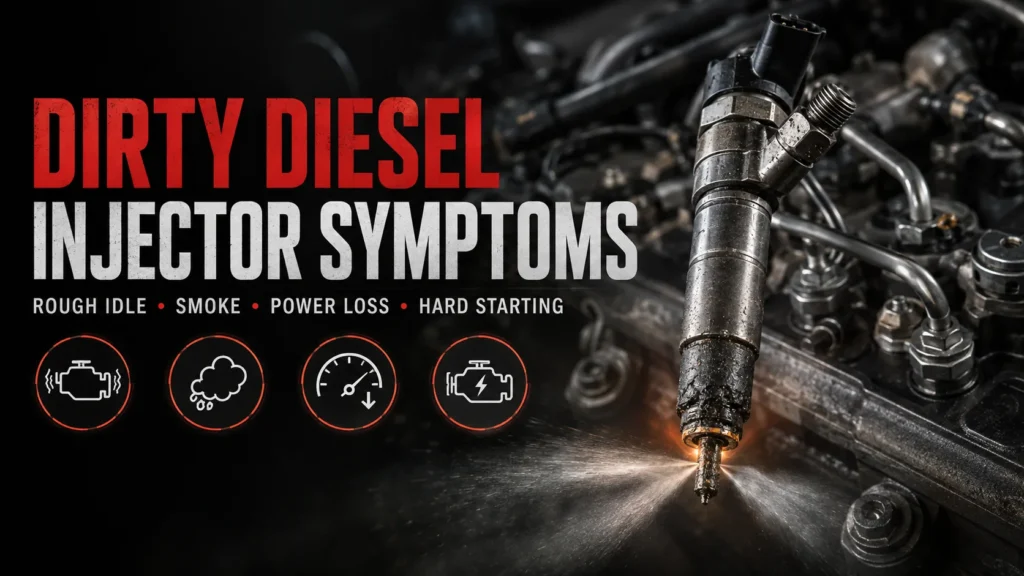
If your diesel engine has started to shake at idle, lose power, use more fuel, or produce more smoke, dirty injectors could be one possible cause. But I would not assume the injectors are dirty from one symptom alone. Several diesel faults can cause similar problems, so it helps to look at the full picture before spending money on cleaning or replacement.
Quick Answer
The most common dirty diesel injector symptoms include rough idle, engine hesitation, poor acceleration, loss of power, hard starting, increased fuel use, black or white smoke, diesel knock, and excess soot. These signs can also come from the EGR, DPF, turbo, fuel filter, glow plugs, or other fuel-system faults, so testing may be needed to confirm the cause.
What Are the Symptoms of Dirty Diesel Injectors?

Diesel injectors spray a precise amount of fuel into each cylinder. The fuel needs to leave the injector in the correct spray pattern for good combustion.
If deposits partly block the injector nozzle or affect the spray, the engine may not burn the fuel as it should. This can cause several changes in the way the car starts, idles, accelerates, and produces exhaust gases.
Here are the main signs I would look for.
1. Rough or Lumpy Idle
A rough idle is one of the common signs of a diesel injector problem.
You may feel the engine shaking through the steering wheel, seat, or body of the car. The engine may also sound uneven when the vehicle is stopped.
Dirty injector deposits can affect the amount and pattern of fuel entering a cylinder. That can lead to uneven combustion and a lumpy idle.
A rough idle does not prove that the injectors are dirty, though. EGR problems, air leaks, glow plugs, engine mounts, and other faults can cause a similar feeling.
2. Engine Misfire or Hesitation
A diesel engine should deliver steady power as you press the accelerator. If fuel delivery becomes uneven, you may notice hesitation or a slight misfire.
The car may feel as if it briefly loses power and then picks up again.
I would pay attention to whether this happens at idle, during acceleration, or under heavy load. That extra detail can help a mechanic narrow down the cause.
3. Poor Acceleration and Loss of Power
Dirty or faulty injectors can affect fuel delivery and combustion, which may reduce engine performance.
You might notice:
- Slower acceleration
- Less pulling power
- Flat spots when accelerating
- Difficulty climbing hills
- Poor response when overtaking
- The engine feeling weak at higher speeds
Loss of power can also come from a blocked DPF, EGR problem, turbo fault, fuel-pressure issue, or restricted air supply. That is why I would not replace injectors based on power loss alone.
4. Hard Starting
A diesel engine that takes longer than normal to start may have a fuel delivery problem.
You may need to crank the engine for several seconds before it fires. It may then run roughly for a short time.
Injector problems can cause hard starting when the injector does not deliver the correct amount of fuel or when an injector leaks fuel internally. However, glow plugs, the battery, fuel pressure, the fuel filter, and other parts can also cause hard starting.
Cold starts can be especially useful to watch because some injector problems become more noticeable when the engine is cold.
5. Black Smoke From the Exhaust
Black smoke usually means the engine is not burning all the fuel cleanly.
A poor injector spray pattern can contribute to this by affecting how the fuel mixes with air inside the cylinder.
If you see a small amount of smoke under heavy acceleration, do not immediately blame the injectors. Airflow, turbo, EGR, DPF, and other engine problems can also affect exhaust smoke.
Heavy or persistent black smoke deserves a proper check.
6. White Smoke
White smoke from a diesel can have several causes.
Unburnt diesel fuel can produce white smoke, particularly during starting when combustion is poor. A leaking or poorly spraying injector can be one possible cause.
But white smoke can also point to other problems, so I would not treat it as a simple sign of dirty injectors.
If the smoke continues after the engine warms up, the car should be checked.
7. Poor Fuel Economy
A diesel engine with a fuel delivery problem may use more fuel than normal.
You may notice that you are visiting the fuel station more often even though your driving has not changed.
Injector deposits can affect the spray pattern and combustion process. But fuel economy can also change because of tyre pressure, driving conditions, DPF regeneration, air filters, sensors, turbo problems, or other engine faults.
So I would compare fuel use over several tanks rather than judging it from one trip.
8. Diesel Knock or Unusual Engine Noise
A diesel engine naturally makes more noise than a petrol engine. A slight change in sound does not always mean something is wrong.
However, a new ticking, knocking, or rattling sound that changes with engine speed or load deserves attention.
Poor fuel delivery or injector faults can change the way combustion happens and may produce a sharper diesel knock. A leaking injector seal can also create a ticking or chuffing sound in some engines.
Do not assume every new engine noise comes from dirty injectors.
9. Engine Warning Light
An engine management or check engine light can appear when the ECU detects a problem with engine or fuel-system operation.
An injector fault can trigger a warning light, but the light itself does not tell you that the injector is dirty.
A diagnostic scan can show stored fault codes and help point to the affected system or cylinder.
I would use the warning light as a reason to investigate, not as proof that injector cleaner is needed.
10. Diesel Smell or Excess Soot
A strong diesel smell around the engine or exhaust can be a warning sign.
It may point to a fuel leak, injector leakage, poor combustion, or another fuel-system problem. Carbon or soot around an injector can also point to a sealing problem rather than simple dirt inside the injector.
If you can smell raw diesel, I would not ignore it.
Dirty Diesel Injector Symptoms at a Glance
| Symptom | What you may notice | Possible injector link |
| Rough idle | Engine shakes or runs unevenly | Uneven fuel delivery |
| Hesitation | Brief pause during acceleration | Poor fuel spray |
| Loss of power | Car feels weak | Poor combustion or fuel delivery |
| Hard starting | Longer cranking | Poor spray or fuel pressure |
| Black smoke | Dark exhaust smoke | Poor combustion or excess fuel |
| White smoke | Pale smoke from exhaust | Unburnt fuel or other fault |
| Poor fuel economy | More fuel used than normal | Poor combustion |
| Diesel knock | New ticking or knocking | Changed combustion |
| Warning light | Engine light appears | ECU detects a fault |
| Diesel smell | Strong fuel smell | Possible leak or injector fault |
Dirty vs Faulty Diesel Injectors

This is one distinction I think every diesel owner should know.
A dirty diesel injector may have deposits that affect its spray pattern or fuel flow. A faulty diesel injector may have a mechanical, electrical, sealing, or internal problem.
These problems can produce similar symptoms, but they do not have the same solution.
| Dirty injector | Faulty injector |
| Deposits affect the nozzle or fuel spray | Mechanical or electrical damage may be present |
| Symptoms may be mild at first | Symptoms can become more serious |
| Cleaning may help if deposits are the cause | Cleaning cannot repair damaged parts |
| Injector may still work within limits | Injector may need testing, repair, or replacement |
| Fuel quality and deposits may play a role | Wear, leaks, electrical faults, and damage may be involved |
For this reason, I would not treat every injector symptom with a bottle of cleaner.
What Causes Diesel Injectors to Get Dirty?
Diesel injectors work with very small fuel passages and precise moving parts. Deposits or contamination can affect these parts over time.
Common causes can include:
- Fuel contamination
- Poor fuel quality
- Carbon and other deposits
- Restricted or overdue fuel filters
- Water in the fuel
- Long periods of idling
- Frequent short trips
- Normal wear in the fuel system
Short trips and repeated cold running can also contribute to deposit-related problems in modern diesel engines.
Dirty fuel is another concern. Water and other contaminants can affect fuel-system parts and may cause injector sticking, poor spray, or internal wear.
How Dirty Injectors Affect the Engine
A diesel injector needs to deliver fuel at the right time and in the right amount.
The fuel should also leave the nozzle in a fine and even spray. This helps the fuel mix with the air inside the cylinder.
If deposits partly block the nozzle or change the spray pattern, combustion may become less even. You may then notice rough running, hesitation, smoke, poor acceleration, or higher fuel use.
The key point is simple: a symptom can suggest an injector problem, but it cannot prove that the injector is dirty.
How Can You Tell If a Diesel Injector Is Dirty?

There is no reliable way to confirm a dirty injector just by listening to the engine or looking at the exhaust.
I would start by looking at the full set of symptoms.
For example, rough idle plus poor acceleration and increased smoke gives more reason to inspect the fuel system than rough idle on its own.
Check the engine warning light
If the warning light is on, a diagnostic scan can reveal stored fault codes.
The code can help identify an injector circuit, cylinder contribution, fuel-pressure issue, or another problem. But the code still needs to be interpreted correctly because an injector-related code does not always mean the injector itself is dirty or damaged.
Check the fuel filter and fuel
A restricted fuel filter can cause fuel delivery problems that feel similar to injector trouble.
Contaminated diesel can also affect the fuel system.
If injector problems appear soon after a fuel-system issue, I would have the fuel supply checked before blaming the injectors.
Injector testing
A garage or diesel specialist can use tests to check injector performance.
Depending on the vehicle, this may include:
- Injector balance or contribution data
- Fuel-pressure checks
- Injector return-flow testing
- Diagnostic fault codes
- Injector bench testing
A return-flow test can help identify injectors with excessive internal leakage on common-rail systems.
Testing is much more useful than guessing which injector needs replacing.
Could Something Else Be Causing These Symptoms?

Yes. This is where many injector symptom guides can give readers the wrong idea.
A diesel engine has several systems that work together. A fault in one system can create symptoms that look like an injector problem.
| Symptom | Other possible causes |
| Rough idle | EGR, glow plugs, air leaks, engine mounts |
| Loss of power | DPF, turbo, EGR, fuel pressure |
| Black smoke | Airflow problem, turbo, EGR, excess fuel |
| White smoke | Glow plugs, coolant issue, poor combustion |
| Hard starting | Battery, glow plugs, fuel pressure, fuel filter |
| Poor fuel economy | Tyres, driving conditions, DPF, sensors, fuel system |
| Warning light | Many engine or emissions faults |
For example, a blocked DPF can cause poor performance, while an EGR fault can cause rough running or smoke. A weak glow plug can make cold starting difficult.
So if your car has one symptom, I would look at the wider picture before deciding that the diesel injectors are dirty.
Dirty Injector vs Clogged Injector
The terms dirty injector and clogged injector are often used in the same way.
There is a small difference in how I would use them.
A dirty injector usually means deposits have built up around the injector or nozzle.
A clogged injector suggests that the buildup or contamination is restricting fuel flow more severely.
The symptoms can overlap, so you do not need a separate diagnosis for every term.
If you search for clogged diesel injector symptoms, the same core signs can apply:
- Rough idle
- Misfire
- Hesitation
- Poor acceleration
- Smoke
- Hard starting
- Poor fuel economy
Can Diesel Injector Cleaner Help Dirty Injectors?
It can help when deposits are the real cause of the problem.
A diesel injector cleaner is made to work through the fuel system and may help remove or reduce certain deposits.
But I would not treat it as a repair for a damaged injector.
If the injector has an electrical fault, serious internal wear, a sealing problem, or excessive internal leakage, a fuel additive will not fix the underlying fault.
If you want to learn more about the product side, see my guide to diesel injector cleaner.
For the cleaning process itself, see my guide on how to clean diesel injectors.
Can You Drive With Dirty Diesel Injectors?
That depends on how severe the symptoms are.
A small change in idle quality does not mean the car will immediately break down. But I would not ignore symptoms that are getting worse.
I would arrange a check sooner if you notice:
- Severe misfire
- Major loss of power
- Heavy smoke
- Strong diesel smell
- Fuel leakage
- Severe knocking
- Repeated engine warning lights
- Limp mode
- Hard starting that is getting worse
A serious injector fault can affect combustion and other parts of the fuel and emissions system. Excess fuel or poor combustion can also contribute to problems elsewhere in the vehicle.
If you have a visible fuel leak or severe engine fault, I would avoid continuing to drive until the problem has been checked.
When Should You Get the Injectors Checked?
I would get the injectors checked when several symptoms appear together or when the problem keeps getting worse.
For example, rough idle on its own has many possible causes. Rough idle combined with hard starting, smoke, poor fuel economy, and loss of power gives much more reason to inspect the fuel system.
A proper diagnosis can help answer three separate questions:
- Is the injector actually causing the symptom?
- Is it dirty, worn, leaking, or electrically faulty?
- Does it need cleaning, testing, repair, or replacement?
That is a much better approach than replacing parts based on symptoms alone.
Final Take
Dirty diesel injector symptoms can include rough idle, hesitation, loss of power, hard starting, smoke, poor fuel economy, and changes in engine noise.
The important thing is not to treat one symptom as proof of a dirty injector. I would look at the symptoms together and rule out other causes such as the DPF, EGR, turbo, glow plugs, fuel filter, and fuel-pressure system.
If deposits are the problem, suitable injector cleaning may help. If the injector is worn or damaged, it needs proper diagnosis rather than another dose of cleaner.
Frequently Asked Questions
What is the most common symptom of a dirty diesel injector?
A rough or uneven idle is one of the common signs. You may also notice hesitation, poor acceleration, smoke, or increased fuel use. A rough idle alone does not confirm that the injector is dirty.
Can dirty diesel injectors cause black smoke?
Yes, a poor injector spray pattern can contribute to incomplete combustion and black smoke. But black smoke can also come from airflow, turbo, EGR, or other engine problems.
Can dirty injectors cause poor fuel economy?
They can contribute to higher fuel use if deposits affect fuel delivery and combustion. However, poor fuel economy has many possible causes, so it should not be blamed on the injectors without checking the wider vehicle.
Can dirty diesel injectors cause hard starting?
They can. A blocked, leaking, or poorly spraying injector can affect starting. Glow plugs, battery condition, fuel pressure, and the fuel filter can cause similar problems.
Will injector cleaner fix a bad diesel injector?
Not usually. Injector cleaner may help when deposits are the main issue, but it cannot repair mechanical damage, electrical faults, serious wear, or injector leakage.
Are dirty and faulty diesel injectors the same thing?
No. A dirty injector may have deposits that affect fuel spray. A faulty injector can have a mechanical, electrical, sealing, or internal problem that needs proper testing.