Skip to content

Dirty or clogged diesel injectors can affect how an engine starts, idles, accelerates, and uses fuel. But I would not assume that every diesel engine problem comes from dirty injectors.
For mild deposit buildup, an in-tank diesel injector cleaner can be the simplest place to start. If symptoms continue, the next step may be proper injector testing, professional fuel-system cleaning, or injector removal and bench cleaning.
Quick Answer
The easiest way to clean diesel injectors without removing them is to use a suitable diesel injector cleaner in the fuel tank and follow the product dosage and driving instructions. For more serious problems, professional cleaning and injector testing may be needed. Cleaning will not repair an injector with electrical, mechanical, or severe internal damage.
What Do Diesel Injectors Do?
Diesel injectors deliver fuel into the engine at the right time and in the right amount. The injector must also create the correct spray pattern so the diesel can mix with air and burn properly.
Modern diesel engines often use common-rail injection. In this system, diesel stays under high pressure in a fuel rail before the injectors send precise amounts into the engine.
Because the injector has very small internal clearances, dirt, water, fuel contamination, and deposits can cause problems. Deposit buildup can also affect the injector needle and spray pattern.
This is why keeping the fuel system clean matters.
Signs Your Diesel Injectors May Need Cleaning

A dirty injector can cause several engine problems. However, these symptoms can also come from other faults, so I would not use them alone to confirm a dirty injector.
Look for signs such as:
- Rough or uneven idle
- Poor acceleration
- Loss of engine power
- Increased fuel use
- Hesitation when accelerating
- Hard starting
- Excessive smoke
- Poor engine response
- Uneven engine running
- An engine warning light
A change in fuel economy or increased smoke can point to an injector problem, but you still need to find the real cause before replacing or cleaning parts.
For example, a rough-running diesel could have a fuel problem, air problem, electrical fault, compression issue, or another engine fault. Cleaning the injectors may do nothing if the real problem is somewhere else.
How to Clean Diesel Injectors

There is more than one way to clean diesel injectors.
The right method depends on the condition of the engine and injectors.
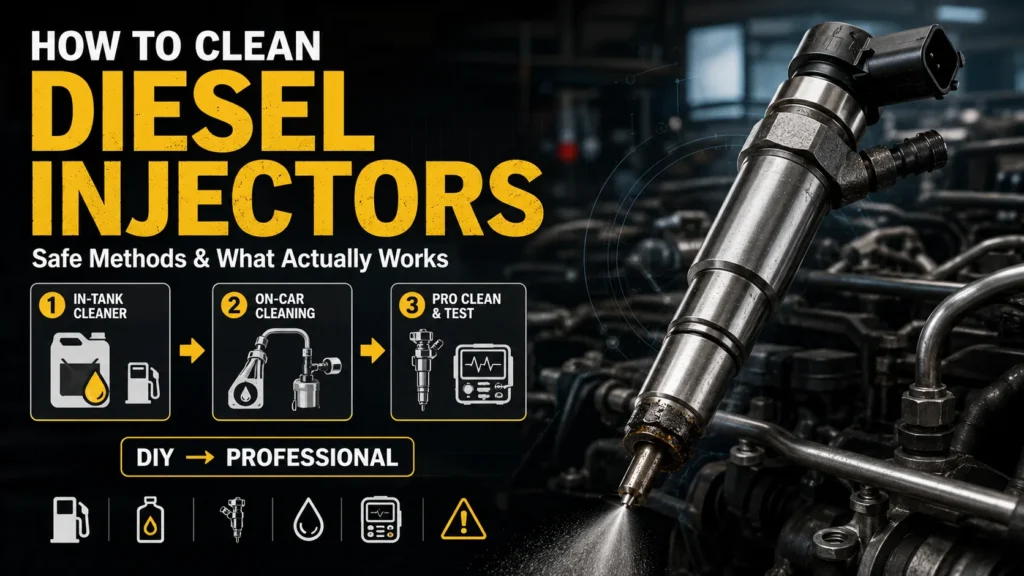
For most drivers, I would think about cleaning in three levels:
- In-tank diesel injector cleaner
- Professional on-car fuel-system cleaning
- Injector removal, cleaning, and testing
The first method is the easiest. The third is a workshop-level job.
Method 1: Use a Diesel Injector Cleaner

For mild deposit buildup, an in-tank diesel injector cleaner is the simplest option.
The cleaner mixes with the diesel fuel and passes through the fuel system as the engine runs. The exact dosage and use method vary by product, so I would always follow the instructions on the bottle.
How to use diesel injector cleaner
- Check that the product is suitable for your diesel engine.
- Read the stated dosage for your fuel tank.
- Add the recommended amount to the diesel fuel.
- Follow the product’s instructions about filling the tank.
- Drive the vehicle as directed.
- Give the cleaner time to pass through the fuel system.
- Watch for changes in engine performance.
Do not add more cleaner just because you think a stronger mixture will work better.
A higher dose does not automatically mean better cleaning. The product instructions should be your guide.
Can diesel injector cleaner clean dirty injectors?
It can help with deposits in the fuel system and injectors, but results depend on the condition of the injector.
If the injector has light deposits, a suitable cleaner may help restore normal fuel flow and spray. If the injector has internal wear, an electrical fault, severe contamination, or physical damage, an additive will not repair it.
That difference is important.
Method 2: Professional On-Car Fuel-System Cleaning
If an in-tank treatment does not solve the problem, a garage may offer a stronger fuel-system cleaning service.
This method can use specialist equipment to run a cleaning solution through the fuel system rather than relying only on the normal fuel tank mixture.
The exact process depends on the vehicle and fuel system.
I would leave this job to a suitable garage because modern diesel fuel systems can operate at very high pressure and need the correct equipment and procedure.
This is very different from simply adding a cleaner to your fuel tank.
Method 3: Remove, Clean, and Test the Injectors
If the injectors have a serious problem, removing them may be the next step.
A professional diesel specialist can remove the injectors and test them using specialist equipment. The test can check things such as fuel delivery, injector operation, and spray performance.
The injector can then be cleaned if deposits are the problem.
Some cleaning systems use specialist solvent equipment. Physical cleaning of certain injector parts may also require an ultrasonic cleaning system.
This gives you a much better answer than simply guessing that an injector is dirty.
Why injector testing matters
I would test an injector before deciding that it needs replacing.
A dirty injector may improve after cleaning. A worn or electrically faulty injector may need repair or replacement instead.
For example, an electrical fault cannot be solved by simply washing deposits away. Some common-rail injector electrical faults require replacement rather than cleaning.
Can You Clean Diesel Injectors Without Removing Them?
Yes, in some cases.
An in-tank diesel injector cleaner is the simplest way to treat the fuel system without removing the injectors.
Some professional cleaning systems can also clean or treat injectors while they remain fitted to the vehicle.
But there is a limit.
If an injector is badly blocked, leaking, worn, seized, or electrically faulty, an additive may not solve the problem. A specialist may need to remove and test it.
So I would split the options like this:
| Injector condition | Suitable approach |
| Mild deposits | In-tank diesel injector cleaner |
| Mild symptoms | Fuel-system cleaner and monitoring |
| Symptoms continue | Diagnostic testing |
| Suspected heavy deposits | Professional cleaning |
| Poor injector test results | Specialist repair or replacement |
| Electrical fault | Usually repair or replacement |
| Severe internal wear | Replacement may be needed |
This is why I would not treat every injector problem with the same cleaning method.
How to Clean Common-Rail Diesel Injectors
Common-rail diesel injectors need extra care.
The system stores diesel under high pressure in a common rail. The injectors then deliver controlled amounts of fuel into the engine.
The injector itself is a precision part. Modern systems use very small clearances and high fuel pressure, so contamination can cause serious problems.
For this reason, I would not recommend removing a common-rail injector at home unless you have the correct tools, vehicle-specific procedure, and experience with high-pressure diesel systems.
There is also a cleanliness issue.
Once fuel pipes are disconnected, dirt must not enter the system. Exposed fuel-system parts should be protected from contamination, and the correct torque and sealing procedures matter during refitting.
Some vehicles also require injector coding after replacement.
So common-rail injector work is very different from adding a cleaner to the fuel tank.
Can You Clean Diesel Injectors at Home?
For basic cleaning, you can use a suitable diesel injector cleaner without removing the injectors.
That is the level of DIY work I would start with if the engine only has mild symptoms and there are no signs of a serious fuel-system fault.
I would not recommend taking apart a common-rail injector or opening high-pressure fuel lines as a casual home repair.
The risks are higher, and the correct procedure can differ between engines.
If the injectors need to come out, a diesel specialist can also test them before you spend money on replacements.
What If Cleaning Does Not Fix the Problem?
If you have used a suitable diesel injector cleaner and the engine still runs badly, I would stop adding more cleaner and look for the real fault.
Possible causes include:
- Faulty injector
- Fuel filter problem
- Fuel contamination
- Air entering the fuel system
- Fuel pressure problem
- Faulty sensor
- Wiring problem
- Turbo or air-intake problem
- EGR-related problem
- Engine compression problem
- Other mechanical faults
A diagnostic scan can help find stored fault codes, but a fault code does not always mean that the named component itself has failed.
For injector problems, further testing may be needed.
If the injector has an electrical fault, cleaning may not solve it. If the injector has worn internal parts or serious damage, replacement may be the better option.
Cleaning vs Replacing Diesel Injectors

Cleaning makes sense when deposits are the main issue.
Replacement makes more sense when the injector has serious damage or a fault that cleaning cannot fix.
| Problem | Clean first? | Replacement likely? |
| Light deposits | Yes | No |
| Mild injector contamination | Yes | No |
| Poor spray caused by deposits | Yes | Not always |
| Electrical injector fault | No | Often |
| Severe internal wear | No | Often |
| Serious injector leakage | Usually no | Often |
| Cleaning does not improve test results | No | Possibly |
I would avoid replacing an injector based only on rough running or poor fuel economy.
Those symptoms can come from many parts of the engine.
Testing gives you a better basis for the repair.
How Often Should Diesel Injectors Be Cleaned?
There is no single cleaning interval that suits every diesel engine.
I would follow the instructions for the particular diesel injector cleaner you use rather than choosing a random interval.
Regular fuel-system maintenance can also help keep the injectors in good condition. Good-quality fuel, a clean fuel filter, and proper servicing all matter.
If your vehicle develops symptoms, that is a better reason to investigate the injectors than simply cleaning them on a fixed schedule.
Some professional guidance suggests checking injectors regularly, with shorter intervals potentially making sense for vehicles that make frequent short trips.
Your vehicle’s service schedule should take priority.
Does Diesel Injector Cleaner Work?
Yes, a diesel injector cleaner can help with certain types of deposits.
But I would keep expectations realistic.
A fuel additive may help when deposits are affecting injector operation. It cannot fix every diesel injector problem.
It will not repair:
- A damaged injector
- A broken electrical component
- Severe internal wear
- A badly damaged nozzle
- A serious fuel-pressure fault
- A failed fuel pump
This is why I see diesel injector cleaner as a cleaning and maintenance product, not a repair product.
If the engine has a serious fault, diagnosis should come before repeated cleaning treatments.
Can Dirty Diesel Injectors Cause Black Smoke?
They can contribute to poor combustion and increased smoke, but black smoke does not prove that the injectors are dirty.
Black smoke can have several causes.
For example, the engine may have an air-flow problem, fuel delivery problem, turbo issue, or another fault that affects combustion.
If you notice heavy or persistent smoke, I would investigate the cause instead of relying on injector cleaner alone.
Can Dirty Diesel Injectors Cause Poor Fuel Economy?
They can.
An injector that does not deliver fuel correctly can affect combustion and fuel use. But poor MPG can also come from many other causes.
Tyre pressure, driving style, air filters, fuel filters, sensors, turbo problems, brakes, and engine faults can all affect fuel economy.
So if your fuel consumption suddenly gets worse, I would treat injector cleaning as one possible step rather than the complete answer.
Can Dirty Injectors Cause Hard Starting?
They can contribute to starting problems if the injector is not delivering fuel correctly.
But hard starting can also come from:
- Weak battery
- Glow plug problems
- Fuel-pressure issues
- Air in the fuel system
- Fuel filter problems
- Sensor faults
- Poor compression
- Injector faults
If the engine is difficult to start, especially when cold, I would check the wider system before assuming the injectors simply need cleaning.
Is Injector Cleaning Better Than Injector Replacement?
It depends on the fault.
If deposits are affecting an otherwise healthy injector, cleaning may be the sensible first step.
If the injector has serious wear or an electrical problem, replacement may be more suitable.
That is why I prefer testing before replacing where practical.
It can save you from paying for parts that do not solve the real problem.
When Should You Get Professional Help?
I would get professional help if:
- The engine has severe power loss
- The vehicle produces heavy smoke
- The engine warning light stays on
- The engine is difficult to start
- You suspect a fuel leak
- The injector is leaking
- The engine runs very roughly
- A diesel injector cleaner does not help
- You suspect a common-rail injector fault
- You need to remove an injector
- The vehicle has a fuel-pressure fault
I would also avoid opening high-pressure diesel fuel lines without the correct procedure and equipment.
Modern common-rail systems work at very high pressure, and injector removal can require specialist tools.
Final Take
If I were dealing with mild signs of dirty diesel injectors, I would start with a suitable diesel injector cleaner and follow the product instructions carefully.
If that does not help, I would not keep adding more cleaner and hoping for a result. I would move on to proper diagnosis and, if needed, professional injector testing.
The main point is simple: cleaning can help dirty injectors, but it cannot repair a damaged injector. Knowing that difference can save you money and help you choose the right repair.
FAQs
Can I clean diesel injectors without removing them?
Yes. An in-tank diesel injector cleaner can treat deposits without removing the injectors. Some professional cleaning systems can also treat the fuel system while the injectors remain fitted.
Can diesel injector cleaner damage an engine?
A suitable product used at the correct dosage should be used according to its instructions. I would never use more than the stated amount or mix products unless the manufacturer says they can be used together.
How long does diesel injector cleaner take to work?
It depends on the product and the condition of the fuel system. Some treatments work as the treated fuel passes through the system, while professional cleaning methods use a separate process. Follow the instructions for the specific product.
Can you clean a common-rail diesel injector?
Yes, common-rail injectors can be cleaned and tested, but the process is more involved than adding cleaner to a fuel tank. Removal and bench cleaning should be handled with the correct equipment and procedure.
Should I replace an injector after cleaning?
Not automatically. If cleaning does not solve the problem, the injector should be tested. An electrical fault, serious wear, or internal damage may mean replacement is needed.