Skip to content
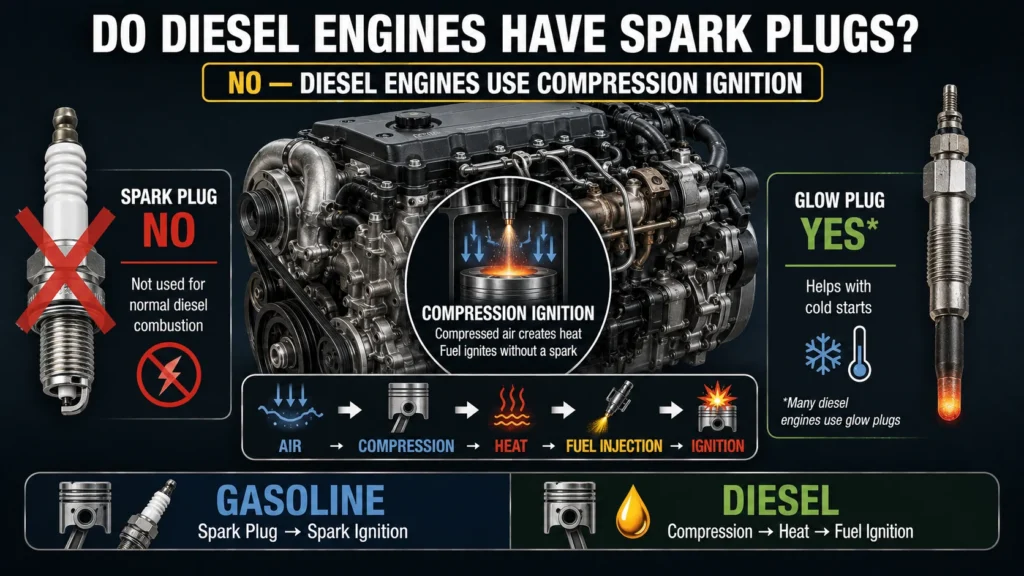
If you have ever looked under the hood of a diesel vehicle, you may have wondered, do diesel engines have spark plugs? The short answer is no. Diesel engines use compression ignition, which means the heat created by compressing air inside the cylinder ignites the injected diesel fuel.
Many diesel engines do have glow plugs, but they serve a different purpose. They help with starting a cold engine rather than creating the spark used by a gasoline engine.
Quick Answer
Diesel engines do not use spark plugs for normal combustion. Instead, they compress air until it becomes hot enough to ignite diesel fuel when it is injected into the cylinder. Many diesel engines use glow plugs to help with cold starts, but a glow plug is a heating element, not a spark plug.
Do Diesel Engines Have Spark Plugs?
No, diesel engines do not have spark plugs for their normal combustion process.
This is one of the main differences between diesel and gasoline engines. A gasoline engine uses spark ignition, where a spark plug creates an electrical spark to ignite the air-fuel mixture.
A diesel engine uses compression ignition. It compresses air to a high pressure, which raises its temperature. Diesel fuel is then injected into this hot compressed air, causing the fuel to ignite without an electrical spark.
So if you are asking, do diesels have spark plugs, the simple answer is no.
Why Don’t Diesel Engines Use Spark Plugs?
The main reason is the way diesel fuel is ignited.
In a gasoline engine, the fuel and air mixture needs an outside ignition source. The spark plug supplies that spark at the right point in the combustion cycle.
A diesel engine takes a different approach. It draws air into the cylinder and compresses it heavily. This compression makes the air very hot. When the fuel injector sprays diesel into the hot compressed air, the fuel can ignite on its own.
That process is called compression ignition.
Because the heat needed for ignition comes from compressed air, a diesel engine does not need a spark plug to start combustion.
How Does a Diesel Engine Ignite Fuel?

I find the easiest way to understand diesel ignition is to look at the process step by step.
1. Air Enters the Cylinder
During the intake stroke, the engine draws air into the cylinder.
Unlike a traditional gasoline engine, the diesel engine does not need to bring a premixed air-fuel charge into the cylinder for this process.
2. The Piston Compresses the Air
The piston moves upward and compresses the air inside the cylinder.
This compression greatly increases the pressure and temperature of the air. The high compression ratio is a key part of diesel engine operation.
3. Diesel Fuel Is Injected
Near the end of the compression stroke, the fuel injector sprays a fine mist of diesel fuel into the hot compressed air.
Modern diesel fuel injection systems control the amount and timing of fuel very precisely.
4. The Fuel Ignites
The compressed air is hot enough to ignite the injected diesel fuel.
There is no spark plug firing across a gap. The fuel ignites because of the heat created by compression.
5. Combustion Pushes the Piston Down
The burning fuel creates expanding gases that push the piston downward.
That movement is transferred through the connecting rod and crankshaft, producing the mechanical energy used to move the vehicle.
6. Exhaust Gases Leave the Cylinder
The piston moves upward again and pushes the combustion gases out through the exhaust system.
The cycle then repeats.
What Are Glow Plugs?

Glow plugs are small electrical heating elements used in many diesel engines.
They are easy to confuse with spark plugs because both are installed in the engine and use electricity. Their jobs, however, are very different.
A spark plug creates a spark.
A glow plug creates heat.
A glow plug helps warm the combustion area so a cold diesel engine can start more easily. It does not replace the normal compression-ignition process.
This is why I would not describe glow plugs as diesel spark plugs. They perform a different job.
What Do Glow Plugs Do in a Diesel Engine?

Glow plugs are especially useful when the engine is cold.
When temperatures are low, the cold cylinder walls and intake air can absorb some of the heat created during compression. This can make it harder for the engine to reach the conditions needed for reliable ignition.
The glow plugs provide extra heat during the starting process. This helps the injected fuel ignite more reliably when the engine is cold.
Some modern diesel systems can also keep glow plugs operating for a short period after the engine starts. This can help support stable combustion while the engine warms up.
Glow Plugs vs. Spark Plugs
The names sound similar, but these parts work in very different ways.
| Feature | Glow Plug | Spark Plug |
| Common engine type | Diesel | Gasoline |
| Main job | Helps with cold starting | Ignites the air-fuel mixture |
| Creates a spark? | No | Yes |
| Produces heat? | Yes | Produces a spark and heat at the gap |
| Used for normal combustion? | No | Yes |
| Main ignition method | Compression ignition | Spark ignition |
| Cold-start role | Important in many diesel engines | Part of normal ignition |
The easiest way to remember the difference is this:
Spark plug = spark
Glow plug = heat
Diesel engine = compression ignition
Diesel vs. Gasoline Ignition

The difference becomes much clearer when you compare the two engine types.
Gasoline Engine
A gasoline engine generally uses spark ignition.
The engine brings air and fuel into the cylinder, compresses the mixture, and then uses a spark plug to ignite it at a precise time.
The spark plug receives high-voltage electricity and creates a spark across its electrode gap.
Diesel Engine
A diesel engine uses compression ignition.
The engine compresses air first. The compression raises the air temperature. Diesel fuel is then injected into the hot compressed air, where it ignites without a spark.
Here is the basic difference:
Gasoline: air + fuel → compression → spark → combustion
Diesel: air → high compression → fuel injection → ignition
That difference explains why diesel engines do not need traditional spark plugs.
Do All Diesel Engines Have Glow Plugs?
No. Glow plugs are common in many diesel engines, particularly modern passenger vehicles and light-duty applications, but the exact starting system depends on the engine design.
Diesel engines have used different cold-start systems over the years. Some designs rely more heavily on glow plugs, while others use different methods to assist starting.
So the safest answer is that many diesel engines have glow plugs, but not every diesel engine uses the exact same starting system.
Can a Diesel Engine Start Without Glow Plugs?
It depends on the engine and conditions.
A warm diesel engine may be able to start without functioning glow plugs because the engine and surrounding components are already warm.
Cold conditions make starting more difficult. If the engine depends on glow plugs for cold-start assistance, failed plugs can cause longer cranking, rough starting, or difficulty starting.
This is why a diesel that starts normally when warm but struggles on a cold morning may have a problem with its glow plug system or another part of the starting system.
What Happens When Glow Plugs Go Bad?

A failed glow plug does not mean the diesel engine suddenly needs a spark plug.
Instead, the engine may have trouble starting, especially when it is cold.
Possible signs include:
- Hard cold starts
- Longer cranking before the engine starts
- Rough running immediately after startup
- White or gray smoke during cold starts
- A glow plug warning light
- Poor cold-start performance
These symptoms can have other causes too. Battery condition, fuel delivery, compression, sensors, and other engine components can also affect diesel starting.
Do Glow Plugs Stay On After the Engine Starts?
They can, depending on the engine and its control system.
Modern diesel engines may continue operating the glow plugs for a short period after startup. This is sometimes called post-glow operation.
The goal is to help maintain stable combustion while the engine is still cold.
The exact operating time varies by vehicle, engine design, temperature, and control strategy. So I would not assume that glow plugs switch off immediately after the engine starts.
Do Diesel Engines Have an Ignition System?

Diesel engines do not use the same spark-based ignition system found in gasoline engines.
A gasoline engine needs components such as spark plugs and ignition coils to create and control the spark.
A diesel engine relies on compression ignition instead. Its electrical and electronic systems still control many important functions, including fuel injection, engine timing, sensors, and cold starting.
So saying a diesel has no spark ignition is more accurate than saying it has no electrical systems involved in starting and running.
Do Diesel Trucks Have Spark Plugs?
No, conventional diesel trucks do not use spark plugs to ignite diesel fuel.
The same basic compression-ignition principle applies to diesel cars, trucks, SUVs, buses, and other diesel-powered vehicles.
The engine compresses air, raises its temperature, and injects diesel fuel into the hot compressed air.
Some diesel trucks may have glow plugs or other cold-start equipment, depending on the engine design.
Why Do Diesel Engines Use High Compression?
High compression is central to diesel combustion.
When the piston compresses the air inside the cylinder, the air becomes much hotter. The engine then injects diesel fuel into this hot compressed air.
The higher compression used by diesel engines helps create the temperature needed for fuel ignition. The exact compression ratio varies by engine design.
This is one reason diesel engines are built differently from gasoline engines.
Do Diesel Engines Need Ignition Coils?
No, diesel engines do not need ignition coils to create sparks for normal combustion.
Ignition coils are used in spark-ignition engines to produce the high voltage needed by spark plugs.
A diesel engine does not need that spark because its fuel ignites through compression ignition.
A diesel can still have electrical components that control fuel injection, glow plugs, sensors, and other systems, but these are different from the spark-producing ignition system used by gasoline engines.
Can Diesel Engines Use Spark Plugs?
A conventional diesel engine does not need spark plugs for its normal combustion process.
A modified or specialized engine can use a different combustion system, but that is not how a standard diesel engine operates.
For a normal diesel vehicle, the key parts involved in ignition are the compressed air, fuel injector, diesel fuel, and the heat produced by compression.
Why Does a Diesel Need Glow Plugs if It Does Not Need Spark Plugs?
This is where a lot of confusion comes from.
A diesel engine does not need a spark to ignite fuel, but a cold engine may not create ideal ignition conditions quickly enough through compression alone.
Glow plugs add heat during the starting process. This makes cold starts more reliable.
Once the engine reaches operating temperature, normal compression ignition can maintain combustion without a spark.
Final Answer: Do Diesel Engines Have Spark Plugs?
No, diesel engines do not use spark plugs for normal combustion.
They use compression ignition. The piston compresses air until it becomes hot, and the fuel injector then sprays diesel fuel into that hot compressed air. The fuel ignites without a spark.
Many diesel engines use glow plugs to help with cold starts. A glow plug is a heating element, while a spark plug creates an electrical spark.
The simplest way to remember it is:
Gasoline engine = spark ignition
Diesel engine = compression ignition
Glow plug = cold-start heating aid
FAQs
Can a Diesel Engine Run With Bad Glow Plugs?
Yes, some diesel engines can continue running with bad glow plugs, especially after the engine is warm. Cold starting may become much harder.
How Long Do Glow Plugs Last?
Their service life varies by vehicle, engine, driving conditions, and glow plug design. They should be tested if cold-start problems or a glow plug warning appear.
Can Bad Glow Plugs Drain a Battery?
A glow plug problem does not normally drain a battery by itself, but repeated long cranking during difficult starts can put heavy strain on the battery.
Why Does a Diesel Smoke When Starting?
Cold combustion, fuel delivery problems, glow plug faults, and other engine issues can cause startup smoke. The color and amount of smoke can help narrow down the cause.
Do Diesel Engines Use Ignition Coils?
No, conventional diesel engines do not use ignition coils to create sparks. They rely on compression ignition instead.
Do Modern Diesel Engines Still Use Glow Plugs?
Yes, many modern diesel engines use glow plugs or another form of cold-start heating system. The exact setup depends on the engine.
Can a Diesel Start Without a Glow Plug?
Some diesel engines can start without functioning glow plugs when the engine is warm. Cold weather can make starting much harder if the glow plug system is not working.
Are Glow Plugs the Same as Spark Plugs?
No. A spark plug creates an electrical spark to ignite fuel. A glow plug is a heating element that helps a diesel engine start, especially when cold.