Skip to content
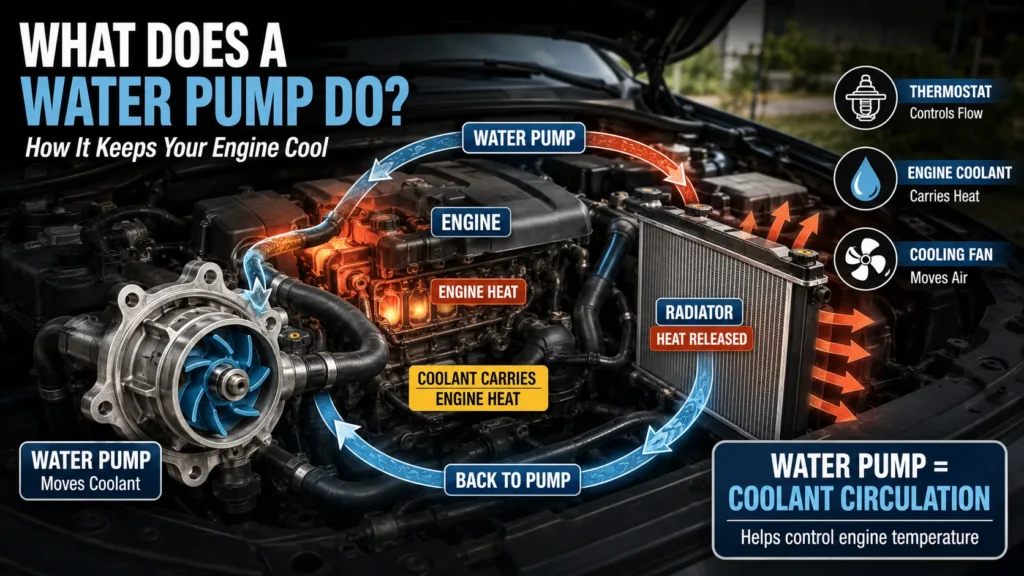
A car water pump keeps coolant moving through the engine and cooling system. The coolant picks up heat from the engine, travels to the radiator, releases that heat, and then returns to the engine. This constant flow helps keep the engine at a safe operating temperature.
Despite its name, a modern car water pump usually moves engine coolant, not plain water. The coolant is made to handle high temperatures and protect the cooling system from freezing and corrosion.
Quick Answer
A water pump circulates engine coolant through the engine, radiator, hoses, and other parts of the cooling system. The coolant absorbs heat from the engine and carries it to the radiator, where the heat is released. If the water pump stops moving coolant properly, the engine can overheat.
What Does a Water Pump Do in a Car?
The main job of a water pump is to move coolant through the engine cooling system.
Your engine creates a lot of heat while it runs. If that heat stays in the engine, temperatures can rise too far and damage important parts.
The water pump keeps the coolant moving so it can collect heat from the engine and carry it to the radiator. The radiator then removes much of that heat before the coolant returns to the engine.
I think of the water pump as the part that keeps the coolant moving. Without that movement, the rest of the cooling system cannot do its job properly.
How Does a Car Water Pump Work?

Most mechanical car water pumps use an impeller, which is a small wheel with blades inside the pump housing.
As the engine turns, the pump also turns. The spinning impeller moves coolant through the cooling passages, hoses, and radiator. Many mechanical water pumps are driven by a serpentine, accessory, or timing belt, depending on the vehicle.
The basic process looks like this:
Water Pump → Engine → Hot Coolant → Radiator → Cooled Coolant → Water Pump
This cycle continues while the cooling system is operating.
1. The Water Pump Moves Coolant
The pump’s impeller spins and pushes coolant through the cooling system.
The impeller uses centrifugal force to move the coolant through the pump and into the engine’s cooling passages.
2. Coolant Flows Through the Engine
The coolant moves through passages around the engine’s cylinders and other hot areas.
As it passes through these areas, it absorbs heat produced by the running engine.
3. Hot Coolant Travels to the Radiator
After picking up heat, the coolant travels through hoses toward the radiator.
The radiator is usually positioned near the front of the vehicle so air can pass through it as the car moves.
4. The Radiator Releases Heat
The hot coolant moves through the radiator while air passes across its fins.
This allows heat to leave the coolant and move into the surrounding air.
5. Cooled Coolant Returns to the Pump
After passing through the radiator, the coolant travels back through the cooling system.
The water pump then moves it through the engine again.
This repeated circulation helps control engine temperature.
What Parts Work With the Water Pump?

The water pump is just one part of the engine cooling system.
Several components work together to keep engine temperature under control.
| Component | Main job |
| Water pump | Circulates coolant |
| Engine | Transfers heat into the coolant |
| Thermostat | Controls coolant flow based on temperature |
| Radiator | Releases heat from the coolant |
| Cooling fan | Helps move air through the radiator |
| Hoses | Carry coolant between components |
| Coolant reservoir | Holds and manages coolant as its volume changes |
| Heater core | Uses hot coolant to provide cabin heat |
A problem with another component can sometimes look like a water pump problem. That is why I would not assume the pump is bad just because the engine is overheating.
Why Is the Water Pump Important?
The water pump helps prevent excessive engine heat from building up.
An engine needs to operate within a controlled temperature range. Too much heat can cause serious problems with components such as the cylinder head, head gasket, and engine block.
If coolant cannot circulate correctly, the engine may overheat. A severely overheated engine can suffer major damage, so a rising temperature gauge or overheating warning should not be ignored.
The water pump is therefore an important part of the cooling system, even though most drivers never see it while driving.
Where Is the Water Pump Located on a Car?
The exact location depends on the engine design.
On many vehicles, the water pump is mounted near the engine block and connected to a belt-driven system. On some engines, the pump may be driven by the timing belt or chain.
Electric water pumps can be mounted in different locations because they do not need a direct mechanical connection to the engine.
Because of these differences, I would not use one fixed location as a guide for every car.
If you need to locate the water pump on your vehicle, the engine design and service information for that specific model matter.
What Drives a Car Water Pump?

There are two main types of water pump drive systems you may find in modern vehicles.
Belt-Driven Water Pump
A traditional mechanical water pump is driven by the engine.
Depending on the vehicle, the pump may use:
- Serpentine belt
- Accessory belt
- Timing belt
- Timing chain
When the engine turns, the mechanical pump turns as well.
This means a problem with the belt or the pump itself can affect coolant circulation.
Electric Water Pump
Some vehicles use an electric water pump.
An electric pump has its own motor and does not depend directly on engine speed. This gives the vehicle more control over coolant circulation.
Electric coolant pumps can also continue operating independently of engine speed and, on some vehicles, may provide cooling after the engine is turned off.
This type of setup is more common in newer vehicles and some hybrid applications.
What Are the Signs of a Bad Water Pump?

A failing water pump can produce several warning signs.
However, these symptoms can also come from other cooling-system problems. I would treat them as clues rather than proof that the water pump has failed.
1. Engine Overheating
Overheating is one of the biggest warning signs.
If the pump cannot circulate coolant properly, the engine may not be able to get rid of heat efficiently.
Watch for:
- Temperature gauge moving into the hot range
- Overheating warning
- Steam from under the hood
- Sudden temperature increase
- Engine running hotter than normal
If the engine is overheating, I would stop driving and allow it to cool safely before checking anything.
2. Coolant Leak
A leaking water pump can leave coolant around the pump or beneath the vehicle.
A failed seal, gasket, or another damaged pump component can allow coolant to escape.
But a coolant leak does not automatically mean the water pump is the source.
Radiator hoses, the radiator, thermostat housing, heater components, and other parts can also leak.
3. Grinding or Whining Noise
A worn water pump bearing can create unusual noise.
You may hear:
- Grinding
- Whining
- Rumbling
- Squealing
The sound may change as engine speed changes.
A strange noise from the belt or water-pump area deserves attention because the noise may come from the pump, belt, pulley, or another accessory.
4. Temperature Fluctuations
A temperature gauge that moves up and down more than usual can point to a cooling-system problem.
A failing pump can reduce coolant circulation, but a thermostat, low coolant level, trapped air, or another cooling-system fault can create similar symptoms.
5. Poor Cabin Heat
Your vehicle’s heater uses hot engine coolant to warm the air entering the cabin.
If coolant is not circulating correctly, the heater may produce less heat than normal.
Poor cabin heat alone does not prove that the water pump is bad. Low coolant and other cooling-system problems can cause the same issue.
6. Coolant Smell or Residue
A coolant leak can leave a noticeable smell or dried residue around the affected area.
If you notice coolant loss along with overheating or an unusual engine noise, I would have the cooling system checked rather than simply adding coolant and continuing to drive.
Can a Bad Water Pump Cause a Car to Overheat?
Yes.
A water pump that cannot circulate coolant properly can cause engine temperature to rise.
The engine creates heat continuously while running. The coolant needs to move through the engine and radiator so that heat can be transferred away.
If coolant circulation is seriously reduced, the cooling system may not remove enough heat. Overheating can then occur.
But there is an important point here: an overheating engine does not automatically mean the water pump is bad.
Other possible causes include:
- Low coolant
- Coolant leak
- Stuck thermostat
- Blocked radiator
- Failed cooling fan
- Air trapped in the cooling system
- Damaged hose
- Other cooling-system faults
A proper diagnosis should check the whole system.
Can a Water Pump Fail Without Leaking?
Yes.
A water pump can develop mechanical problems without producing an obvious puddle.
For example, the pump bearing can wear out, the impeller can become damaged, or a pump driven by a belt can have a drive-related problem. Electric pumps can also develop electrical or motor faults.
This is why I would not use the absence of a coolant leak as proof that the pump is healthy.
If the engine overheats or the pump area makes an unusual noise, further inspection may be needed.
How Do I Know If My Water Pump Is Bad?
There is no single quick check that confirms every water pump failure.
I would start with the basic signs:
- Check whether the engine is overheating.
- Check the coolant level only when the engine is safely cool.
- Look for signs of coolant leakage.
- Listen for unusual noise from the pump or belt area.
- Check for unusual temperature changes.
- Look at the condition of the drive belt where applicable.
- Have the cooling system tested if the cause is not obvious.
A mechanic may use additional tests to locate a leak or check coolant-system operation.
The key point is that water pump symptoms can overlap with other cooling-system problems.
Does the Water Pump Run All the Time?
It depends on the type of pump.
A mechanical water pump is connected to the engine through a belt or other drive system, so it operates as the engine runs. Its speed is related to engine operation.
An electric water pump works differently.
The vehicle can control an electric pump separately from engine speed. Depending on the design, it can run only when cooling is needed and may continue operating after the engine is turned off.
So there is no single answer that applies to every vehicle.
Does the Water Pump Use Water or Coolant?
Modern vehicles normally use engine coolant, not plain water.
Coolant contains water along with antifreeze and other additives. It is made to help manage temperature and protect cooling-system components.
Using plain water may be appropriate only as a temporary emergency measure in some situations, but it should not replace the correct coolant mixture for normal vehicle operation.
Always use the coolant type specified for your vehicle.
Can a Water Pump Affect the Heater?
Yes.
The heater uses hot engine coolant to transfer heat into the cabin.
If coolant circulation is poor, the heater may not receive enough hot coolant. This can result in weak or inconsistent cabin heat.
However, poor heater performance can have several causes, including low coolant, air in the cooling system, a thermostat issue, or a heater-core problem.
Can a Water Pump Make a Whining Noise?
Yes.
A worn bearing or another mechanical problem can cause a whining, grinding, or rumbling sound from the water-pump area.
The sound may become more noticeable as engine speed increases.
Because other belt-driven components can make similar sounds, the noise should be checked rather than automatically blamed on the water pump.
Can Low Coolant Damage a Water Pump?
Low coolant can create problems for the cooling system and may contribute to poor cooling performance.
If coolant is low, I would look for the reason rather than simply topping it off repeatedly.
A leak may be present, and continued coolant loss can eventually lead to overheating.
Can a Bad Thermostat Look Like a Bad Water Pump?
Yes.
Both problems can interfere with engine temperature control.
A thermostat controls coolant flow based on temperature, while the water pump circulates the coolant.
If either component has a problem, you may see overheating or unusual temperature behavior.
That is why testing the complete cooling system is better than replacing the water pump based on one symptom.
Can You Drive With a Bad Water Pump?
I would avoid driving a vehicle that has a confirmed bad water pump, especially if the engine is overheating or losing coolant.
Continuing to operate an overheating engine can turn a cooling-system repair into a much larger engine repair.
If the temperature gauge reaches the hot zone or an overheating warning appears, pull over safely and shut the engine off.
Do not open a hot cooling system because pressurized coolant can cause serious burns.
How Long Does a Car Water Pump Last?
There is no single service life that applies to every water pump.
The lifespan depends on the vehicle, pump design, coolant condition, belt system, driving conditions, and maintenance.
Some water pumps last well over 100,000 miles, while others may need replacement earlier. The vehicle manufacturer’s maintenance schedule and the condition of the actual pump are more useful than one universal mileage number.
If the pump is driven by a timing belt, its replacement may also be considered when the timing belt is serviced, depending on the vehicle’s maintenance procedure.
How Much Does Water Pump Replacement Cost?
The cost can vary widely from one vehicle to another.
The biggest factors include:
- Vehicle make and model
- Pump location
- Pump type
- Labor time
- Belt or chain access
- Replacement parts
- Related components that need service
A water pump that is easy to reach can require much less labor than one located behind a timing-belt system.
That is why I would not use one average price as a reliable estimate for every car.
What Can Cause a Water Pump to Fail?
Several problems can eventually damage a water pump.
Common causes include:
- Worn bearings
- Damaged seals
- Coolant leaks
- Damaged impeller
- Corrosion
- Poor coolant condition
- Belt problems
- Electrical faults in electric pumps
- Incorrect installation
Technical sources also identify impeller damage, bearing or seal failure, corrosion, cavitation, and electrical faults as possible causes of coolant-pump failure.
Regular cooling-system maintenance can help reduce some of these problems.
Water Pump vs. Thermostat: What’s the Difference?
The two parts have different jobs.
The water pump moves coolant.
The thermostat controls coolant flow based on engine temperature.
A simple way to separate them is:
| Part | Job |
| Water pump | Moves coolant |
| Thermostat | Controls when and how coolant flows through the radiator |
| Radiator | Removes heat from coolant |
| Cooling fan | Moves air through the radiator |
| Coolant | Carries heat away from the engine |
If the car overheats, any of these components may deserve inspection.
Water Pump vs. Radiator: What’s the Difference?
The water pump and radiator work together, but they do different things.
The water pump moves the coolant.
The radiator removes heat from the coolant.
The pump keeps the fluid moving through the system, while the radiator gives that hot coolant a place to release heat into the surrounding air.
A problem with either component can lead to overheating.
What Happens When a Water Pump Stops Working?

When the water pump stops circulating coolant properly, heat can build up inside the engine.
The exact result depends on the pump design and the type of failure.
A mechanical pump may stop working because of a seized bearing, damaged impeller, broken drive system, or another mechanical problem. An electric water pump can stop because of an electrical or motor fault.
The main concern is the same: poor coolant circulation can cause the engine to overheat.
If you notice rapid temperature rise, an overheating warning, or other serious cooling-system symptoms, stop driving and allow the vehicle to cool safely.
Final Takeaway
The water pump is responsible for circulating coolant through the engine and cooling system.
The coolant absorbs heat from the engine, travels to the radiator, releases that heat, and then returns through the system. The water pump keeps this cycle moving so the engine can maintain a controlled operating temperature.
If a water pump starts failing, you may notice overheating, coolant loss, unusual noises, or other cooling-system problems. These signs can also come from other components, so I would not diagnose a bad water pump from one symptom alone.
If your car is overheating, losing coolant, or making an unusual noise from the engine area, deal with the problem promptly. A small cooling-system fault can become a much bigger engine problem if the vehicle continues running while overheated.
FAQs
Does every car have a water pump?
Yes. Most gasoline and diesel vehicles have a water pump or coolant pump, although the design can vary. Some newer vehicles use electric water pumps instead of traditional belt-driven pumps.
Can a water pump affect fuel economy?
Yes, but usually indirectly. If a cooling-system problem causes the engine to run at the wrong temperature, engine efficiency can suffer. A failing water pump should be checked if you also notice overheating or other cooling problems.
Can a water pump cause a check engine light?
It can in some vehicles, especially if a cooling problem causes the engine temperature to move outside its expected range. However, a check engine light does not automatically mean the water pump is faulty.
Does a new water pump need new coolant?
Usually, yes. Replacing a water pump often requires draining some or all of the coolant. The cooling system may then need to be refilled and properly bled to remove trapped air.
Can air in the cooling system cause water pump problems?
Air trapped in the cooling system can interfere with coolant circulation and cause temperature problems. It can also make symptoms look similar to a failing water pump.
Can a water pump affect engine performance?
A failing water pump can affect engine performance if it causes the engine to overheat. Severe overheating can lead to reduced performance and potentially serious engine damage.
Can a water pump cause coolant to disappear without a puddle?
Yes. A small leak may evaporate or leave residue before a visible puddle forms. Coolant loss can also come from other parts of the cooling system, so the source should be checked.
Does changing the water pump require changing the thermostat?
Not always. Some repairs include thermostat replacement because the parts are located near each other or because the thermostat is due for service. The exact recommendation depends on the vehicle.
Can a water pump make the engine run too cold?
A water pump problem is more commonly linked with poor cooling and overheating. An engine that runs too cold is more often associated with a thermostat that remains open or another temperature-control problem.
Can a water pump fail suddenly?
Yes. A bearing, seal, impeller, belt, or electrical component can fail with little warning. Other pumps may show gradual signs such as noise, coolant loss, or rising engine temperature before complete failure.