Skip to content

If you check your coolant reservoir and notice the level is lower than it was before, it is easy to wonder, does antifreeze evaporate? Hot weather can make that question even more confusing.
The short answer is that coolant should not disappear quickly from a properly sealed cooling system. The water in the coolant mixture can evaporate in some conditions, but noticeable or repeated coolant loss is more often linked to a leak, pressure problem, overheating, or another cooling system fault.
Quick Answer: Does Antifreeze Evaporate?
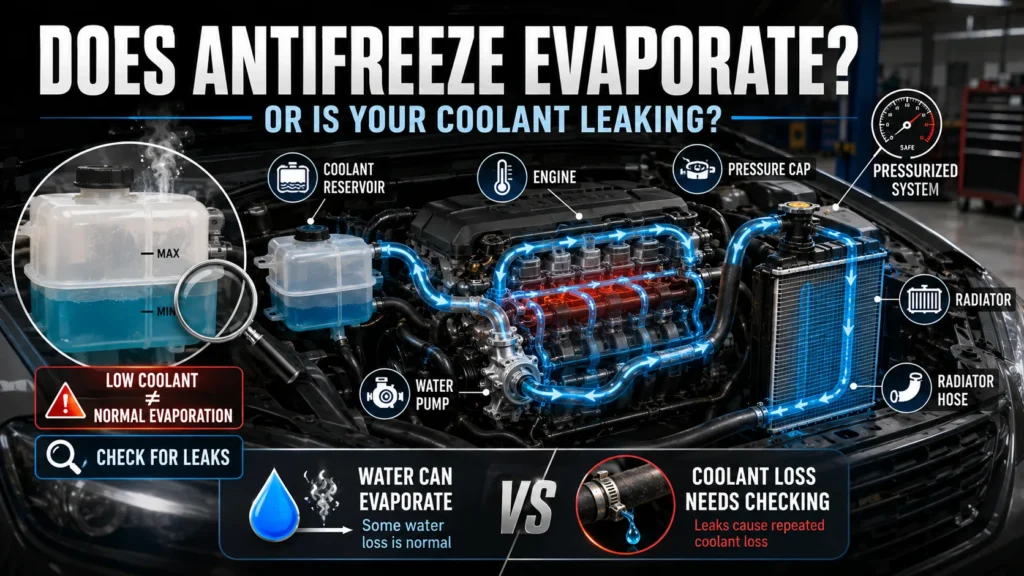
Antifreeze does not normally evaporate away in large amounts from a properly sealed car cooling system. Engine coolant contains water and glycol-based antifreeze, and the system is built to keep this mixture contained. If the coolant level keeps dropping, I would look for a leak or another cooling system problem instead of assuming it is simple evaporation.
What Is Antifreeze and Engine Coolant?
Antifreeze and coolant are related, but they are not always the same thing.
Antifreeze is the concentrated fluid that helps protect the cooling system from freezing, boiling, and corrosion. Engine coolant is usually a mixture of antifreeze and water that circulates through the engine and radiator.
Many vehicles use a roughly 50/50 mixture, but the correct ratio depends on the vehicle and coolant product. Always follow the owner’s manual or coolant manufacturer’s instructions.
The coolant has several jobs:
- Carry heat away from the engine
- Help prevent freezing in cold weather
- Raise the boiling point of the mixture
- Protect metal parts from corrosion
- Help keep the water pump and other cooling system parts working properly
So when I talk about coolant loss, I am talking about the fluid mixture inside the vehicle’s cooling system.
Does Engine Coolant Evaporate in Hot Weather?

This is where the answer needs some detail.
The water portion of coolant can evaporate when exposed to the air. Glycol-based antifreeze is much less likely to evaporate under normal vehicle operating conditions.
Your car also does not leave the coolant sitting in an open container. The cooling system is built as a contained system, and many systems operate under pressure. That pressure helps raise the boiling point of the coolant.
Because of this, hot outdoor temperatures alone should not cause a healthy cooling system to lose a noticeable amount of coolant.
If you find yourself adding coolant again and again during summer, I would not assume the heat is simply making it disappear. A leak, faulty cap, overheating, or another fault may be allowing coolant to escape.
Why Doesn’t Coolant Normally Evaporate From a Car?

The cooling system is built to keep coolant inside the engine, radiator, hoses, and related components.
As the engine warms up, the coolant expands. Depending on the vehicle, excess coolant moves into a reservoir or expansion tank. As the engine cools, the fluid contracts and can be drawn back into the cooling system.
This means the coolant level can look different when the engine is hot compared with when it is cold.
That is one reason I would always check the coolant level under the conditions listed in the owner’s manual, usually with the engine cold.
The Role of the Radiator Cap
The radiator cap or pressure cap is more than a simple cover.
It helps control pressure inside the cooling system. When the pressure reaches the cap’s set point, the system can direct coolant toward the recovery or expansion tank.
If the cap is damaged or cannot hold the correct pressure, coolant may escape earlier than it should.
A bad cap can therefore cause coolant loss without leaving a large puddle under the car.
Why Pressure Matters
Pressure raises the boiling point of a liquid.
The cooling system uses this principle to help keep coolant in liquid form while the engine is operating at high temperatures. The coolant mixture also contains glycol, which gives it a higher boiling point than plain water.
This does not mean coolant can never become vapor. A cooling system that is overheating, leaking, or unable to maintain pressure can lose coolant as steam or vapor.
The key point is that a healthy cooling system should not need frequent top-offs because of normal heat.
How Much Coolant Loss Is Normal?

There is no single amount that applies to every vehicle.
Cooling systems, coolant mixtures, reservoir designs, temperatures, and service conditions vary. Some vehicles may also have a small change in reservoir level as the fluid expands and contracts.
What matters most is the pattern.
| Coolant level change | What I would do |
| Small change over a long period | Monitor the level |
| Level keeps dropping | Check for a cooling system problem |
| Level drops quickly | Stop and investigate |
| Low coolant plus overheating | Do not keep driving |
| Coolant smell with no puddle | Look for a hidden leak |
| Steam or visible coolant loss | Let the vehicle cool and have it checked |
A cooling system should not require constant refilling.
If you are adding coolant every few days or weeks, that is a much stronger warning sign than a small change over a long period.
Why Is My Coolant Disappearing?

If the coolant level keeps falling, there are several possible causes.
External Coolant Leak
An external leak is one of the most common reasons for coolant loss.
The leak can come from:
- Radiator hoses
- Hose clamps
- Radiator
- Water pump
- Thermostat housing
- Coolant reservoir
- Expansion tank
- Gaskets and seals
A large leak may leave a puddle under the vehicle. A small leak may leave only a stain or dried coolant residue.
Coolant can also land on a hot engine part and dry before it reaches the ground. That can make a leak much harder to spot.
Small Pressure-Only Leak
Some leaks appear mainly when the cooling system becomes hot and pressurized.
A hose connection may stay dry when the engine is cold but release a small amount of coolant once pressure rises.
That is why checking only for a puddle after the vehicle has been parked may not reveal the source.
Dried coolant residue around a hose connection, radiator, or other component can be an important clue.
Faulty Radiator or Reservoir Cap
A pressure cap that does not seal correctly can allow coolant to escape.
It may also cause the cooling system to lose pressure earlier than intended.
If the cap is damaged, cracked, or no longer seals properly, replacing it with the correct part may be necessary.
Water Pump Leak
The water pump moves coolant through the engine and cooling system.
A worn seal or gasket can allow coolant to escape. Depending on the vehicle, you may see coolant residue around the pump or notice coolant loss without an obvious puddle.
A failing water pump can also cause circulation problems, which may lead to overheating.
Radiator Leak
The radiator releases heat from the coolant before the fluid returns through the engine.
Corrosion, physical damage, cracked tanks, or damaged connections can cause coolant to leak.
A radiator leak may be easier to see when the system is hot and pressurized, but do not inspect or touch hot coolant.
Heater Core Leak
The heater core sits inside the passenger compartment and uses hot engine coolant to provide cabin heat.
A heater core leak may cause:
- A sweet coolant smell inside the car
- Fogging or a film on the windshield
- Damp carpet in some cases
- Low coolant levels
Because the heater core is inside the dashboard area, the leak may not create a puddle under the engine.
Internal Engine Leak
Coolant can also escape inside the engine.
A damaged head gasket, cracked cylinder head, or damaged engine block can allow coolant to enter areas where it should not be.
Possible warning signs include:
- White exhaust smoke or steam
- Sweet smell from the exhaust
- Repeated coolant loss
- Overheating
- Milky-looking engine oil in some cases
These signs can have other causes, so they should not be used alone to diagnose a head gasket problem.
Can Coolant Evaporate From a Leak Before It Reaches the Ground?

Yes, this can happen.
This is one reason a vehicle can lose coolant without leaving an obvious puddle.
Imagine a small leak near a hot part of the engine. A small amount of coolant can escape, contact a hot surface, and dry or turn into vapor before it reaches the ground.
This can leave behind dried residue instead of a wet spot.
A small pressure leak may also happen only when the engine is warm. By the time the vehicle is parked and cools down, the evidence may be difficult to see.
So if the coolant level is dropping but you cannot find a puddle, that does not automatically mean the coolant is simply evaporating inside the cooling system.
Signs Your Car Is Losing Coolant

A low coolant level is the most obvious clue, but it is not the only one.
Watch for these signs:
- Coolant reservoir level keeps dropping
- Sweet smell around the vehicle
- Sweet smell inside the cabin
- Dried coolant residue
- Wet areas around hoses or the radiator
- Steam from under the hood
- Engine temperature rising
- Overheating warning
- Heater blowing cool air when it should be warm
- White exhaust smoke or steam
- Visible coolant around the engine
One symptom by itself may not tell you what is wrong. A combination of symptoms gives you more useful information.
How to Check for Coolant Loss

I would start with a simple visual inspection, but safety comes first.
Check the Coolant Level When the Engine Is Cold
Never remove a radiator or pressure cap from a hot cooling system.
Hot coolant can be under pressure and may cause serious burns.
Let the vehicle cool completely, then check the coolant reservoir according to the instructions in your owner’s manual.
Look at the MIN and MAX marks if your vehicle has them.
Look for Visible Leaks
With the engine cold, inspect areas such as:
- Radiator hoses
- Hose connections
- Radiator
- Coolant reservoir
- Water pump area
- Thermostat housing
- Ground underneath the vehicle
Look for wet spots, stains, or dried residue.
Check Around the Water Pump
If coolant is leaking near the water pump, you may see residue or wetness around the pump area.
The exact location varies by vehicle, so use your vehicle’s service information when checking this component.
Look for Internal Leak Signs
If you cannot find an external leak but the coolant keeps dropping, an internal leak is one possibility.
White exhaust smoke, overheating, coolant contamination, or other symptoms may point to a more serious issue.
A proper diagnosis is needed before assuming the head gasket is the cause.
Get a Cooling System Pressure Test
A pressure test can help find leaks that are difficult to see during a normal inspection.
A technician pressurizes the cooling system and checks whether it can hold the required pressure.
This can help reveal leaks around hoses, the radiator, water pump, seals, and other components.
Does Hot Weather Cause Coolant to Disappear?
Hot weather can increase the stress placed on a vehicle’s cooling system, but a healthy system should not repeatedly lose coolant just because the outside temperature is high.
During hot weather, the engine and coolant operate at high temperatures. If the system has a weak hose, bad pressure cap, damaged component, or another fault, the extra heat can make the problem more noticeable.
This is why coolant loss may seem more common during very hot weather.
The heat may be exposing an existing problem rather than causing normal coolant to disappear through evaporation.
What Happens If Your Car Runs Low on Coolant?
Coolant removes heat from the engine.
When the coolant level becomes too low, the system may not be able to move heat away from the engine as it should.
That can lead to:
- Higher engine temperatures
- Overheating
- Poor cabin heat
- Temperature fluctuations
- Engine damage in severe cases
An overheating engine is not something I would ignore.
If the temperature gauge enters the hot range, a warning light appears, or you see steam, stop driving when it is safe to do so and let the vehicle cool.
Do not remove the radiator cap while the engine is hot.
Can You Drive With Low Coolant?
It depends on how low the level is and what the vehicle is doing, but driving with a serious coolant loss is risky.
If the coolant level is low and the engine is overheating, continuing to drive can cause severe engine damage.
If you find a low reservoir when the engine is cold, follow your vehicle manufacturer’s instructions for checking and adding the correct coolant.
If the level keeps dropping, adding more coolant only treats the symptom. The cause still needs to be found.
How to Prevent Coolant Loss

A few simple checks can help you catch cooling system problems early.
Check the Coolant Level
Check the reservoir at the interval recommended for your vehicle.
Always compare the level under similar conditions, such as when the engine is cold.
Use the Correct Coolant
Do not choose coolant only by its color.
Different vehicles can require different coolant formulas. Check the owner’s manual or vehicle manufacturer’s specifications.
Inspect Hoses and Connections
Look for cracks, swelling, loose clamps, wet areas, and dried residue.
Small leaks are easier to deal with before they become major leaks.
Watch the Temperature Gauge
A rising temperature gauge can be an early warning that the cooling system is struggling.
Do not wait for an overheating event before checking the system.
Pay Attention to Smells
A sweet smell around the engine or inside the cabin can be a clue that coolant is escaping.
It does not prove the exact source, but it is worth investigating.
Does Antifreeze Evaporate Faster Than Water?
Water generally evaporates more readily than glycol-based antifreeze.
That matters because engine coolant is usually a mixture rather than pure antifreeze.
However, the cooling system keeps this mixture contained and operates under conditions that greatly reduce ordinary evaporation.
So I would not use water evaporation as the main explanation for a coolant reservoir that repeatedly drops.
If the level keeps falling, look for the reason.
Does Coolant Evaporate When the Car Is Parked?
Coolant can lose some water to evaporation if it is exposed to air, but the cooling system is designed to keep the fluid contained.
If a parked vehicle repeatedly loses coolant, especially by a noticeable amount, I would check for a leak, damaged cap, overflow problem, or another cooling system fault.
The fact that the car is parked does not make repeated coolant loss normal.
Can a Coolant Reservoir Lose Fluid Without a Radiator Leak?
Yes.
The radiator is only one part of the cooling system.
Coolant can escape through:
- Hoses
- Water pump
- Thermostat housing
- Reservoir
- Pressure cap
- Heater core
- Engine gaskets
- Other cooling system connections
That is why finding a low reservoir does not automatically mean the radiator is leaking.
Why Is My Coolant Level Higher When Hot?
Coolant expands as it gets hotter.
That is why the level in the reservoir can rise when the engine reaches operating temperature and fall again after it cools.
For an accurate level check, follow the vehicle manufacturer’s instructions and use the specified cold or hot reference marks.
Do not remove a pressure cap from a hot system just to check the level.
Why Does My Coolant Level Drop After the Engine Cools?
Some vehicles use a recovery or expansion system that allows coolant to move between the engine cooling system and reservoir as temperatures change.
When the engine cools, the coolant contracts.
If the level drops significantly below the expected mark after cooling, especially over repeated drives, check for a leak or other cooling system issue.
Can a Bad Thermostat Cause Coolant Loss?
A thermostat controls coolant flow based on engine temperature.
A thermostat problem does not usually cause coolant to disappear by itself, but it can contribute to overheating or abnormal cooling system operation.
If coolant is also disappearing, I would look for a leak or another problem rather than blaming the thermostat alone.
Can Low Coolant Cause the Heater to Blow Cold Air?
Yes, it can.
The cabin heater depends on hot engine coolant flowing through the heater core.
If the coolant level is too low or coolant circulation is poor, the heater may blow cool or inconsistent air.
This can be one clue that the cooling system needs attention.
Should I Add Water If My Coolant Is Low?
Use the correct coolant mixture specified for your vehicle whenever possible.
Adding plain water may be acceptable as a temporary emergency measure in some situations, but it can change the coolant mixture and reduce the protection the system needs.
Check your owner’s manual for the correct procedure and coolant type.
Final Answer: Does Antifreeze Evaporate?
So, does antifreeze evaporate?
The simple answer is that coolant can lose some water as vapor under certain conditions, but a properly functioning vehicle should not regularly lose a noticeable amount of coolant through ordinary evaporation.
If your coolant level keeps dropping, I would treat that as a reason to inspect the cooling system.
Look for leaks around the radiator, hoses, water pump, thermostat housing, reservoir, and pressure cap. If you cannot find an external leak, a pressure test can help locate a hidden problem.
Most importantly, do not ignore low coolant or an overheating engine. A small cooling system problem can become a much more serious engine problem if it is left alone.
FAQs
Can old antifreeze evaporate?
Old antifreeze can lose some water over time, but significant fluid loss usually needs further checking.
Does coolant evaporate overnight?
A properly sealed cooling system should not lose noticeable coolant overnight through normal evaporation.
Can a loose coolant cap cause coolant loss?
Yes. A loose or faulty cap can let coolant escape and prevent the system from holding the correct pressure.
Can a coolant flush cause the level to drop?
Yes. Trapped air can leave the system after service, causing the coolant level to fall slightly.
Does coolant evaporate faster with a bad radiator cap?
It can. A faulty cap may allow coolant to escape as vapor or overflow because the system cannot maintain proper pressure.
Can coolant disappear without overheating?
Yes. A small leak can cause coolant loss before the engine starts overheating.
Does coolant evaporate from the overflow tank?
Some water loss can occur if the tank is exposed to air, but repeated drops usually need investigation.
Can a cracked coolant reservoir cause coolant loss?
Yes. A cracked reservoir can slowly leak coolant, especially as the fluid heats and expands.
Can low coolant cause engine damage?
Yes. Low coolant can reduce heat transfer and increase the risk of overheating and engine damage.