Skip to content
If you are planning to tint your car windows, the first question is usually simple: how much will it cost?
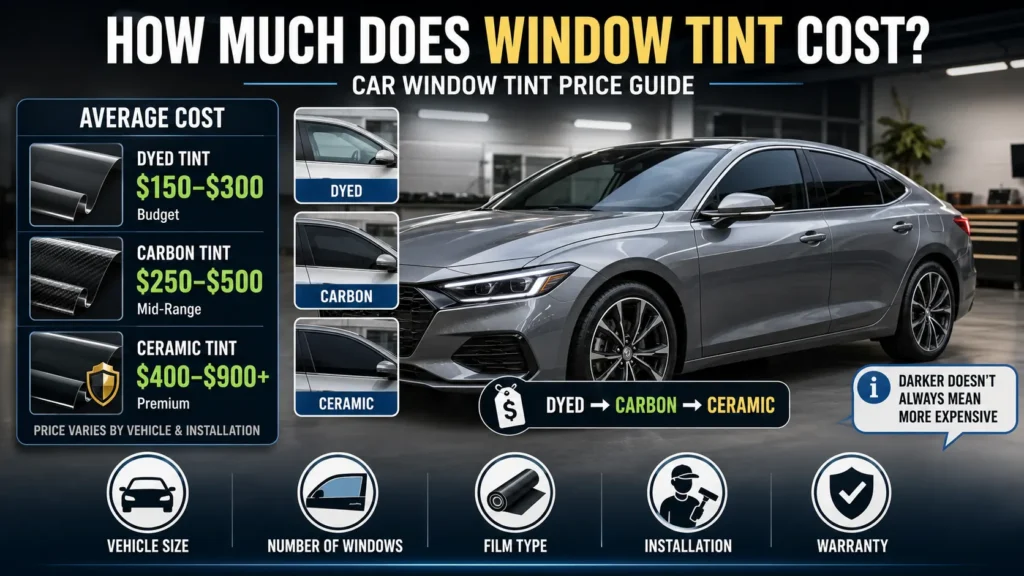
Professional car window tinting can cost roughly $150 to $900 or more, depending on the film, vehicle size, number of windows, installation quality, and extra services. A basic dyed tint usually costs less, while ceramic and premium ceramic films can push the price much higher.
I would not compare tint quotes by price alone. Two shops can quote very different amounts for the same car because they may be using different films, warranties, installation methods, or coverage.
Quick Answer
Professional car window tinting usually costs about $150 to $900+ in the U.S. A basic sedan with dyed film may cost around $150 to $300, while carbon tint often falls around $250 to $500 and ceramic tint can reach $400 to $900 or more. Larger vehicles, old tint removal, windshield work, and premium films can increase the final price.
How Much Does Window Tint Cost?
There is no single window tint cost that applies to every vehicle.
For a standard professional installation, these ranges are useful starting points:
| Tint job | Typical price range |
| Two front windows | 80–200 |
| Small coupe | 150–400 |
| Sedan | 200–500 |
| SUV or crossover | 250–600 |
| Truck or van | 250–900 |
| Premium ceramic installation | 500–1,000+ |
| Luxury or complex vehicle | 800–1,500+ |
These are planning ranges rather than fixed national prices. Current U.S. pricing guides show wide differences based on film, vehicle, glass coverage, and shop.
The biggest mistake I see in price comparisons is treating every tint job as the same service. A quote for two front windows is very different from a full SUV with ceramic film, and neither may include the windshield.
Average Car Window Tint Cost by Film Type

Film type is one of the biggest factors behind the price.
Here is a simple comparison:
| Film type | Sedan | SUV/Truck | General position |
| Dyed | 150–300 | 200–400 | Budget |
| Carbon | 250–450 | 300–600 | Mid-range |
| Ceramic | 400–800 | 500–1,000+ | Premium |
| Premium ceramic | 600–1,100+ | 750–1,500+ | High-end |
The exact numbers vary by film brand, installer, vehicle, and location. Current U.S. pricing sources show similar tiering, with ceramic consistently costing more than dyed and carbon films.
Dyed Window Tint
Dyed window tint is usually the least expensive option.
It can give your car a darker appearance, improve privacy, and reduce some glare. It is a common choice for drivers who mainly want the look of tinted windows without spending a large amount.
If your main goal is keeping the initial window tint cost low, dyed film is usually where I would start comparing prices.
The tradeoff is that lower-cost dyed films may not provide the same heat control or long-term performance as higher-grade films.
Carbon Window Tint
Carbon tint sits in the middle of the usual price range.
It can offer better heat control and color stability than many basic dyed films while avoiding the higher price of ceramic.
For someone who wants a balance between cost and performance, carbon film can make sense.
Ceramic Window Tint
Ceramic window tint is usually much more expensive.
It uses ceramic particles rather than relying mainly on dye. Premium ceramic films are marketed for stronger heat rejection, UV protection, glare reduction, and long-term performance.
Current pricing guides commonly place ceramic installations around the $400 to $900 range for many sedans, with larger vehicles and premium films costing more.
If you live in a hot, sunny area or spend a lot of time driving, I would compare ceramic quotes carefully rather than automatically choosing the cheapest film.
Premium Ceramic or Nano-Ceramic Tint
Premium ceramic and nano-ceramic products can sit at the top of the price range.
Some current U.S. pricing estimates put premium ceramic installations well above $1,000 for larger or complex vehicles.
At this level, the film brand, product series, warranty, installer experience, and exact vehicle matter a lot.
How Much Does It Cost to Tint Different Types of Vehicles?

The vehicle affects the amount of film required and the amount of labor involved.
Coupe
A coupe often costs less because it has fewer side windows.
A full job may fall around $150 to $400, depending on film and the rear glass shape.
Sedan
A typical sedan may cost about $200 to $500 for a professional full-car installation.
A basic dyed film will usually sit near the lower end, while ceramic can push the quote much higher.
SUV or Crossover
SUVs generally cost more because they often have more glass.
A reasonable starting range is $250 to $600, although premium ceramic work can go above $1,000.
Truck
A truck may cost around $250 to $900, depending on cab size, rear glass, film type, and coverage.
A crew-cab truck with several windows can require much more film and labor than a smaller two-door pickup.
Van or Minivan
Vans and minivans can sit at the higher end because they often have many windows.
A full job can reach $300 to $650 or more, with premium film pushing the price higher.
How Much Does It Cost to Tint Two Front Windows?

If you only want the two front windows tinted, you do not need to pay for a full-car installation.
A common planning range is around $80 to $200 for two front windows, although local prices can be higher or lower.
The price depends on:
- Film type
- Vehicle model
- Glass shape
- Installer
- Local labor rates
- Warranty
- Existing tint removal
Before booking, ask whether the quote includes both windows, installation, film, and any taxes or fees.
What Factors Affect Window Tint Cost?

Several things can change your final car window tint cost.
Film Type
This is one of the biggest factors.
Dyed film usually costs the least. Carbon sits in the middle, while ceramic and premium ceramic films can cost considerably more.
Vehicle Size
A larger vehicle generally has more glass to cover.
That means more material and more installation time.
Number of Windows
A full tint job can include different combinations of side windows and rear glass.
Some shops price a package, while others price individual windows.
Always ask exactly which windows are included.
Glass Shape and Complexity
A simple flat window is easier to work on than a large curved rear windshield.
Small quarter windows, steep curves, deep gaskets, and unusual glass shapes can increase labor time.
Installer Experience
Installation quality matters.
A cheap film installed poorly can develop bubbling, peeling, uneven edges, or other problems. A higher quote may include better preparation, more experienced labor, and a stronger warranty.
Location
Window tint prices vary by city and region.
Labor rates, demand, competition, local regulations, and operating costs can all affect the price.
Warranty
A tint quote should tell you what the warranty covers.
Ask whether it covers:
- Bubbling
- Peeling
- Color change
- Film failure
- Installation defects
A longer warranty does not automatically mean better film, but it is useful when comparing similar products.
How Much Does Old Tint Removal Cost?
If your car already has tint, removing it can add to the bill.
A common planning range is around $50 to $200, depending on how much film needs to be removed and how difficult the adhesive is to clean.
Old tint that is bubbling, peeling, or turning purple may take more time to remove.
Ask whether tint removal is included before accepting a quote. Otherwise, a low installation price can become much higher after the shop sees the condition of the existing film.
How Much Does Windshield Tint Cost?
A full windshield installation is usually an extra service.
Current pricing guides commonly put full windshield tint around $150 to $350, although the actual cost depends on film type, vehicle, local rules, and installer.
A windshield sun strip is much cheaper because it covers only the upper section.
Expect a sun strip to cost roughly $50 to $100 in many markets.
Windshield tint also needs special attention because laws for front glass can be stricter than those for rear windows.
How Much Does Sunroof Tint Cost?
Sunroof and moonroof tint can add another $75 to $200 to the project.
Large panoramic roofs can cost more because they cover much more glass.
If your vehicle has a large glass roof, ceramic film may be worth comparing because reducing heat through that large glass area can make the cabin more comfortable.
Does Darker Tint Cost More?
Not necessarily.
The darkness of window tint is usually described by VLT, or Visible Light Transmission.
VLT tells you how much visible light can pass through the glass and film.
| VLT | General appearance |
| 70% | Very light |
| 50% | Light |
| 35% | Medium |
| 20% | Dark |
| 5% | Very dark |
A lower VLT number means darker tint.
A 20% film is darker than a 50% film. But a darker film does not automatically mean it costs more.
The film technology can have a much bigger effect on the price.
For example, a light ceramic film can cost more than a very dark dyed film.
What Does VLT Mean?

VLT stands for Visible Light Transmission.
It is the percentage of visible light that passes through the window.
For example, a 70% VLT film allows much more visible light through than a 20% VLT film.
This matters for two reasons:
- It changes how dark your windows look.
- It can affect whether the tint is legal on a particular window in your state.
Tint laws differ by state, and front side windows often have stricter limits than rear windows.
I would check your state’s current rules before choosing a film percentage.
Is Ceramic Tint Worth the Extra Cost?
For many drivers, ceramic tint can be worth the extra money, but it depends on what you want from the installation.
If you mainly want darker windows and privacy, a basic film may be enough.
If your priorities include heat control, UV protection, glare reduction, and long-term performance, ceramic is worth comparing.
The price difference can be substantial, so I would ask the installer what specific ceramic film they use rather than accepting the word ceramic as enough information.
A shop should be able to tell you:
- Film manufacturer
- Film series
- VLT
- Heat rejection information
- UV protection
- Warranty
- Total installed price
DIY vs Professional Window Tint
DIY tint kits can cost much less than professional installation.
But the lower price comes with a tradeoff.
| Factor | DIY | Professional |
| Initial cost | Lower | Higher |
| Installation skill | You provide it | Included |
| Tools | Usually extra | Included |
| Finish | Depends on skill | Usually more consistent |
| Warranty | Often limited | Often available |
| Time | Can take longer | Usually faster |
Installing tint looks easier than it is.
Dust, dirt, incorrect cutting, trapped moisture, creases, and poor edges can ruin the final result.
If you have never installed automotive window film before, I would compare the full DIY cost with a professional quote rather than looking only at the price of the film kit.
Why Are Some Window Tint Quotes So Different?
This is one of the most useful things to know before you buy.
Suppose one shop quotes $200 and another quotes $600.
That does not automatically mean the second shop is overcharging.
The two quotes may include completely different products.
The difference could come from:
- Dyed vs ceramic film
- Basic vs premium film
- Different film brands
- Different warranties
- Different vehicle coverage
- Tint removal
- Windshield work
- Installer experience
- Local labor rates
- Shop conditions
Current pricing guides show that film technology alone can create large differences between quotes.
This is why I would never ask only, “How much do you charge for tint?”
Ask, “Which film series is included in that price?”
That gives you a much better basis for comparison.
How to Compare Window Tint Quotes

Before choosing an installer, ask each shop the same questions.
1. What film is included?
Get the exact manufacturer and film series.
2. Which windows are included?
Make sure you know whether the quote includes:
- Front windows
- Rear windows
- Rear windshield
- Quarter windows
- Sunroof
- Windshield
3. What VLT will be installed?
Do not simply say you want dark tint.
Give the exact VLT you want, as long as it is legal for the window.
4. Is old tint removal included?
If your vehicle already has film, ask about removal before booking.
5. Is the warranty included?
Find out what the warranty covers and how long it lasts.
6. Are there extra charges?
Ask about:
- Taxes
- Removal
- Windshield work
- Sunroof work
- Mobile installation
- Special glass
- Large vehicles
7. How long will installation take?
Installation time can vary with vehicle design, number of windows, film, and shop workload.
Getting these details in writing makes different quotes much easier to compare.
How Long Does Window Tint Last?
Tint lifespan depends on the film, installation, sunlight exposure, climate, and care.
Basic dyed film generally has a shorter service life than higher-grade carbon or ceramic film.
Some current pricing guides place dyed films around a few years, carbon films around several years, and premium ceramic films at 10 years or more when properly installed.
These figures are estimates, not guarantees.
If a shop promises a specific lifespan, check whether it is referring to the film warranty or the expected service life.
Those are two different things.
Is Window Tint Worth the Cost?
For many car owners, yes.
Tint can provide:
- Reduced glare
- More privacy
- UV protection
- Better cabin comfort
- Reduced solar heat
- Protection for interior materials
- A different appearance
The value depends on your needs.
If you park outside in strong sun every day, heat reduction may matter more to you than appearance.
If you mostly want privacy, a basic film may do the job without the price of premium ceramic.
If you plan to keep the car for many years, paying more for a higher-grade film and professional installation may make more sense.
Should You Get Ceramic or Cheaper Tint?
I would make the decision based on your main goal.
Choose dyed tint if:
- You want the lowest initial cost
- Appearance and privacy are your main goals
- You do not need maximum heat rejection
Choose carbon if:
- You want a middle-ground option
- You want better performance than basic dyed film
- You want to keep the price below premium ceramic
Choose ceramic if:
- Heat reduction matters
- You drive in strong sun often
- You want premium film
- You plan to keep the vehicle for a long time
- The added cost fits your budget
There is no need to buy the most expensive tint simply because it is available.
Check Your State’s Window Tint Laws Before Installation
Before choosing your tint percentage, check the rules for your state.
Tint laws can set different limits for:
- Front side windows
- Rear side windows
- Rear windshield
- Windshield
- Reflectivity
- Tint colors
VLT is one of the main measurements used in these laws.
A film that is legal on a rear window may not be legal on a front side window.
I would tell the installer which state the vehicle is registered in and ask for a film that meets the current requirements.
Do not assume that a tint percentage legal in another state is legal where you live.
What Should a Good Window Tint Quote Include?
A good quote should make the scope clear.
At minimum, I would want to see:
- Vehicle make and model
- Exact windows being tinted
- Film manufacturer
- Film series
- VLT percentage
- Installation price
- Tint removal price, if needed
- Windshield or sunroof cost, if included
- Warranty details
- Any additional fees
This makes it much easier to compare a $250 quote with a $600 quote.
A lower price is useful only if you are comparing similar products and services.
Final Thoughts
So, how much does window tint cost?
For many professional car tinting jobs in the U.S., a reasonable starting budget is around $150 to $900+. Basic dyed film usually sits at the lower end, carbon film falls in the middle, and ceramic or premium ceramic can take the price much higher.
The vehicle, number of windows, film technology, installer, location, old tint removal, and optional windshield or sunroof work can all change the final price.
If I were comparing quotes, I would focus on the exact film and coverage first, then the price.
A $200 quote and a $600 quote are not necessarily competing products. Once you know what each quote includes, the better value becomes much easier to spot.
FAQs
How much does it cost to tint a single car window?
A single automotive window may cost roughly $40 to $100, depending on the vehicle, film, and installer.
Does factory privacy glass need window tint?
Not always. Factory privacy glass is part of the glass itself, while aftermarket tint is a film applied to the glass. You may still add film if you want additional heat or UV protection.
Can I tint over factory-tinted glass?
In many cases, yes, but the final darkness will change. Ask the installer to measure the existing glass and confirm the resulting VLT before installation.
Does window tint increase car resale value?
Tint may make a vehicle more appealing to some buyers, but it should not be treated as a guaranteed way to increase resale value. Installation quality and legal compliance matter.
Why are some tint shops much cheaper than others?
The difference may come from film quality, installer experience, warranty, shop overhead, vehicle coverage, and additional services. A low quote is not directly comparable with a premium ceramic quote.
Can window tint reduce air conditioning use?
Window tint can reduce solar heat entering the cabin, which may make it easier to keep the interior comfortable. How much difference you notice depends on the film, vehicle, weather, and parking conditions.
Does ceramic tint look different from dyed tint?
Both can be available in similar VLT levels, so the visual difference may be small. The bigger differences are in film construction, heat control, and other performance features.
Can old tint be removed without damaging the glass?
Professional removal can usually be done without damaging normal automotive glass, but old adhesive and difficult film can make the job more involved. Defroster lines and other glass features require extra care.
Does darker tint always block more heat?
No. Darkness and heat rejection are different things. A light-colored ceramic film can reject substantial heat without looking as dark as a basic film.
Is a cheap window tint worth it?
It can be if your main goal is basic privacy and appearance, but compare the film, warranty, installation quality, and expected lifespan before choosing based on price alone.