Skip to content
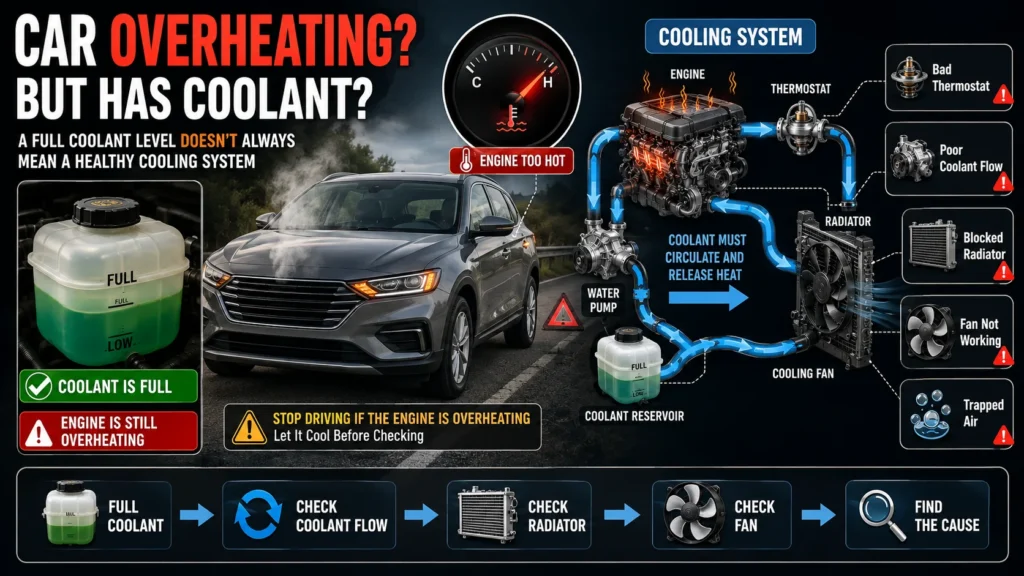
It can be confusing to see your car’s temperature gauge climb when the coolant reservoir looks full. I would not assume the coolant itself is the problem. A car can still overheat if the coolant cannot circulate, the radiator cannot remove heat, or another part of the cooling system has failed.
The key point is simple: having coolant is only one part of keeping an engine at a safe temperature. The coolant also needs to move through the engine and radiator, transfer heat, and work within a properly functioning cooling system.
Quick Answer
If your car is overheating but has coolant, the problem may be a bad thermostat, failing water pump, blocked radiator, faulty cooling fan, trapped air, bad radiator cap, restricted hose, coolant leak, or head gasket problem. A full coolant reservoir does not prove that coolant is circulating or that the cooling system is removing heat correctly.
Why Is My Car Overheating if I Have Coolant?

Coolant has to do more than simply sit inside the reservoir.
During normal operation, coolant moves through the engine and absorbs heat. It then travels to the radiator, where that heat is released. The thermostat controls when coolant flows through the radiator, the water pump moves the coolant, and the cooling fan helps move air through the radiator when natural airflow is limited.
If one of these parts stops working, the engine can overheat even though the coolant level looks normal.
That is why I would treat a full coolant reservoir as one clue, not proof that the cooling system is healthy.
Car Overheating but Coolant Is Full: Common Causes

1. A Bad Thermostat Is Restricting Coolant Flow
The thermostat controls coolant flow between the engine and radiator.
When the engine is cold, the thermostat stays closed so the engine can warm up. As the coolant reaches its operating temperature, the thermostat opens and allows coolant to flow through the radiator.
If the thermostat gets stuck closed or does not open properly, hot coolant cannot move through the radiator as it should. The engine can then become too hot even though the coolant reservoir is full.
A thermostat problem becomes more likely if the temperature rises quickly and stays high.
2. The Water Pump Is Not Circulating Coolant
The water pump moves coolant through the engine and radiator.
A failing pump may not circulate enough coolant. In some cases, the pump can have an internal problem without producing an obvious coolant leak.
A water pump problem can also come with unusual noises or coolant leakage, depending on how the pump has failed.
If the coolant is full but the engine keeps overheating, I would put the water pump on the list of parts that need to be checked.
3. The Cooling Fan Is Not Working
The radiator needs airflow to release heat.
When your car is moving, air naturally passes through the radiator. When you are sitting in traffic or idling, the cooling fan provides much of that airflow.
If the fan motor, relay, fuse, wiring, or temperature-control system has a problem, the fan may not run when it should. This can cause a car to overheat mainly while sitting still or moving slowly.
This is one of the first things I would consider if the car overheats in traffic but seems fine at highway speed.
4. The Radiator Is Blocked or Not Removing Enough Heat
The radiator transfers heat from the coolant to the surrounding air.
Over time, the radiator can develop internal restrictions. Dirt and debris can also block airflow through the radiator fins.
When heat cannot leave the coolant efficiently, engine temperature can continue to rise even when the coolant level is correct.
A radiator problem becomes more likely when overheating continues despite normal coolant levels and a properly working fan.
5. Air Is Trapped in the Cooling System
A cooling system can contain air even when the coolant reservoir looks full.
Air can enter after a coolant leak, cooling-system repair, coolant change, hose replacement, thermostat replacement, or other work that allows air into the system.
An air pocket can interfere with coolant circulation and create areas where heat is not carried away properly. Temperature fluctuations, gurgling sounds, and inconsistent heater performance can point toward trapped air.
Some vehicles require a specific procedure to remove air from the cooling system, so I would follow the vehicle’s service instructions rather than guessing at the process.
6. The Radiator Cap Is Not Holding Pressure
The radiator cap or cooling-system pressure cap has an important job.
It helps maintain the pressure the cooling system needs during normal operation. If the cap cannot hold the correct pressure, coolant can boil at a lower temperature and the system may not work as intended.
A bad cap can therefore contribute to overheating even when there appears to be enough coolant.
7. A Coolant Hose Is Restricted or Damaged
Coolant needs a clear path between the engine, radiator, thermostat, and other cooling-system components.
A damaged or internally restricted hose can interfere with coolant flow. Some hoses can also weaken and collapse under certain operating conditions.
If you see a damaged hose, coolant residue, swelling, cracks, or other obvious problems, the cooling system needs further inspection.
8. There Is a Coolant Leak You Cannot Easily See
A full reservoir does not rule out a coolant leak.
Some leaks are small and may happen only when the cooling system is hot and pressurized. Coolant can also leak onto hot components and evaporate before leaving an obvious puddle.
A recurring drop in coolant level, sweet coolant smell, wet areas, or visible residue can point toward a leak.
If you keep adding coolant but the car continues to overheat, I would not treat adding more coolant as the fix. The source of the coolant loss needs to be found.
9. A Head Gasket Problem Is Allowing Cooling-System Trouble
A head gasket problem can cause overheating even when coolant is present.
Possible warning signs include unexplained coolant loss, persistent white exhaust smoke, bubbling in the cooling system, milky engine oil, or repeated overheating. These signs can also have other causes, so they do not prove a head gasket has failed.
Because head gasket problems can lead to major engine damage, repeated overheating with these symptoms should be checked promptly.
10. The Temperature Sensor or Gauge Is Giving a False Reading
Not every overheating warning means the engine is actually at the temperature shown on the dashboard.
The temperature gauge depends on information from the vehicle’s temperature-sensing system. A sensor, wiring, or gauge problem can produce an inaccurate reading.
If the gauge says the engine is overheating but there are none of the other signs you would expect, such as steam, boiling sounds, or unusual heat, the temperature reading itself may need to be checked.
How to Tell Why Your Car Is Overheating

The way your car overheats can give you useful clues.
| What you notice | Possible area to check |
| Overheats mainly at idle | Cooling fan or airflow |
| Overheats in traffic | Cooling fan, radiator airflow |
| Overheats at highway speed | Coolant flow, radiator, thermostat, water pump |
| Temperature rises and falls | Thermostat or trapped air |
| Heater blows cold while engine is hot | Coolant circulation problem |
| Coolant keeps disappearing | External or internal leak |
| White exhaust smoke | Possible internal coolant leak |
| Bubbling or gurgling | Air, pressure, or combustion-gas problem |
| Overheats soon after cooling-system work | Possible trapped air or filling problem |
These clues do not give a final diagnosis by themselves. They help narrow down which parts deserve attention first.
Why Does My Car Overheat in Traffic but Not on the Highway?

If your car overheats in traffic but cools down once you start moving, I would look closely at the cooling fan and radiator airflow.
At higher speeds, air moves through the radiator naturally. At low speeds, the cooling fan has a much bigger role.
A failed fan motor, relay, fuse, wiring issue, or fan-control problem can therefore cause overheating at idle while the vehicle appears normal at highway speed.
This pattern does not prove the fan is bad, but it is a useful clue.
Why Does My Car Overheat While Driving?
Overheating while driving can point to a problem with coolant flow or the radiator’s ability to remove heat.
Possible causes include:
- Bad thermostat
- Weak or failed water pump
- Restricted radiator
- Restricted coolant hose
- Cooling-system pressure problem
- Trapped air
- Serious internal engine problem
A car that overheats at highway speed should not be ignored just because it does not overheat while sitting still.
Why Does the Temperature Go Up and Down?
A temperature gauge that moves from normal to hot and back again can have several causes.
Trapped air can cause inconsistent coolant flow. A thermostat that is sticking can also change how coolant moves through the radiator. A coolant circulation problem can produce similar behavior.
If the temperature keeps changing, I would avoid assuming that the problem will correct itself.
Why Is My Heater Blowing Cold Air While the Engine Is Overheating?
This combination deserves attention.
The cabin heater normally uses heat from the engine coolant. If the engine is overheating but the heater is blowing cold air, there may be a problem with coolant circulation or the amount of coolant actually reaching the heater system.
Possible causes include trapped air, low effective coolant flow, or another cooling-system problem.
I would not use the heater temperature alone to diagnose the problem, but it is a useful clue to mention during an inspection.
What Should I Do If My Car Is Overheating but Has Coolant?

If the temperature gauge moves into the danger zone or you receive an overheating warning, I would treat it as a real problem even if the coolant reservoir is full.
1. Pull over safely
Find a safe place to stop away from moving traffic.
2. Stop driving if the temperature remains too high
Continuing to drive an overheating engine can turn a cooling-system problem into serious engine damage.
3. Turn off the engine when appropriate
If the temperature is dangerously high, stop the engine and let the vehicle cool.
4. Do not open a hot radiator cap
A hot cooling system can be pressurized. Removing the cap too soon can release hot coolant or steam.
5. Let the engine cool
Give it enough time to cool before checking the cooling system.
6. Look for obvious signs after it cools
Check for visible coolant leaks, damaged hoses, and other obvious problems.
If the cause is not clear or the vehicle overheats again, I would arrange for a proper inspection rather than continuing to drive it.
Can You Drive a Car That Is Overheating but Has Coolant?
I would not keep driving a car that is actively overheating just because the coolant level is full.
A full coolant reservoir does not tell you whether the thermostat is opening, the water pump is circulating coolant, the radiator is releasing heat, or the cooling fan is working.
Continued overheating can cause serious engine problems, including head gasket damage and damage to other internal engine components.
If the temperature rises again after cooling down, the safer choice is to stop driving and have the problem diagnosed.
What Can I Safely Check After the Engine Cools?

Once the vehicle has cooled enough for a safe inspection, I would start with simple visual checks.
Check the coolant level
Look at the coolant reservoir and compare the level with the markings.
Do not remove a radiator or pressurized coolant cap while the system is hot.
Look for visible leaks
Check the ground underneath the vehicle and look around visible hoses and cooling-system components for signs of coolant.
Inspect the hoses visually
Look for cracks, swelling, damage, or obvious coolant residue.
Check for obvious radiator blockage
Look at the front of the radiator for dirt, leaves, or other debris that could restrict airflow.
Look for signs of repeated overheating
Pay attention to coolant loss, unusual smells, steam, temperature fluctuations, and other changes.
I would avoid touching hot hoses, fans, belts, or other engine components simply to test them.
When Should You Stop Driving and Get the Car Towed?
I would arrange a tow if:
- The temperature gauge reaches the red zone.
- Steam is coming from under the hood.
- Coolant is leaking heavily.
- The engine overheats again after cooling.
- The engine starts making severe or unusual noises.
- The vehicle loses power.
- You cannot find the cause of the overheating.
- The temperature keeps climbing while you drive.
- You suspect a serious cooling-system or engine problem.
A full coolant reservoir does not make an overheating vehicle safe to drive.
How Is a Car Overheating Problem Diagnosed?
A proper diagnosis starts with the symptoms and then checks the cooling system.
A technician may inspect:
- Coolant level
- Visible leaks
- Cooling-system pressure
- Thermostat operation
- Water pump operation
- Radiator condition
- Cooling fan operation
- Fan controls
- Coolant circulation
- Hoses
- Temperature sensor readings
- Signs of combustion gases entering the cooling system
The goal is to find why the engine is getting too hot, rather than simply replacing random parts.
That matters because several different cooling-system problems can produce similar symptoms.
Does Low Engine Oil Cause Overheating?
Low engine oil can contribute to excessive engine heat because oil helps lubricate and cool internal engine components.
If your car is overheating and the coolant level looks normal, I would also check the engine oil level according to the vehicle’s instructions.
This does not mean low oil is automatically the cause. It is simply another basic fluid level worth checking.
Can a Bad Thermostat Cause Overheating With Full Coolant?
Yes.
If the thermostat does not open correctly, hot coolant may not reach the radiator in the way it should.
The reservoir can still look full because the issue is coolant flow, not simply coolant quantity.
Can a Water Pump Fail Without Leaking Coolant?
Yes.
A water pump can have an internal failure that reduces coolant circulation without producing an obvious external leak.
A failed pump can therefore cause an overheating problem even when the coolant level looks normal.
Can a Bad Radiator Cap Cause Overheating?
Yes.
The pressure cap helps the cooling system maintain the correct pressure. If it cannot hold pressure properly, the cooling system may not manage heat as it should.
Why Is My Car Overheating but Not Losing Coolant?
If the coolant level stays steady, the problem may be related to circulation or heat removal rather than coolant loss.
Possible causes include:
- Thermostat failure
- Water pump problem
- Cooling fan failure
- Restricted radiator
- Trapped air
- Pressure problem
- Temperature-sensing fault
- Internal engine problem
The overheating pattern can help narrow down the cause.
Why Is My Car Overheating After Adding Coolant?
Adding coolant can correct a low-fluid problem, but it does not repair the reason the vehicle overheated.
If the system has trapped air, the thermostat is stuck, the water pump has failed, the fan is not working, or the radiator is restricted, the engine can continue to overheat after coolant is added.
If overheating returns soon after adding coolant, I would have the cooling system checked rather than continuing to top it off.
Is a Full Coolant Reservoir Enough?
No.
A full reservoir tells you that coolant is present at that location. It does not prove that the engine has proper coolant circulation, that the radiator is working, that the cooling fan is operating, or that the system is maintaining the correct pressure.
That is the main reason a car can be overheating but have coolant at the same time.
How Can I Prevent My Car From Overheating?
A few basic habits can help reduce cooling-system problems:
- Check the coolant level when the engine is cold.
- Use the correct coolant for your vehicle.
- Pay attention to the temperature gauge.
- Do not ignore coolant leaks.
- Check damaged or aging hoses during routine service.
- Fix recurring overheating quickly.
- Keep the radiator area reasonably clear of debris.
- Follow the vehicle’s recommended cooling-system service schedule.
If your car has already overheated, prevention starts with finding the cause.
Final Thoughts
A car overheating but has coolant may seem strange, but the coolant level is only one part of the cooling system.
The coolant still needs to circulate through the engine and radiator. The thermostat needs to control flow, the water pump needs to move the coolant, the radiator needs to release heat, and the cooling fan needs to provide airflow when required.
If your coolant is full but the temperature gauge keeps rising, I would look at the overheating pattern rather than assuming the problem is solved because the reservoir is full.
Overheating at idle may point toward an airflow or cooling-fan issue. Overheating while driving can point toward coolant flow, radiator, thermostat, or water-pump problems. Fluctuating temperatures, a cold heater, coolant loss, or repeated overheating can provide more clues.
Most importantly, do not keep driving an actively overheating vehicle just because it has coolant. Let it cool safely, avoid opening a hot pressurized cooling system, and have the cause checked if the problem returns.
FAQs
Can a car overheat if the coolant level is slightly above the full mark?
A small amount above the recommended mark usually does not cause overheating by itself. However, an overfilled cooling system can expand as it heats up, so keep the level within the range marked on the reservoir.
Can the wrong type of coolant cause a car to overheat?
Yes. Using an unsuitable coolant or mixing incompatible coolant types can affect cooling-system performance and may contribute to deposits or corrosion. Use the coolant type specified for your vehicle.
Can a dirty radiator make a car overheat?
Yes. Dirt, leaves, bugs, and other debris can block airflow through the radiator. This can reduce heat transfer, especially when the vehicle is moving slowly.
Can a broken serpentine belt cause overheating?
Yes. On vehicles where the serpentine belt drives the water pump, a broken or slipping belt can stop proper coolant circulation. It can also affect other engine accessories.
Can an overheating car damage the transmission?
Repeated or severe engine overheating can also create extra heat in the transmission area, depending on the vehicle’s cooling system design. If the engine is overheating, it is better to stop driving rather than risk additional damage.
Can an old coolant cause overheating even if the reservoir is full?
It can contribute to cooling-system problems. Coolant can lose some of its protective properties over time, while deposits or corrosion can restrict cooling-system components. Follow the vehicle maker’s recommended coolant service interval.
Why does my car overheat after a coolant flush?
Overheating after a coolant flush can happen if air remains trapped in the cooling system, the system was not filled correctly, or an existing cooling-system fault was not fixed. A recurring problem should be inspected rather than repeatedly adding coolant.
Can a stuck cooling fan relay cause overheating?
Yes. A faulty relay can prevent the cooling fan from receiving power when it needs to run. This can make overheating more noticeable during idling or slow traffic.
Can a clogged air filter cause engine overheating?
A severely restricted air filter can affect engine performance and airflow, but it is usually not the first cause to suspect when the temperature gauge is rising. Cooling-system faults are more likely to be responsible.
Can a car overheat because of a damaged radiator hose?
Yes. A damaged, collapsed, or restricted radiator hose can reduce coolant flow or allow coolant to escape. Either problem can lead to overheating.