Skip to content
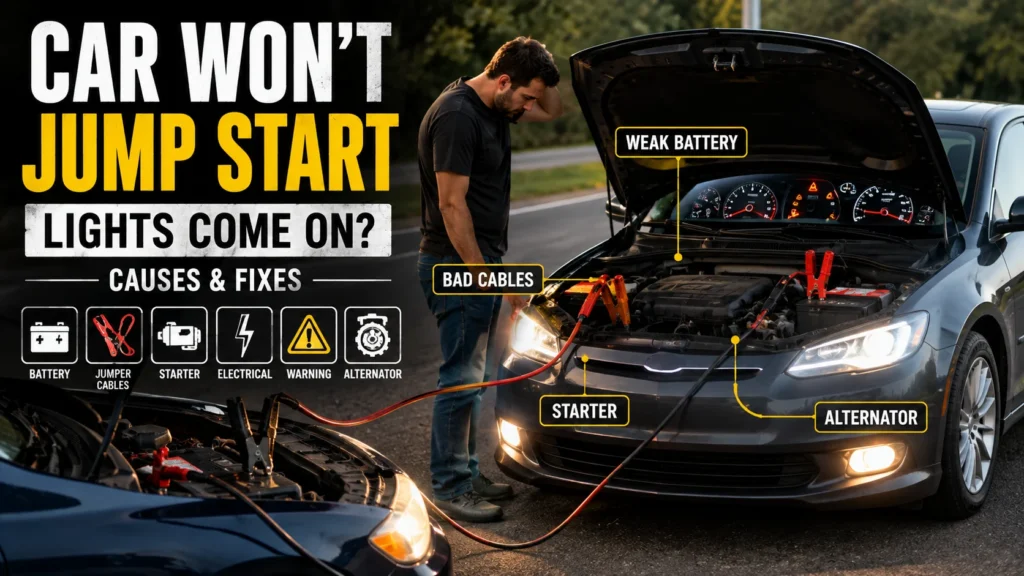
If your car won’t jump start but the lights come on, the battery is not always the only problem. A weak battery can still run the lights but fail to provide enough current for the starter. Poor battery connections, bad jumper cables, a faulty starter, or a charging system problem can also stop the engine from starting.
I would start with the simple checks before assuming you need a new starter or battery. The sound you hear when you turn the key or press the start button can also give you a useful clue.
Quick Answer: Why Won’t My Car Start With a Jump?
If your car will not start with a jump, check the battery terminals, jumper cable connections, battery condition, and starter system first. Working headlights or dashboard lights do not prove that the battery has enough current to crank the engine. If the engine does not crank after a proper jump, the starter, cables, battery, or another starting-system part may be at fault.
Why Won’t My Car Jump Start Even Though the Lights Come On?

This is one of the most confusing parts of a dead battery problem.
You may turn the key and see bright dashboard lights. The radio may work, and the headlights may turn on. Yet the engine does nothing.
The reason is simple: different parts of the car need different amounts of electrical current. The starter motor needs a much larger amount of current than the lights or radio. So a weak battery may still run smaller electrical items while failing to crank the engine.
I would not use working lights as proof that the battery is healthy.
Instead, listen carefully when you try to start the car.
What Happens When You Try to Start the Car?
The sound, or lack of sound, can help narrow down the problem.
| What you hear or see | What it may point to |
| Rapid clicking | Weak battery, poor connection, or low voltage |
| One loud click | Starter, solenoid, cable, or battery problem |
| No sound | Starter circuit, relay, switch, fuse, or connection |
| Slow cranking | Weak battery, poor connection, or starter problem |
| Normal cranking but no start | Fuel, spark, security, or another engine problem |
| Starts with a jump but dies again | Battery, alternator, or charging problem |
These signs are not a final diagnosis. They simply help me decide what I would check next.
Why a Car Won’t Start With a Jump

There are several possible reasons a jump start fails. I would check them in a simple order instead of replacing parts at random.
1. The Battery Is Too Weak or Damaged
A jump start can help a discharged battery, but it cannot repair a battery that has failed internally.
An old or damaged battery may be unable to accept or hold a charge. In that case, connecting another battery may still leave you with a car that will not start.
A battery can also become deeply discharged after the lights were left on, the car sat unused, or an electrical problem drained it.
If the battery has been going dead repeatedly, I would look for the reason instead of simply replacing it.
2. The Battery Terminals Are Loose or Corroded
Battery terminals need a clean and secure connection.
Corrosion can create resistance between the battery terminal and cable. A loose terminal can cause a similar problem.
This can leave you with enough electricity for the dashboard and lights but not enough current for the starter.
Look for:
- White, blue, or green buildup
- Loose battery clamps
- Damaged cable ends
- Broken battery cables
- Signs of battery leakage
If the terminals look badly damaged, I would stop and have them checked rather than forcing the connection.
3. The Jumper Cables Are Bad
Can jumper cables go bad?
Yes. Jumper cables can wear out over time. Corroded clamps, damaged insulation, broken wire strands, or poor connections can reduce the amount of current reaching the battery and starter.
This is easy to overlook because the cables may look fine at first glance.
I would inspect the entire cable set before trying another jump.
Check for:
- Frayed wires
- Cracked insulation
- Heavy corrosion
- Loose clamps
- Broken clamp springs
- Burn marks
- Damaged cable ends
If another known-good set of jumper cables works, your original cables may be the problem.
4. The Jumper Cables Are Not Making Good Contact
Even good jumper cables cannot help if the clamps are not making solid contact.
A clamp sitting on corrosion, paint, dirt, or a poor grounding point may restrict current flow.
I would make sure the connections follow the vehicle manufacturer’s jump-start instructions. Some vehicles also have specific jump-start terminals rather than using the battery posts directly.
Do not guess if your vehicle has a special procedure.
5. The Battery Is Too Deeply Discharged
Sometimes a battery has lost so much charge that a quick jump does not get the car started.
The battery may need more time or a proper battery charger rather than another short jump attempt.
I would also consider the battery’s age and condition. If it repeatedly goes flat, there may be a battery, alternator, or electrical drain problem behind it.
6. The Starter Motor Has Failed
A jump start does not repair a bad starter motor.
The starter uses electrical energy to turn the engine. If the starter motor has failed, supplying more battery power may not make the engine crank.
A single click with otherwise strong electrical power can point toward the starter or its control circuit, although other faults can create the same symptom.
If a known-good battery and proper cable connections make no difference, I would consider the starter system next.
7. The Starter Solenoid or Relay Has a Problem
The starter does not work alone.
The starting circuit uses switches, relays, wiring, and a starter solenoid to send power to the starter.
If one of these parts fails, the battery can have enough power but the starter may never receive the correct signal.
This is one reason I would not replace the battery simply because the car refuses to start.
8. The Alternator Has a Problem
The alternator charges the battery while the engine runs.
If the alternator stops charging properly, the battery may become discharged. You may then jump-start the car, drive for a short time, and find that the battery is dead again later.
A jump can get you moving, but it does not fix a charging-system problem.
If your battery keeps dying after a jump, I would have the charging system checked.
9. There Is an Ignition or Safety-Switch Problem
The starting system also depends on the car receiving the correct start command.
Possible causes include:
- Ignition switch
- Starter relay
- Neutral safety switch
- Clutch safety switch
- Wiring problem
- Blown fuse
- Security or immobilizer issue
For example, an automatic vehicle may refuse to crank if it does not detect Park or Neutral correctly.
A manual vehicle may have a clutch safety switch that affects the starting circuit.
10. The Problem Is Not the Battery
This is an easy point to miss.
If the engine cranks at normal speed but does not actually start, a jump start may not solve the problem.
The engine needs the correct combination of fuel, air, ignition, and engine control signals to run.
In that situation, I would stop treating it as a simple dead battery problem and move to a different diagnosis.
Can Jumper Cables Go Bad?
Yes, jumper cables can go bad.
They do not have a fixed replacement date. Their condition depends on how they are stored, used, bent, and exposed to moisture or chemicals.
The main problems I would look for are corrosion, damaged insulation, broken internal wire strands, and weak clamps. These problems can increase resistance and reduce the current that reaches the other vehicle.
A cable may also look acceptable from the outside while having internal damage.
That is why I would not judge a cable only by its outer appearance.
How to Tell If Your Jumper Cables Are Bad

Before using an old set of jumper cables, I would inspect them carefully.
Look for these signs:
- Frayed sections
- Cracked or split insulation
- Exposed wire
- Heavy corrosion
- Loose clamps
- Weak clamp pressure
- Burn marks
- Bent or damaged connectors
- Cable damage near the clamps
- Excessive heat during use
If the clamps do not grip firmly, the cables may not make a reliable electrical connection.
If the cables become unusually hot during a jump attempt, I would stop and check the setup rather than continuing.
What to Check Before Trying Another Jump

I would follow a simple order.
1. Check the battery
Look for obvious damage, leakage, corrosion, or loose connections.
2. Check the battery terminals
Make sure the connections are secure and free from heavy corrosion.
3. Inspect the jumper cables
Check the wires, clamps, insulation, and connection points.
4. Check the cable connections
Follow the correct jump-start procedure for your vehicle.
5. Listen when you try to start
Note whether you hear rapid clicks, one click, no sound, or normal cranking.
6. Consider the starter
If the battery and connections look good but the engine still will not crank, the starter system may need testing.
7. Consider the charging system
If the car starts with a jump but the battery keeps going dead, check the alternator and charging system.
This order helps me avoid jumping straight to an expensive repair.
What If the Car Starts With a Jump but Dies Again?
This is a different problem from a car that never starts with a jump.
If the engine starts with external power but later dies or refuses to restart, I would look at the battery and charging system.
A weak battery may accept enough power to start the car but fail to hold that charge.
A faulty alternator can also leave the battery without enough charge after the engine starts.
Loose battery connections can create similar symptoms.
If this keeps happening, I would have the battery and charging system tested instead of relying on repeated jump starts.
What If the Car Clicks but Does Not Start?

The type of clicking matters.
Rapid clicking
Rapid clicking often points to low voltage. A weak battery, poor connection, or problem with the jump-start setup may be responsible.
I would check the battery terminals and jumper cable connections first.
One loud click
One strong click can point to the starter, starter solenoid, battery cable, or another part of the starting circuit.
If the lights stay bright and a known-good jump source makes no difference, I would have the starter system checked.
No click at all
No sound can point to a problem with the start command or electrical circuit.
Possible causes include:
- Starter relay
- Ignition switch
- Neutral safety switch
- Clutch switch
- Fuse
- Wiring
- Security system
The exact cause depends on the vehicle.
What If the Engine Cranks but Won’t Start?
This is an important distinction.
If you hear the engine turning over normally, the starter is doing its job. A jump start may not fix the actual problem.
At this point, I would look beyond the battery and starting motor.
Possible causes include:
- Fuel delivery problem
- Ignition problem
- Spark issue
- Engine control problem
- Immobilizer issue
- Sensor failure
- Mechanical engine problem
A battery problem usually causes a no-crank or weak-crank condition. A normal crank with no start needs a different diagnostic path.
When a Jump Start Won’t Help
A jump start is useful when low battery power is stopping the vehicle from starting.
It will not repair a failed starter motor, damaged wiring, a bad ignition switch, a fuel problem, or a major engine fault.
I would stop repeating the jump attempt if the same problem continues after checking the basic connections.
Repeated attempts can also create extra heat in the cables or starter system.
When Should You Stop Trying to Jump the Car?
There are situations where I would stop instead of trying another jump.
Stop if you notice:
- Smoke
- Burning smell
- Excessive cable heat
- A damaged or leaking battery
- Heavy sparking
- Melted wiring
- Strange grinding noises
- A cracked battery case
- A vehicle that behaves abnormally after connection
Do not continue if you are unsure about the correct cable connections.
Also avoid working around a damaged battery. Get professional help if the situation looks unsafe.
How to Prevent Failed Jump Starts
A little preparation can save a lot of trouble later.
I would:
- Keep jumper cables in good condition.
- Store them away from moisture and chemicals.
- Check the clamps from time to time.
- Watch for battery corrosion.
- Fix loose battery connections.
- Replace damaged cables.
- Pay attention to repeated battery drain.
- Test an aging battery if starting problems appear.
- Have the charging system checked if the battery repeatedly goes flat.
A jump starter can also be useful to keep in the vehicle, but it should be suitable for the vehicle and used according to its instructions.
Should I Replace the Battery or the Jumper Cables?
I would not replace either one based on the failed jump alone.
Start with the symptoms.
If the battery is old, damaged, or cannot hold a charge, replacement may be needed.
If another set of known-good cables works but your old cables do not, the cables are the better suspect.
If a good battery and good cables still produce a no-crank condition, the starter or another part of the starting circuit may be at fault.
The goal is to find the failed part rather than replace parts at random.
Final Takeaway
If your car won’t jump start but the lights come on, don’t assume the battery is automatically the problem.
I would start with the battery terminals and jumper cable connections. Then I would pay attention to what happens when I try to start the engine. Rapid clicking, one click, no sound, and normal cranking can point you in very different directions.
If a proper jump with good cables does not work, the battery, starter, charging system, or another part of the starting circuit may need testing. The right diagnosis is better than repeatedly replacing parts and hoping the car starts.
Frequently Asked Questions
Why won’t my car start with a jump?
The problem may be a weak or damaged battery, poor battery connection, bad jumper cables, incorrect cable contact, a failed starter, or another starting-system fault. If the engine cranks normally but does not start, the problem may be outside the battery and starter system.
Why won’t my car jump start but the lights come on?
Working lights do not prove that the battery can provide enough current for the starter. A weak battery, poor battery connection, bad cables, or a starter problem can leave the lights working while the engine refuses to crank.
Can jumper cables go bad?
Yes. Jumper cables can develop corrosion, damaged insulation, broken internal strands, or weak clamps. Any of these problems can reduce their ability to transfer enough current for a jump start.
How do I know if my jumper cables are bad?
Look for frayed wires, cracked insulation, corrosion, loose clamps, damaged ends, or signs of heat damage. If a known-good set works but your cables do not, your cables may be faulty.
Why does my car click but not start after a jump?
Rapid clicking often points to low voltage or a poor electrical connection. One loud click can point to the starter or its control circuit. The battery, cable connections, and starting system should be checked before replacing parts.
Can a bad alternator stop a car from starting?
Yes, indirectly. A faulty alternator can fail to recharge the battery, leaving it too weak to start the car later. If the vehicle repeatedly needs a jump, the charging system deserves a check.
Can a bad starter prevent a jump start?
Yes. A jump provides electrical energy, but it cannot repair a starter motor that has failed. If the battery and cable connections are good but the engine still will not crank, the starter system may be the cause.
Why does my car start with a jump and then die?
A weak battery, charging-system fault, alternator problem, or poor battery connection can cause this. A jump may provide enough energy to start the engine, but the vehicle still needs its own electrical system to keep running.
How long should I keep trying to jump my car?
I would not keep making repeated attempts without checking the cause. If the car does not start after you confirm the battery, cables, connections, and jump procedure, further attempts may not help.