 Skip to content
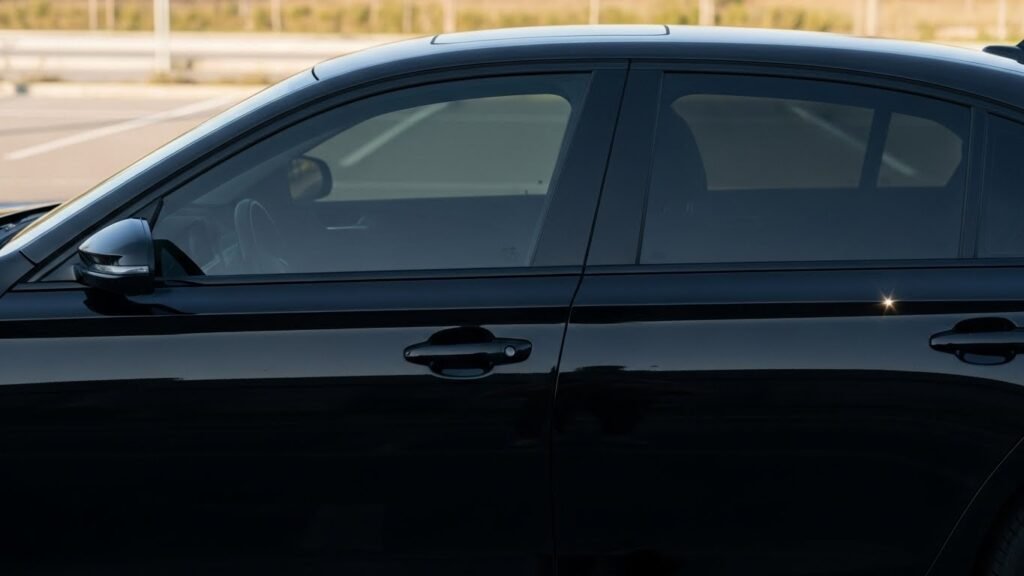
Window tinting is more than just a style upgrade for your vehicle. It is a strategic application of a thin, protective film to glass surfaces, reducing excessive light and blocking harmful UV rays. In the automotive world, the popularity of window tint is soaring. People are more aware of its advantages, particularly for enhanced privacy and superior UV protection.
Choosing the right kind of tint can be a challenge. The market offers many different types of tint for cars, each with unique features, pros, and cons. This selection process can be complex. This comprehensive guide will break down all your options. Our goal is to help you find the best film to meet your specific needs, budget, and local legal requirements.
Essential Benefits of Window Tinting

Adding an aftermarket tint to your car is one of the best investments you can make. It offers immediate returns in comfort and long-term protection. These benefits extend far beyond just aesthetics or giving your ride a custom look.
Health and Comfort Benefits
- Superior UV Protection: High-quality window tint films are serious health investments. They can block up to 99% of damaging ultraviolet (UV) radiation. This protection significantly reduces the risk of skin cancer and other health issues over years of driving.
- Glare Reduction: The sun can be brutal, but tint films are designed to manage harsh light. They effectively reduce sun glare and the blinding effect of bright headlights. This improved visibility makes driving much safer and reduces eye strain, especially for commuters or older drivers.
Interior Protection and Energy Efficiency
- Heat Rejection/Insulation: Modern types of tint for cars are engineered for superior heat reduction. By preventing a significant amount of solar heat from entering the vehicle, high-performance film helps your car remain cooler in summer. This insulation effect also helps in colder weather.
- Energy Efficiency: When your car stays cooler, your air conditioning doesn’t have to work as hard. This lower demand for cooling contributes to better fuel economy and extends the lifespan of your A/C unit. This is a win-win for your wallet and the environment.
- Interior Preservation: Blocking UV rays is critical for protecting the inside of your car. Tinting prevents the fading and oxidation of your upholstery, leather seats, dashboard, and plastic trims. This preserves the vehicle’s pristine appearance and helps maintain its resale value.
Privacy, Security, and Aesthetics
- Enhanced Privacy and Security: A darker shade makes it tougher for outsiders to see the car’s interior. This provides greater privacy for occupants and acts as a deterrent for potential thieves. The added security helps protect valuables left inside your automobile.
- Aesthetic Appeal: The sleek, uniform color and darkness that tint adds immediately gives any car a sophisticated and high-end style. It is one of the quickest ways to achieve a custom look.
- Shatter Resistance: Certain high-quality film types add considerable strength to the windows. This makes them more shatter-proof from minor impacts or accidents, providing an important layer of safety.
Technical Specifications and Performance Metrics
Understanding the technical language behind window tint is key to separating the marketing hype from real performance. Not all types of tint for cars are created equal, especially when it comes to managing heat.
Visible Light Transmission (VLT)
- Definition: Visible Light Transmission, or VLT, is the percentage of total visible light that passes directly through the combined window glass and film.
- VLT Meaning: The number is inversely proportional to the darkness. A higher VLT number means more light passes through (lighter tint), while a lower number means less light passes through (darker shade).
- Legal Implication: VLT is the most important metric used by law enforcement. It determines the legal percentage of tint allowed on specific windows in your state. For example, 50% VLT lets in 50% of light, while 5% VLT (often called “limo tint”) lets in only 5% of light.
Infrared Rejection (IRR) and Heat Blocking
- Definition: Infrared Rejection (IRR) measures the film’s ability to block infrared radiation, which is the primary contributor to the sensation of heat inside the vehicle.
- Performance Differences: IRR is the metric that truly differentiates high-end types of tint for cars.
- Films that rely on absorption (like Carbon) can block heat effectively, but the film itself can get warm.
- Films that use advanced nano-ceramic technology actively reflect and scatter infrared energy. This results in much better heat rejection and a cooler interior.
- Conclusion: Films with high IRR ratings (Ceramic) perform better at heat reduction than films that are simply dark but lack the correct materials.
Comprehensive Overview of Window Tint Types
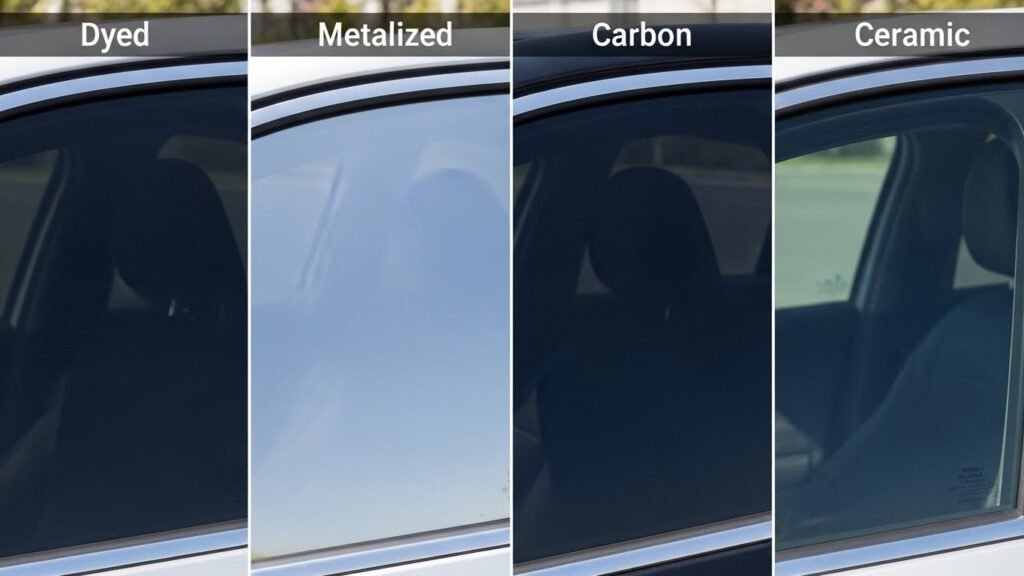
Choosing the right types of tint for cars depends entirely on your priorities: budget, performance, and local regulations. The industry offers several distinct film compositions, ranging from basic dye to advanced ceramic particles.
1. Dyed Window Tint
- Overview: This is the most cost-effective and common type of window tint. It consists of multiple layers of dye sandwiched between an adhesive layer and a polyester top coating. The dye works by absorbing sunlight to create darkness.
- Key Features: It has a non-reflective, pure matte finish. It provides basic privacy and adequate glare reduction.
- Drawbacks: It offers the lowest heat rejection and UV protection compared to premium options. The primary issue is its lack of durability; the dye will typically break down from sun exposure and may fade, often taking on an unappealing purple hue. This results in the shortest lifespan (3–5 years).
2. Metalized Window Tint
- Overview: Instead of just dye, this film incorporates tiny metal microparticles into its layers. These metal particles use reflection to bounce sunlight and heat away from the car.
- Key Features: This tint has a distinct shiny, reflective, sometimes mirror-like appearance. The added metal provides increased strength and makes the film more scratch-resistant and shatter-proof.
- Performance: Offers much stronger heat rejection than Dyed tint.
- Drawbacks: The metallic content can interfere with electronic devices that rely on radio waves. This means compromised reception for radio signals, GPS signals, cell phones, and satellite radio.
3. Hybrid Window Tint
- Overview: This film is the attempt to get the best of both worlds—the look of dye with some of the performance of metal. It typically uses several dyed layers combined with a thin layer of metal microparticles, often titanium, in between.
- Performance: It provides a balanced mid-level of heat reduction and UV protection. It generally offers less radio signal interference than pure Metalized films.
- Cost: It is more affordable than Carbon or Ceramic, positioning it as a decent mid-level option for the everyday vehicle.
4. Carbon Window Tint
- Overview: This high-quality film contains dispersed carbon fiber particles. Carbon is naturally color-stable and blocks a significant amount of infrared light, which is the source of heat.
- Key Features: It boasts a deep, rich black color with a desirable matte finish that will never fade or turn purple. Crucially, since it contains no metal particles, it causes no Signal Interference with electronic devices.
- Performance: It offers excellent UV protection and strong insulation. It is noted for rejecting up to 40% of the solar heat that enters the car.
- Value: It provides a long lifespan (7–10 years) and is a significant upgrade from Dyed or Metalized films.
5. Ceramic Window Tint
- Overview: Ceramic tint is widely considered the premium, gold-standard technology. It is constructed using advanced nano-ceramic technology, embedding tiny, non-conductive ceramic particles into the film. These particles are chemically inert.
- Performance: It provides the highest level of heat rejection available. Since the particles do not conduct heat, they actively reflect and scatter infrared rays. This film can block 80%–90% of infrared rays, keeping the car exceptionally cool. It offers 99%+ UV protection.
- Key Features: It ensures superior optical clarity, meaning great visibility even when the shade is dark. It is highly durable, will not fade, and causes zero Signal Interference. It also provides maximum shatter-proof strength.
- Cost: This is the most expensive option, but its superior durability and comfort justify the investment.
6. Crystalline Window Tint
- Overview: Crystalline tint is often nearly transparent or clear. It uses specialized multi-layer optical film technology designed to deliver performance without the visual darkness.
- Key Features: It delivers superior UV protection and outstanding heat rejection despite its clarity. It is the ideal choice when high VLT is needed to meet strict legal requirements, but maximum sun protection is still desired.
- Drawbacks: It is one of the most expensive types of tint for cars. It does not offer the privacy or security benefits associated with a darker shade.
The Decision-Making Process: Choosing the Right Tint
Selecting the perfect window tint is a balance of performance, personal preference, and budget. By carefully assessing your needs and the environment you drive in, you can narrow down the vast array of types of tint for cars.
Assessing Personal Needs and Priorities
- Heat Reduction: If you live in a climate like Florida or any intensely hot region, prioritize films with the best IRR. Ceramic or high-grade Carbon films are the clear winners here.
- Budget: For the most cost-effective solution, Dyed tint is the starting point. If you are seeking a high-quality, long-term investment, the premium price of Ceramic is justified by its decade-plus lifespan.
- Aesthetic Preferences: Do you want a subtle, non-reflective look? Choose a matte finish from Dyed or Carbon film. If you like a bold, somewhat reflective or shiny style, Metalized tint is your pick.
- Electronics Usage: If you use electronic devices like GPS signals or satellite radio often, you must avoid traditional Metalized films. Stick with Carbon or Ceramic to prevent Signal Interference.
- Privacy vs. Clarity: For maximum privacy and a high darkness level, select a low VLT shade in a Carbon or Dyed tint. If you want sun protection without the dark look, Crystalline tint offers a virtually transparent solution.
Considering External Factors
- Vehicle Type: Large windows, like those on SUVs or vans, can let in a lot of heat. Using a high performance tint like Ceramic ensures uniform heat reduction throughout the cabin.
- Climate: In sunny, warm climates, high IRR films are essential. They maximize cabin cooling, reduce the load on your A/C, and offer a long-term economic advantage. In cooler climates, insulation might be a lower priority than aesthetics.
- Long-Term Investment: Choosing quality Carbon or Ceramic types of tint for cars may seem expensive upfront, but their durability and lack of fading mean they last much longer than cheaper films. This longevity makes them a better investment over the lifespan of your car.
Compliance with Window Tint Laws
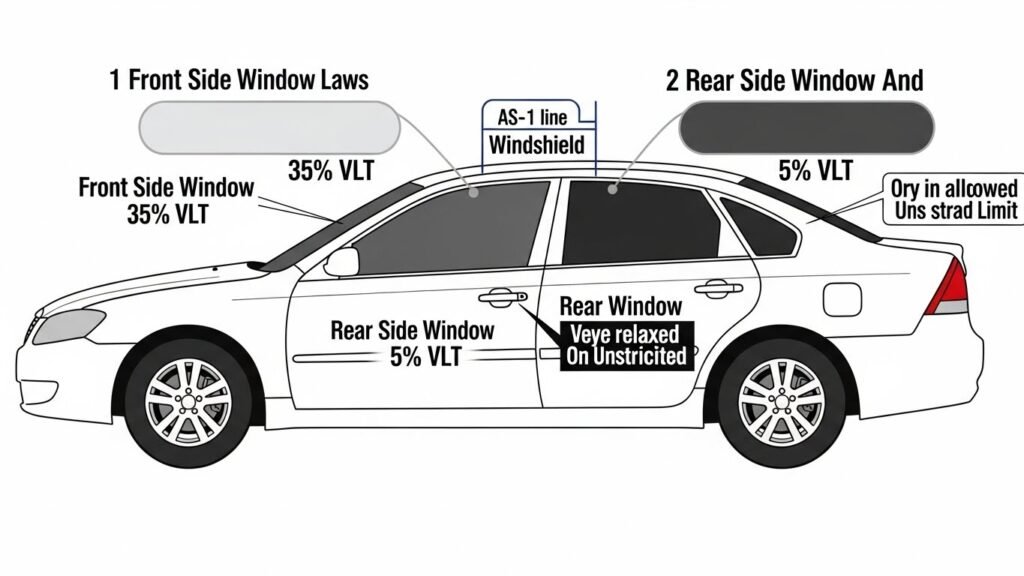
Navigating window tint regulations is a critical part of the installation process. Violating state or country law can lead to costly fines, failed vehicle inspections, and the mandatory removal of your new film.
Understanding Legal Requirements (VLT and Reflectivity)
- Visible Light Transmission (VLT): This is the legal percentage metric that must be strictly followed. Laws specify the minimum amount of light (the VLT) that must be able to pass through the windows.
- Front Side Windows (driver and passenger): These typically have the strictest limits, often requiring a higher VLT (lighter tint) so law enforcement can see into the car. Limits are commonly 35% to 50% VLT.
- Back Side Windows & Rear Window: These are usually allowed to be much darker. Many states permit very low VLT (darker shade) or even ‘any’ darkness on these windows for certain vehicle types (like SUVs or trucks).
- Reflectivity: Many jurisdictions specifically regulate how much light the tint can reflect. Mirror-like appearance or highly reflective films (like some Metalized types of tint for cars) are often prohibited on front side windows to prevent dangerous glare for other driving commuters.
- Windshield Strip: No state allows full windshield tinting. Only a non-reflective strip, usually above the manufacturer’s AS-1 line or the top 4-6 inches, is permitted.
Adherence to Regional Regulations
- Variability is Key: Window tint law is not uniform across the USA. For instance, a tint that is legal in Washington State might be illegal in Florida, or vice-versa. Driving a non-compliant vehicle across state lines can still result in a ticket.
- Example (Washington State): As an example, Washington State mandates that front side windows must allow more than 24% of light to pass through (meaning 24% VLT or higher). However, the back side windows and the rear window can be tinted to any darkness.
- Medical Exemptions: If you have a medical condition that makes you photosensitive, you may be able to apply for a state-specific medical exemption. This exemption allows a darker legal percentage than standard regulations, but requires proper documentation.
Maintenance and Longevity of Window Film

Proper maintenance is essential to maximize the durability and lifespan of your investment, regardless of the types of tint for cars you choose. Even the best premium Ceramic film can be damaged by improper care.
Post-Installation Care
- Curing Time: The most critical step is patience. You must allow the film to fully adhere to the glass.
- Do not roll down the windows for the full curing period, which typically takes 3 to 5 days. Some installers recommend up to 30 days.
- The adhesive requires time to dry and bond correctly. If you roll the windows down too early, the edges can peel or lift.
- Cleaning Solutions: Your cleaning routine must change.
- Only use ammonia-free cleaner. Ammonia is a harsh chemical that can break down the film’s dye and adhesive over time, causing it to bubble and fade.
- Opt for a specialized, tint-safe cleaner, or a simple solution of mild dish soap and distilled water.
- Always spray the cleaner onto a soft cloth, not directly onto the window, to prevent the solution from seeping into the edges and weakening the adhesion.
Recognizing and Preventing Common Tinting Mistakes
- Avoid Abrasion: Never use abrasive tools like paper towels, scouring pads, steel wool, or hard squeegees on the film. These materials can easily scratch-resistant surfaces and dull the finish. Use a soft microfiber cloth for cleaning and drying.
- Protect Against Accidental Damage: Be mindful of items that contact the windows.
- Watch out for dirt and grit in the window tracks, which can scratch the tint when the windows are operated.
- Seat belts can whip back and strike the glass, potentially marking the film.
- If you travel with pets, their claws can damage the tint, so consider using a protective barrier.
- Minimize Heat Exposure: Even films designed for high heat rejection can wear down over time from constant direct sunlight.
- Park your vehicle in shaded areas or a garage whenever possible.
- Use a reflective sunshade on the windshield when parked for extended periods.
- Inspection: Regularly inspect your tint for early signs of trouble. Look for bubbling, peeling edges, discoloration, or creasing. These issues should be addressed by a professional before they worsen.
Importance of Professional Installation
Hiring a professional specialist for window tinting is crucial. The quality of the final product—its performance, durability, and appearance—is heavily dependent on the installation process.
- Expert Consultation: A certified technician will guide you through the various types of tint for cars, explaining the true performance differences between Dyed, Carbon, and Ceramic films. They can provide detailed information about product specifications, film durability, and the manufacturer’s long life warranty.
- Precision Application: Achieving a flawless, seamless application takes skill and specialized tools. A professional uses computer-cut patterns and follows meticulous procedures to prevent imperfections like dust particles, creases, or bubbles. Correct application is essential for the film’s maximum performance and aesthetic quality.
- Legal Compliance Assurance: A reputable expert knows the specific legal percentage VLT requirements for the windshield, front side windows, and rear window in your local regulations. This knowledge ensures your car leaves the shop fully compliant with the law, saving you from potential fines or having to replace the tint later.
- Trusted Brands and Warranty: A legitimate professional shop uses high-quality, trusted film brands. These films are backed by robust warranties, often covering bubbling, peeling, or fade for a period of several years or even the lifespan of the vehicle.
Technical Deep Dive: Performance Comparison
To finalize your decision on the best types of tint for cars, compare the performance of the top three aftermarket film materials: Metalized, Carbon, and Ceramic.
| Film Type | Heat Rejection Mechanism | Signal Interference | Color/Finish | Durability & Lifespan | Performance Ranking |
| Metalized | Reflection (via metal microparticles) | High (Blocks radio signals and GPS signals) | Shiny, reflective, mirror-like appearance | High strength and scratch-resistant | Mid-Tier |
| Carbon | Absorption (via carbon fiber particles) | None (Metal-free) | Deep black, matte finish | Very high durability, won’t fade | High-Tier |
| Ceramic | Reflection and Scattering (via nano-ceramic technology) | None (Non-conductive ceramic particles) | Deep neutral tone, optically clear | Elite durability, maximum shatter-proof strength | Premium-Tier |
Key Technical Details You Should Know

Total Solar Energy Rejected (TSER)
TSER is the most important number for overall heat control. It measures the total percentage of solar energy (including visible light, infrared, and UV rays) that is blocked by the film.
- Think of it as the film’s total defense score against the sun.
- When comparing two films that look equally dark, the one with the higher TSER is the one that will actually keep your car cooler.
- A high TSER score is the reason premium ceramic films work so well.
Light-to-Solar-Gain Ratio (LSG)
The LSG helps you compare how well a film rejects heat based on how dark it is.
- This measurement is key if your local laws require a lighter, less dark tint (high VLT).
- A high LSG means the film is highly efficient—it blocks a lot of the hot, invisible infrared and UV light without making the window very dark.
- This explains why a light-colored, high-tech ceramic film can keep your car much cooler than a very dark, low-cost dyed film.
Emissivity and U-Factor (For True Insulation)
These technical terms describe the film’s ability to act as a true insulator, not just a sun blocker.
- Emissivity: This measures how well the film prevents absorbed heat from radiating (or spreading) into your car. A film with low emissivity helps keep your car cooler by not letting the heat it captures move inside.
- U-Factor: This is a measure of the insulation quality of the glass/film. A lower U-Factor means the glass is better insulated. It keeps heat out in the summer and also helps keep your heated air in the car during the winter.
What You Should Expect to Pay
Estimated Professional Installation Cost Ranges
The price depends on the type of film and the size of your vehicle. These are typical cost ranges for a professional installation on an average four-door sedan:
- Dyed Film: $100 – $250. (The most affordable, but minimal heat protection.)
- Metalized/Hybrid Film: $250 – $400. (Mid-range protection, but be aware of possible signal issues.)
- Carbon Film: $300 – $500. (A great, high-quality look with good heat performance and no electronic interference.)
- Premium Ceramic Film: $550 – $900+. (The top choice for the best heat rejection, longest lifespan, and clearest visibility.)
- Full Windshield (Clear/Light Ceramic): Expect to add an extra $150–$300 to your total, as this panel requires specialized, high-TSER film.
Cost and Complexity of Removing Old Tint
If your old tint is faded, bubbling, or peeling, it must be removed completely before new film is applied.
- Cost: Professional removal typically costs between $50 and $150.
- The Rear Window Risk: Removing tint from the rear window is the most difficult and risky part of the job. Professionals use steam and special solvents to ensure the electrical wires of the rear defroster are not damaged. Trying to do this yourself can easily lead to broken defroster lines, which are very costly to fix.
Installation Secrets and Tricky Spots

The Impact of Factory Tint on Final VLT
It’s important to know that most factory car glass is already lightly tinted (around 70% to 85% VLT).
- When you add tint film, the final legal VLT is the combined result of the glass and the film.
- The Formula is Key: You must multiply the glass VLT by the film VLT. For example, if you apply a 35% VLT film to 70% VLT factory glass, the final reading is 24.5% VLT (0.70 x 0.35 = 0.245).
- This small calculation error can make your car illegal in states with strict 35% or 50% VLT limits.
The Problem with the Dot Matrix
The dot matrix refers to the small black ceramic dots printed around the edges of your windows. They are there to hide the glue that holds the glass in place.
- The Issue: Because the dots are slightly raised, the tint film struggles to stick perfectly in this area. This often leaves a small perimeter that looks lighter, silvery, or hazy.
- Professional Solution: Skilled installers have special techniques (like lightly sanding the dots or using heat and pressure) to improve adhesion, but a slight visual difference in the dot matrix area is common and unavoidable.
Protecting the Rear Defroster Lines
The thin electrical lines on your rear window (the defroster) are sensitive:
- Installation: The tint film is installed directly over these lines. A professional must be careful not to damage them when cutting the film or applying heat.
- Long-Term Care: While defrosters can be used safely, the repeated heating and cooling cycles can eventually stress the film’s adhesive, which may lead to small horizontal bubbles along the defroster lines over time. High-quality film is more resistant to this stress.
Specific Vehicle Situations
Tinting Sunroofs and Panoramic Roofs
For sunroofs and panoramic glass roofs, the goal is heat rejection, not necessarily darkness.
- Best Film: The ideal choice is a clear or very light (70% VLT) nano-ceramic film.
- Benefit: Since heat comes straight down, this film provides maximum TSER and blocks nearly all UV light without removing all the natural light, keeping the cabin significantly cooler.
EVs and Hybrids: Saving Battery Life

High-performance tint offers a direct benefit for electric (EV) and hybrid vehicle owners:
- Range Protection: Air conditioning draws a lot of power from the car’s main battery, which reduces your driving range.
- Solution: Installing high-TSER ceramic film dramatically reduces the amount of heat entering the car. This means the A/C compressor runs less often and less intensely, which saves battery power and helps preserve your driving range.
Rules and Paperwork
Details of the Medical Exemption Process
If you have a medical condition (like severe light sensitivity) that requires a darker tint than what is legally allowed, you may need a medical exemption. The steps usually include:
- Doctor’s Note: Getting a signed and notarized statement from a licensed physician (like a dermatologist) explaining your specific need for the darker tint.
- State Approval: Submitting this medical statement and an application to your state’s DMV or state police.
- Required Documents: If approved, you will be issued a special sticker or certificate that must be kept in the vehicle (or sometimes affixed to the window frame) to show law enforcement during a traffic stop.
State-Specific VLT Tolerances
In some states, a small margin of error is allowed on VLT readings to account for slight differences in handheld meters.
- Example: A state might have a strict 35% VLT limit but allow a tolerance of 3%. This means a reading of 32% VLT might still be considered legal.
- Best Practice: Professional installers always aim for a VLT slightly lighter than the legal limit (e.g., 38% in a 35% zone) to build in a safe buffer against legal issues.
Conclusion
Window tinting is a valuable and strategic upgrade for your vehicle. It is far more than a simple aesthetic choice; it is a long-term investment that substantially enhances comfort, security, and long-term value.
The modern market for types of tint for cars offers a solution for every need and budget.
- If you need a basic, affordable shade, Dyed tint is your entry point.
- For excellent UV protection and a solid balance of performance and cost, Carbon film is the smart middle ground.
- If you live in extreme heat and demand the absolute best in heat rejection and durability, the premium Ceramic tint is unmatched.
Before making your final choice, always weigh the performance metrics, especially IRR and VLT, against your personal priorities and local regulations. Once you have selected your film, always entrust the installation to a certified professional to ensure quality, long life, and compliance with all aspects of the law. Make the investment and enjoy the countless benefits of a cooler, safer, and better-looking car.
Frequently Asked Questions (FAQs) About Window Tinting
How does the Visible Light Reflectance (VLR) differ from VLT?
VLT (Visible Light Transmission) measures the amount of light that passes through the window and film. VLR (Visible Light Reflectance) measures the amount of visible light that is reflected away from the window. While VLT determines darkness, VLR is the key legal metric that regulates how mirrored or shiny a film can be, as high reflectance can cause dangerous glare for other drivers.
Is it legal to apply tint film over factory-tinted glass?
Yes, it is legal to apply aftermarket film over factory-tinted glass, but you must ensure the combined VLT meets your state’s minimum legal requirement. Factory tint is often in the glass itself (dyed glass), not a film, and usually registers around 70-85% VLT. Applying a darker film will drastically reduce the final VLT, which is the number police use. Always confirm the final combined VLT is compliant.
What is the most common reason window tint bubbles or peels?
The most common reason for bubbling or peeling is the failure of the adhesive layer, often due to improper curing or exposure to harsh chemicals. Rolling the windows down before the film is fully cured (typically 3–5 days) or using ammonia-based cleaners, which break down the adhesive, are the primary culprits.
What is the difference between dyed film and carbon film from an installation standpoint?
Dyed film is typically thinner and easier for an amateur to crease or tear during installation. Carbon film is thicker and more robust due to the carbon particles, making it slightly more challenging for a novice to install but offering greater durability and better conformability to curved windows when professionally shrunk.
Do I need to tint the small corner windows (quarter glass)?
Yes, if your car has small, fixed corner windows (often found on SUVs or sedans near the rear door), they should also be tinted. Omitting them will leave a gap in UV and heat protection, and it will look unfinished or inconsistent compared to the rest of the car.
What does the term “shrinking” mean in window tint installation?
“Shrinking” is the process where a professional installer uses a heat gun to carefully remove excess moisture and tension from a flat piece of film so that it can be perfectly molded and adhered to the curves of automotive glass, especially the rear window. This technique is essential for a seamless, bubble-free finish.
Why do some films cause a hazy appearance at night?
Lower-quality films, especially some dyed or older-generation metalized films, can cause a slight haze, distortion, or rainbow effect known as “oil canning,” particularly when looking through the window at night toward bright headlights. High-quality ceramic and carbon films are engineered for superior optical clarity to minimize this issue.
Can I tint the inside of a car with a pre-existing exterior scratch on the glass?
Yes, you can tint the inside, but the scratch will still be visible and may even be highlighted when the film is applied. The film cannot fill or conceal a scratch or chip in the glass itself. If the scratch is deep, it might even damage the film upon application or subsequent cleaning.
What is the ideal ambient temperature for professional tint installation?
The ideal conditions are a controlled, dust-free environment with an ambient temperature between 60°F and 90°F (15°C and 32°C). Extreme cold can make the film brittle and the adhesive set too slowly, while extreme heat can cause the water/slip solution to evaporate too quickly, making it difficult to position the film correctly.
What should I do if my brand-new tint looks streaky or has tiny water pockets?
It is normal for new tint to look streaky, hazy, or have small water bubbles for several days to a few weeks. This is trapped water from the installation process that needs time to evaporate through the film (the curing process). Do not panic or try to pop them; they will disappear as the film cures.
Are there any maintenance tips for car windows with frameless doors?
Yes. Cars with frameless doors (common on coupes and some sedans) require extra caution. Because the window dips slightly when the door is opened, the top edge of the film is exposed to the elements more often. Be extremely careful not to touch or clean the top edge of the film until the adhesive has fully cured (at least 7 days).
How long does a typical full-car professional tint installation take?
A professional installation on a standard sedan, including cleaning, cutting, and application, typically takes between 2 to 4 hours, depending on the complexity of the vehicle’s windows (e.g., highly curved rear glass) and the film type.
Does window tint protect the vehicle’s speakers or electronic components?
Indirectly, yes. By significantly reducing the internal cabin temperature (heat rejection), the tint protects all interior components, including electronic screens, sound systems, and plastic speaker cones, from prolonged exposure to extreme heat, which can lead to premature failure or degradation.
Can tinting the rear window affect the antenna embedded in the glass?
In older cars or those with embedded grid-style antennas (for radio or keyless entry), metalized films can potentially interfere with the signal. However, modern, non-conductive films like Carbon and Ceramic will have no negative impact on any embedded antenna systems.
What is the lifespan difference between a good quality carbon film and a cheap dyed film?
A cheap dyed film typically begins to fade, bubble, and peel after only 3 to 5 years. A high-quality carbon film, due to its color-stable material, is generally warrantied and designed to last 7 to 10 years or more without significant color change.
Can I use my rear windshield wiper on newly tinted glass?
You should avoid using the rear wiper for the first 30 days after installation. The film is still settling, and the friction from the wiper blade could damage the edge or cause the film to lift prematurely.
Why is the UV protection rating almost always 99% for all quality films?
All modern, high-quality window films—even dyed ones—use a chemical layer or UV inhibitors in the adhesive that are highly effective at blocking both UVA and UVB rays. The difference between film types isn’t their UV protection (which is nearly universal at 99%+), but their heat rejection (IRR and TSER).
What should I look for in a film warranty?
A comprehensive warranty should cover bubbling, peeling, cracking, and color change (fading) for the stated period, often the lifetime of the film. A good warranty will also cover the cost of the film and the reinstallation labor.
Is there a specific type of car soap that should be avoided when washing the car exterior?
You should avoid using highly acidic or extremely harsh wheel cleaners or degreasers near the windows. If overspray from these chemicals gets on the tint film’s edge, it can seep under the film and damage the adhesive, leading to premature peeling.
Why is the driver’s side window tint often the first to fail or lift?
The driver’s side window is used most frequently, which means the edge of the film is constantly scraped by the rubber gasket every time the window is rolled up or down. It also receives the most direct sun exposure while driving, making the adhesive and film edge work harder, leading to earlier signs of wear.