 Skip to content
If you own a car, you know the engine is the heart of the machine. But the car water pump is the tireless guardian that keeps that heart from exploding from heat. When this crucial component fails, the results aren’t just inconvenient; they can lead to costly engine damage. Learning how to test a car water pump is the best defense against a major breakdown. This comprehensive guide will walk you through everything, from understanding what the pump does to diagnosing those scary symptoms and performing maintenance that can save you a fortune. We’re going to dive deep, so grab a wrench and let’s get started.
Understanding the Water Pump: Function and Mechanism
The most essential component in your cooling system is the automotive water pump. Its critical job is to ensure coolant flows continuously through the engine. This process keeps the engine operating at its optimal temperature and prevents dangerous overheating.
Mechanism (Centrifugal Pump)

The most common design is the centrifugal water pump. The engine drives the pump shaft and impeller via a pulley or fan belt. This rotation uses centrifugal force to throw the coolant outwards, generating pressure. This action forces the hot coolant out of the engine block and simultaneously draws cool coolant into the impeller from the radiator, ensuring constant circulation.
Thermostat Role
A thermostat works hand-in-hand with the pump. Located next to the pump, it controls the coolant flow based on temperature.
- During a cold start, it stays closed, allowing a small water circulation system only within the engine. This helps the engine warm up fast.
- Once the engine temperature reaches above 95 degrees, the thermostat opens. This allows the hot coolant to flow into the radiator for heat dissipation.
Types of Automotive Water Pumps and Their Characteristics
Not all water pumps are built the same. Knowing which type your car has is helpful for maintenance and replacement. The failure modes often depend on the pump’s design.
Mechanical Water Pumps (Belt-Driven)
- Design: This is the most common type you’ll see. It’s driven directly by the serpentine belt, V-belt, or timing belt/chain.
- Operation: The pump’s speed is tied directly to the engine RPM. This means its efficiency can sometimes decrease at very high engine speeds.
- Failure Modes: These pumps are susceptible to bearing failure, pump seal leaks, and pulley issues due to continuous mechanical stress.
Electric Water Pumps (Auxiliary and Main)
- Design: This type uses an electric motor, allowing it to operate independently of engine speed.
- Advantages: They allow for variable flow rates based on the actual cooling demand. This improves fuel efficiency and reduces engine warm-up time. They are crucial for hybrid and stop-start vehicles.
- Failure Modes: Electric water pumps can suffer from electrical failures (in the motor or controller) or wiring issues. While often more durable, they can still experience internal leakage.
Common Causes of Water Pump Failure and Premature Wear
Understanding the causes of damage is essential for prevention. Most failures are a result of time, improper maintenance, or stress on connected parts.
External Force/Component Issues
- Over-tightened engine combination belt: This puts excessive stress on the bearing and pump shaft, leading to premature wear.
- Extended use: Every pump has a service life. Operating it beyond this limit without replacement guarantees eventual failure.
- Worn Impeller: The impeller blades can wear down, leading to poor performance. This means the pump can’t propel the coolant effectively, causing inadequate circulation.
Internal Component Damage

- Seal Degradation: Coolant leakage is common due to the aging of the mechanical seal or the water seal and gasket.
- Shaft Damage: The pump shaft can bend, or the shaft neck can become worn. Even damage to the thread at the shaft end can disrupt operation.
- Blade Failure: Impeller blades can break, or the shaft bearing holes can become worn. This drastically affects coolant flow and pump efficiency.
Coolant Management: Maintenance and Damage Prevention
The coolant running through your engine is the lifeblood of the cooling system. Its condition directly affects the pump’s health. Learning how to test a car water pump often starts with checking the fluid.
Coolant Best Practices
- Replacement Schedule: Coolant should be replaced every three to seven years to prevent internal corrosion. Over time, the additives that prevent rust deplete.
- Corrosion Risk: Prolonged use of old coolant causes internal corrosion. This corrosive fluid eventually damages the water pump.
- Mixing Ratios: Never use pure water in modern engines. Always follow the recommended ratio, usually a 50/50 mix. Pure water has a low boiling point, which can cause the car’s temperature to rise.
- Inspection: Check the coolant reservoir regularly. A consistently low level may indicate a leak in the system.
Essential Safety Warning
- Crucial Warning: If the engine is hot or has just been started, never add cold water or coolant immediately. Adding cold fluid when the engine temperature is high can cause a sudden temperature change. This temperature shock can result in damage to engine components (e.g., cracked engine block/head) and leading to costly engine damage. Always let the car cool down first.
Key Symptoms and Diagnosis of Water Pump Failure
A failing pump gives clear warnings. Recognizing these symptoms quickly is the first step in how to test a car water pump and save your engine.
Coolant Leak Diagnosis: Symptoms and Troubleshooting

- Visible Symptoms: One of the most common signs is finding coolant leaks. Look for a bright green, orange, or pink puddle under the car when parked.
- Weep Hole Leak: Many pumps have a weep hole in front of the sealing device. If you see water droplets or flowing water coming from this small hole, the internal mechanical seal is damaged.
- Visual Tracing: To confirm the leak location, park the car overnight on a clean cardboard or concrete floor. If you see wet coolant on the cardboard in the morning, you have a leak.
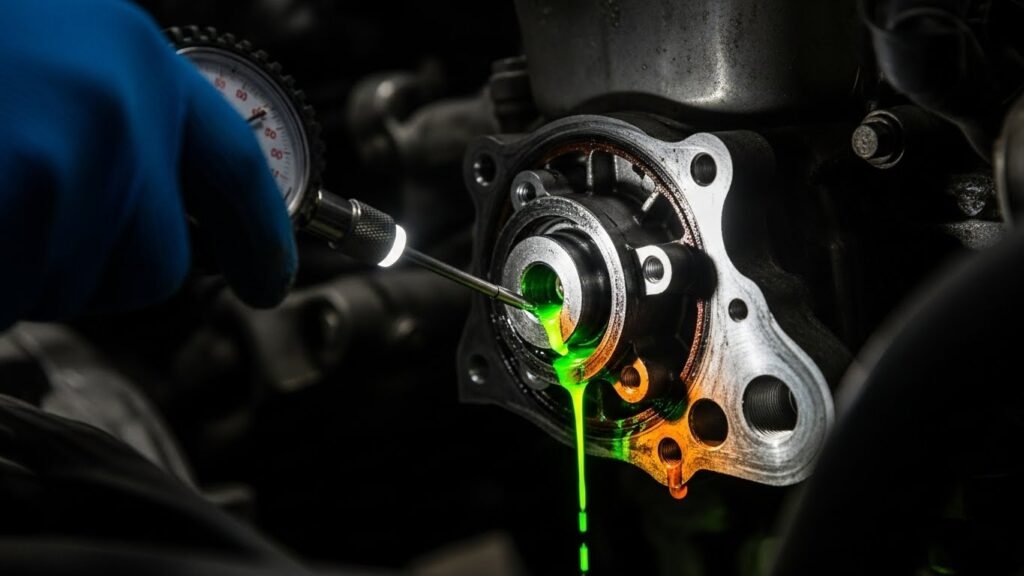
- Advanced Detection: Using UV dye added to the coolant system to pinpoint the exact leak location, or pressure testing the cooling system to observe pressure drops, confirming if the leak is fast or slow.
Abnormal Noises and Pulley Issues: Symptoms and Differentiation
When you hear a grinding noise or squealing, it’s vital to confirm the water pump is the source, not another accessory.
- Noise Symptoms: A failing water pump often makes unusual noises.
- A squealing sound means the drive belt is loose or worn.
- A grinding noise or whining sound often indicates the bearing is failing. The noise will get louder as the damage worsens.
- Pulley Check: Find the pulley component where the belt wraps. Wiggle it back and forth; if it feels loose pulley, the bearing is failing and needs replacement.
- Isolation Techniques:
- Similar bearing noises can come from the alternator, air conditioning compressor, or power steering pump.
- A mechanic can use an automotive stethoscope to isolate the grinding noise directly to the water pump housing. In some cases, briefly removing the serpentine belt can confirm the noise source.
Engine Overheating, Impeller Wear, and Warning Lights
- Overheating Symptoms: A pump that isn’t circulating coolant effectively will cause the engine to overheating. Watch for a rising temperature gauge or steam coming from under the hood.
- Warning Lights: The temperature warning light will be triggered if the engine temperature rises too high. The coolant warning light might also illuminate if the coolant levels are low due to a pump failure.
- Diagnosing Impeller Wear: Sometimes, the plastic impellers inside the pump wear down. This happens when additives are depleted, causing them to be unable to propel the coolant.
- Cold Engine Test Only: Remove the radiator cap (only when cold!) and cold start the car. If you don’t see the coolant moving inside the radiator, the impeller might be damaged or missing.
Secondary and Minor Symptoms
- Signs of Coolant Loss and Residue: If you are constantly having to top off the coolant reservoir, it indicates a persistent leakage. Look for corrosion or rust (often white deposits) on the pump’s surface. This is caused by coolant residue from a slow leak.
- Poor Vehicle Heating Performance: In cold weather, you might notice poor heating performance. The car’s heater won’t blow warm air if the pump can’t circulate coolant properly to the heater core.
Routine Maintenance for Water Pump Longevity
Regular upkeep is the best way to avoid having to figure out how to test a car water pump under emergency conditions. Proper maintenance is your first line of defense against pump failure and costly engine damage. Focusing on both the fluid and the pump’s structure is essential.
Essential Inspection Steps
- Bearing Check: You should check the condition of the bearing based on the sound they produce. If you hear any unusual noises or abnormalities, the bearing needs to be replaced.
- Impeller Inspection: Disassemble and inspect the impeller for any signs of wear. If wear is present, it can affect the flow, lift, and efficiency of the pump, requiring a replacement.
- Seal Verification: Verify if the mechanical seal is still usable. If it is damaged, it should be replaced immediately to prevent leakage.
- Oil Level (Where Applicable): Check if the oil tank is adequately filled. If the level is low, add oil to the appropriate level.
Advanced Troubleshooting and Diagnostic Techniques
When the symptoms point directly to the cooling system, advanced techniques are necessary to accurately diagnose the problem. These steps go beyond a simple visual check and are crucial for correctly identifying a failing automotive water pump.
Locating the Source of Coolant Leaks
- Dye Detection: Mechanics can use UV dye added to the coolant system to pinpoint the exact location of a leak under black light. This is great for tiny, intermittent leaks.
- Pressure Testing: A specialized tool is used to pressurize the cooling system. By observing where the pressure drops, you can confirm if the leak is fast or slow, which helps in identifying a hidden pump leak.
- Visual Tracing: Placing light-colored cardboard under the engine to confirm the leak location (under the water pump area) is a simple, effective test. The water pump is more likely to leak when the engine is running.
Differentiating Noises from Other Components
When you hear a grinding noise or squealing, it’s vital to confirm the water pump is the source, not another accessory.
- Accessory Belt Isolation: Briefly removing the serpentine belt can confirm if the unusual noises are coming from the water pump or another component, like the air conditioning compressor, power steering pump, or alternator. This isolation helps clearly identify the source of the sound.
- Stethoscope Diagnosis: An automotive stethoscope allows a mechanic to listen directly to the water pump housing. This helps isolate the grinding or whining noise, confirming the bearing failure.
The Water Pump Replacement Process
If your test confirms the pump is failing, replacement is the only fix. This job can be complicated, but proper planning ensures a long-lasting repair.
Pre-Replacement Considerations
- Required Parts: Always replace the water pump gasket and strongly consider replacing the thermostat simultaneously. These components wear out together and replacing them at the same time is preventative maintenance.
- Timing Belt/Chain Drive: If the water pump is driven by the timing belt (or chain), it is highly recommended to replace the entire timing kit (belt, tensioners, idlers). The labor to reach the water pump overlaps significantly with the timing belt service.
- Component Inspection: Inspect all connected hoses and the drive belt for cracking or wear and replace them as needed before installing the new pump.
Installation and Post-Installation Steps
- Proper Flushing: Thoroughly flush the old, potentially corrosive coolant from the entire cooling system before installing the new pump. This removes residual internal corrosion.
- Torque Specifications: Always use a torque wrench to tighten all bolts to the manufacturer’s specified value. This prevents stripping threads or warping the housing, which could cause a new leakage.
- System Bleeding: Carefully bleed the cooling system to remove all air pockets. Trapped air can cause ‘hot spots’ in the engine block and lead to immediate overheating after the repair.
Factors Affecting Repair Complexity and Coolant Integrity
Water Pump Location and Accessibility

The amount of labor required to replace a water pump is heavily dependent on its position within the engine bay, which varies significantly between vehicle types.
- Front-Mounted (Serpentine Belt Drive): In many older and some rear-wheel-drive (RWD) vehicles, the water pump is bolted directly to the front of the engine block and is driven by the visible serpentine belt. Access is relatively straightforward, requiring the removal of the belt and a few accessories, making the repair less time-intensive.
- Timing Belt/Chain-Driven: On many modern and front-wheel-drive (FWD) vehicles, the water pump is strategically placed behind the timing cover, driven by the timing belt or chain. This requires significant disassembly, including the removal of drive belts, tensioners, and the entire timing cover assembly. This location drastically increases the repair time and cost due as the engine must often be partially supported and the engine mount removed.
- Inaccessible Locations: In some compact FWD engine bays, the pump may be positioned deep within the engine, requiring the removal of other major components like the intake manifold or alternator bracket just to reach the fasteners. This complexity is why getting an accurate labor quote is essential before a repair.
Specific Coolant Chemistries and Their Risks

While using the correct coolant concentration is important, using the correct type of coolant is paramount. Modern vehicles require specific chemical formulas designed for their engine metals and seals. Mixing incompatible types can lead to serious damage.
- Inorganic Acid Technology (IAT): Typically green, this older formula uses silicates and phosphates and is common in pre-1990s domestic vehicles. Its additives deplete quickly, requiring frequent changes.
- Organic Acid Technology (OAT): Often orange, red, or dark green, OAT coolants are silicate-free, designed to last much longer (often 5 years/150,000 miles). They are common in GM and European vehicles.
- Hybrid Organic Acid Technology (HOAT): Usually yellow or pink, this blend combines IAT and OAT components to offer better corrosion protection for certain metals. It is frequently used by Chrysler and Ford.
- The Danger of Mixing: Mixing incompatible coolants (e.g., IAT with OAT) can lead to the chemicals reacting poorly. This often results in the formation of a gel-like sludge that clogs the radiator and heater core, compromises the pump seals, and accelerates corrosion, leading to sudden and complete cooling system failure.
System Pressurization and Water Quality
The Crucial Function of the Radiator Cap

Often overlooked, the radiator cap is much more than a simple lid; it is a two-way pressure valve that controls the internal pressure of the cooling system.
- Raising the Boiling Point: The cap maintains a specific pressure (typically 14 to 16 psi) inside the system. By increasing the pressure, the cap effectively raises the boiling point of the coolant, preventing it from turning to steam under normal operating temperatures, thus ensuring liquid coolant is always available for heat transfer.
- Cap Failure Symptoms: A failed radiator cap often presents symptoms that mimic water pump failure, such as sudden, unexplained overheating, or the visible loss of coolant through the overflow reservoir. If the cap is faulty and fails to hold pressure, the coolant will boil prematurely, leading to steam pockets and inadequate cooling, even if the water pump is working perfectly.
Preventing Corrosion with Water Quality
The type of water used to mix with the coolant concentrate has a direct impact on the long-term health of the water pump and cooling system.
- The Problem with Tap Water: Tap water contains minerals like calcium, magnesium, and iron. When this water is heated and cooled repeatedly within the engine, these minerals precipitate out, forming hard scale and mineral deposits (scaling) inside the engine passages, radiator, and on the pump impeller.
- Impeller Damage: These deposits can reduce the flow efficiency of the impeller and create friction against the pump seals, leading to premature wear and failure.
- The Solution: Always use distilled or de-ionized water when mixing with coolant concentrate. This ensures the water is free of corrosive minerals, significantly reducing the likelihood of scaling and protecting internal pump components.
Specific Diagnosis for Electric Water Pumps
For vehicles utilizing electric water pumps, troubleshooting goes beyond visual checks and listening for noise, as these pumps are regulated by the engine control unit (ECU).
Advanced Electrical Diagnostics
- Checking for Diagnostic Trouble Codes (DTCs): A failing electric water pump or its control circuit will almost always trigger a specific DTC (P-code) stored in the vehicle’s computer. This code is the first and most critical step in identifying the problem, as it points directly to an electrical fault, a wiring issue, or a pump malfunction detected by the ECU.
- Power and Communication Check: Mechanics must test the pump’s connector for the correct voltage and ground signals while the engine is running or in the “on” position. Since many modern electric pumps use a Controller Area Network (CAN bus) communication line, sophisticated diagnosis involves checking for a proper signal from the ECU, which dictates the pump’s speed.
- Sensor Input Verification: The ECU commands the pump speed based on signals from various sensors, primarily the engine temperature sensor. If the temperature sensor is reading incorrectly, the ECU may fail to activate the electric pump, or command it at the wrong speed, causing overheating even if the pump itself is mechanically sound.
The Critical Importance of Early Diagnosis and Prevention
Ignoring the early symptoms is the biggest mistake a car owner can make. The water pump acts as a fail-safe device; when it stops working, the entire engine is at risk.
Consequences of Ignoring Water Pump Failure
- Catastrophic Engine Damage: Ignoring water pump issues can lead to rapid and severe engine damage. This turns a small expense into a major one.
- Potential Failures: The intense heat from overheating can cause several catastrophic failures:
- Blown head gaskets.
- Cracked engine blocks.
- Total engine failure.
Final Recommendations
- Reliability: The water pump is a critical component for maintaining engine health and reliability.
- Prompt Action: At the first sign of trouble, such as leakage or a grinding noise, consult a trusted mechanic immediately.
- Quality Replacement: When replacing the water pump, select a high-quality replacement and strictly adhere to the manufacturer’s installation instructions. Proper working condition of the pump prevents costly engine damage.
Frequently Asked Questions (FAQs)
What is the average lifespan of a car water pump?
The lifespan of a mechanical water pump typically ranges from 60,000 to 100,000 miles, or about 3 to 5 years, though many modern pumps are engineered to last the life of the timing belt (often 100,000 miles). Electric pumps, due to their controlled operation, can sometimes last longer, but failure can be less predictable.
How much does it cost to replace a water pump?
The cost varies greatly based on the vehicle and the pump’s location. The pump part itself might cost between $50 and $200. Labor is the main factor: a pump driven by a serpentine belt might cost $200 to $400 in labor, while a pump driven by a timing belt can require 4–8 hours of labor, pushing the total cost well over $500 to $1,000 or more.
Should I replace my thermostat when replacing the water pump?
Yes, it is highly recommended to replace the thermostat simultaneously. Both components have similar lifespans, and since the cooling system is already drained and the mechanic has accessed the area for the water pump, replacing the inexpensive thermostat at the same time prevents the risk of future overlapping labor costs.
Can a bad water pump cause a car to lose power?
Yes, a severely failing water pump can lead to the engine overheating. When the engine’s temperature warning light comes on, the engine control unit (ECU) often activates a “limp mode” to protect the engine, which drastically reduces engine power and performance.
What is ‘cavitation’ and how does it affect the water pump?
Cavitation is the formation and rapid collapse of tiny vapor bubbles (pockets of steam) in the coolant near the pump impeller blades, often caused by low pressure or highly turbulent flow. The collapse of these bubbles creates small shockwaves that erode the metal or plastic of the impeller blades over time, leading to significant wear and reduced flow efficiency.
What is the significance of the water pump’s weep hole?
The weep hole is a small vent designed to let out tiny amounts of coolant if the internal mechanical seal begins to fail. Its purpose is to direct leaking coolant away from the pump bearings. If you see coolant dripping from the weep hole, it is a definitive sign that the mechanical seal has failed and the pump needs to be replaced soon.
Can I drive my car short distances if the water pump is failing?
No, it is generally unsafe to drive with a known water pump failure. Even a short drive can quickly lead to severe overheating, which can crack the cylinder head or engine block in minutes. If the temperature gauge rises above the normal operating range, you must stop driving immediately and arrange for a tow.
How does air trapped in the cooling system affect the water pump?
Trapped air pockets (or “air locks”) can prevent coolant from circulating properly, leading to localized “hot spots” in the engine block. This lack of liquid coolant can cause the water pump to run dry or operate less efficiently, increasing the risk of overheating and pump damage. This is why proper system bleeding after a repair is crucial.
Why is there a plastic impeller on some modern water pumps instead of metal?
Many modern pumps use plastic (phenolic composite) impellers because they are lighter, less expensive, and are less susceptible to corrosion and scaling than older metal ones. However, plastic impellers can degrade, crack, or break apart when constantly exposed to extremely hot or incorrect coolant types, leading to sudden failure.
What is the typical life expectancy of a water pump gasket?
The gasket’s life expectancy is tied to the pump’s life. The gaskets are usually made of rubber or specialized composite material. They primarily fail due to constant thermal cycling (hot and cold), chemical degradation from old coolant, or improper installation torque.
Why is using a torque wrench important when installing a new water pump?
Using the correct torque ensures the water pump gasket is compressed evenly and correctly. Over-tightening can warp the pump housing or strip the bolt threads in the engine block; under-tightening can cause an immediate coolant leak. Correct torque is essential for a proper seal.
Does a bad water pump affect my car’s air conditioning?
No, a failing water pump does not directly affect the performance of the air conditioning system itself. However, if the engine overheats due to a bad pump, the car’s computer may automatically shut off the A/C compressor to reduce load on the engine and prevent further temperature rise.
How can I tell the difference between a water pump leak and a radiator hose leak?
Coolant leaks from the water pump are typically seen near the front-center of the engine block. Hose leaks usually appear where the hose connects to the radiator or the engine, or along the hose’s body. The key is tracing the source of the dripping coolant.
What is the role of a bypass hose in the cooling system?
The bypass hose allows a small amount of coolant to circulate through the engine block back to the water pump when the thermostat is closed (during engine warm-up). This prevents the pump from dead-heading and helps the engine reach its operating temperature more quickly and evenly.
Can a worn serpentine belt cause the water pump to fail?
A worn or loose serpentine belt can slip, which reduces the speed and efficiency of the mechanically driven water pump, leading to inadequate circulation and eventual overheating. If the belt is old and cracks, a complete failure could stop the pump, causing rapid overheating.
Why does my water pump leak only when the engine is cold?
A water pump may leak only when cold because the seal materials (rubber or polymer) contract in the cold. Once the engine heats up, the metals and seals expand, temporarily closing the gap and sealing the leak. This is a classic sign of an early-stage seal failure.
Do I need to flush my entire cooling system before replacing the water pump?
Yes, a full system flush is highly recommended. The old coolant often contains abrasive debris, rust particles, and depleted additives. Installing a new pump without flushing introduces these contaminants to the new part, which can immediately compromise the new mechanical seal and shorten the pump’s lifespan.
What is the ‘dead head’ condition in a water pump?
The “dead head” condition occurs when the pump is running, but the coolant flow is severely restricted or completely blocked (often by a closed thermostat or severe clog). Running the pump in this condition puts immense stress on the seals and bearings and can cause cavitation damage near the impeller.
How does water pump failure relate to a cylinder head gasket failure?
A failing water pump causes engine overheating. If the overheating is severe or prolonged, the extreme temperature difference between the engine block and the cylinder head can warp the head and cause the head gasket to fail (or “blow”), allowing combustion gasses to leak into the coolant passages.
Can a defective thermostat damage a new water pump?
Yes. If a defective thermostat fails to open, it prevents coolant flow to the radiator. This causes the coolant to boil around the pump, creating extreme pressure and temperature differentials that can damage the new pump’s seals and put undue stress on the bearings.