 Skip to content
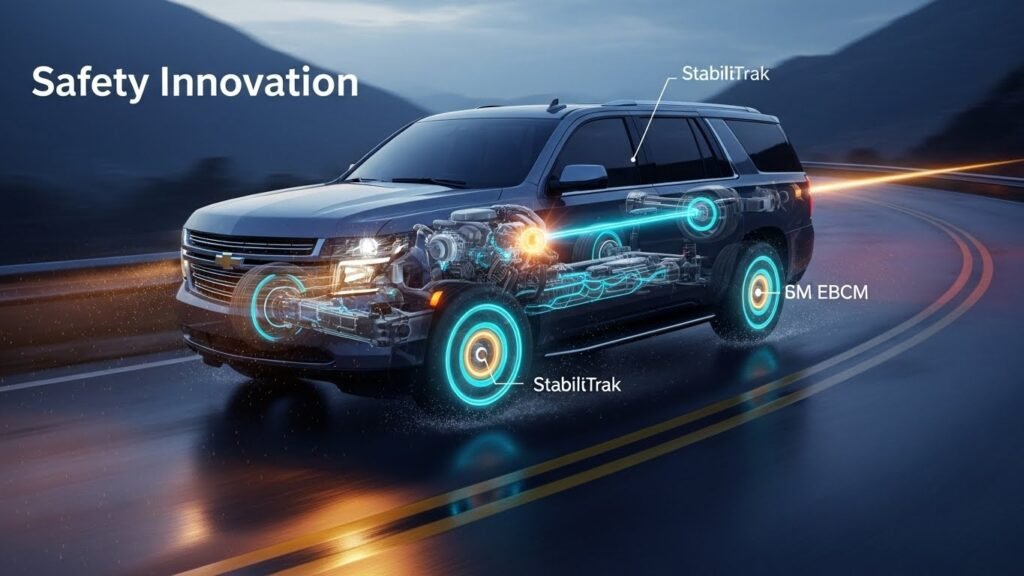
Chevrolet’s StabiliTrak system is a real game-changer for anyone hitting the road today. It has become a key part of modern vehicle safety by giving you better stability and control. This smart tech is designed to keep you steady when things get dicey behind the wheel. Whether the weather is acting up or you face an unexpected turn, it has your back. In this guide, we will dive deep into how this Chevy tech keeps you safe and sound.
What Is Chevrolet StabiliTrak?
StabiliTrak is the name for GM’s own electronic stability control tech. It was made with the help of Delphi Automotive and first showed up in 1996. The main goal of this system is to keep you from losing control of your ride. It does this by tweaking your brakes and engine power automatically. It is basically like having a pro driver helping you out in the background.
The system is a real lifesaver on icy roads or when you have to swerve fast. It keeps the car from skidding out or rolling over on uneven ground. StabiliTrak is a huge part of why Chevy is known for safe and dependable trucks and cars. Experts say these systems cut the risk of fatal single-car crashes by 38%. That is a massive boost for your peace of mind while driving.
The Anatomy of the StabiliTrak System: Key Components
To understand StabiliTrak, you have to look at the parts that make it tick. It is not just one thing, but a team of parts working together. Each piece has a specific job to do to keep you on the road. When they all work right, you probably won’t even notice they are there. Here is a breakdown of the hardware inside your vehicle:
- Electronic Control Module (EBCM): This is the brain of the whole stability operation. It takes in all the data and decides what to do next.
- Hydraulic Modulator Unit: This part handles the physical work of braking. It can pump the brakes on one wheel without you even touching the pedal.
- Wheel Speed Sensors: These are located at each wheel hub. They tell the computer exactly how fast every tire is spinning.
- Steering Wheel Position Sensor: This sensor tracks where you are pointing the car. It lets the system know exactly where you want to go.
- Yaw Rate and Lateral Acceleration Sensors: These measure the forces pushing on the car. They detect if the car is sliding sideways or spinning.
- Powertrain Control Module Interface: This lets the safety system talk to the engine. It can pull back on engine power to stop wheels from spinning too fast.
How StabiliTrak Technology Works

The system uses a huge web of sensors tucked away all over your vehicle. These sensors grab data in real-time about how your car is moving. All that info goes straight to the electronic control unit for a quick check. It happens so fast that you can’t even blink before it reacts. It is constantly comparing what you are doing with what the car is doing.
Monitoring wheel speed and steering input
StabiliTrak is always watching how fast your wheels are turning. It looks at that speed and compares it to your steering wheel angle. If you are turning the wheel but the car stays straight, it knows. This helps it find out if you are starting to slide off path. It is the first line of defense against a nasty skid.
Detecting yaw rate
The yaw rate sensor is like a balance scale for your car. It measures how much the vehicle is rotating around its center. If the car starts to spin too much, the system jumps in. This is how it catches oversteering or understeering before it gets dangerous. It keeps the car pointed in the right direction no matter what.
Applying corrective measures
Once the system finds a problem, it acts fast to fix it. It can put brake pressure on just one wheel to pull you straight. It also cuts engine power so the tires can find their grip again. It works with other parts of the car to keep things steady. Usually, it fixes the slide before you even feel the car wiggle.
Key Benefits of the StabiliTrak System
Having this tech in your Chevy brings a lot of good things. It is mostly about keeping you and your family safe on every trip. You don’t have to worry as much about the road conditions. It makes every drive feel a whole lot smoother and more controlled. Here are the top perks of using this system:
- Enhanced Stability: You get way better grip on roads covered in rain or ice. It stops you from sliding around when the ground is slick.
- Driver Confidence: You can handle sharp curves and quick stops with total ease. It takes the stress out of driving in bad weather.
- Reduced Rollover Risk: It helps keep the car flat and steady during fast turns. This makes it much less likely for the car to tip over.
- Emergency Safety: If you have to move fast to avoid a crash, it helps. It reacts in a split second to keep you in your lane.
StabiliTrak in Advanced Driving Scenarios
There are times when driving gets really tricky for even the best drivers. StabiliTrak shines the brightest when things are at their worst. It handles the physics of the car so you don’t have to. Whether you are towing a heavy load or racing, it adapts. Let’s look at how it handles these tough spots.
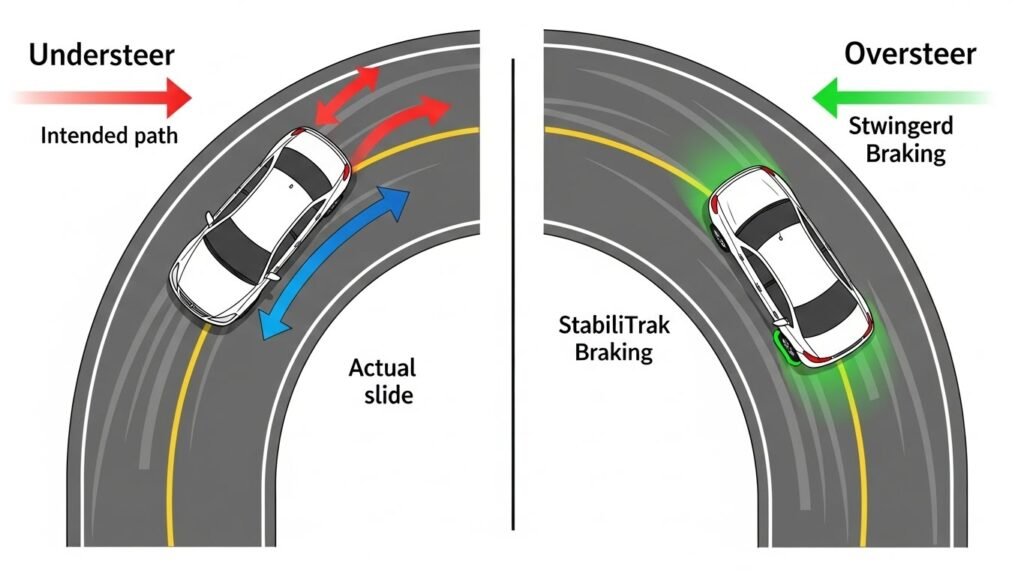
The Physics of Understeer
Understeer happens when you turn the wheel, but the car keeps going straight. It usually feels like the front tires have lost all their grip. StabiliTrak sees this and brakes the inside back wheel to help. This creates a pivot point that pulls the front end into the turn. It makes the car go exactly where you are pointing it.
The Physics of Oversteer
Oversteer is when the back of the car tries to swing around. People often call this fishtailing, and it can be very scary. The system stops this by braking the outside front wheel immediately. This force pushes against the spin and straightens the car out. It keeps you from spinning out into the ditch or other cars.
Trailer Sway Control

If you drive a Silverado, you know that trailers can sometimes wiggle. This “sway” can pull the whole truck off the road. StabiliTrak has a special mode just for people who are towing. It senses the trailer’s movement and uses the truck’s brakes to stop it. It makes pulling a heavy trailer feel a lot safer for everyone.
Chevrolet Models Equipped with StabiliTrak
Chevy puts this safety tech in almost every ride they make now. They want everyone to have the best protection possible on the road. From small cars to the biggest trucks, you will find it there. It shows how much they care about people buying their vehicles. Here are some popular models that come with it standard:
- Chevrolet Silverado: This beast uses it to stay safe while towing heavy stuff. It handles the toughest jobs without breaking a sweat.
- Chevrolet Equinox: A great family SUV that stays steady on every road trip. It keeps the kids safe even when the rain starts pouring.
- Chevrolet Suburban: This huge ride needs stability control to handle big turns. It keeps the large frame balanced and under your full control.
- Chevrolet Traverse: A versatile ride that gives you confidence in the city or woods. It is built to keep you moving forward safely.
- Performance Models: Even fast cars like the Corvette and Camaro use it. It is tuned to help you go fast without losing your grip.
When and Why StabiliTrak Activates
You don’t have to do anything to turn StabiliTrak on normally. It starts working the second you turn your key in the ignition. It is always listening and watching for signs of trouble. You might see a little light flash on your dash when it’s busy. This just means the system is doing its job to help you.
Slippery Surfaces
When you hit a patch of ice or deep water, the system wakes up. It keeps the wheels from spinning out of control on the slick stuff. This is when you are most likely to feel it working for you. It helps you keep moving forward instead of sliding to the side. It is your best friend during a cold winter morning drive.
Sudden Swerves
Sometimes you have to dodge a deer or a pothole very quickly. A sudden move like that can make any car get unstable fast. StabiliTrak steps in to keep the car from tipping or spinning away. It helps you get back into your lane safely after the dodge. It keeps your heart rate down when things get wild.
StabiliTrak vs. Traction Control: Understanding the Difference
Many people think these two systems are the exact same thing. They are related, but they actually do different jobs for you. Both are important for safety, but they watch for different problems. Chevy builds them to work together like a perfect safety duo. Understanding the difference helps you know how your car handles.
- Traction Control: This system only cares about your wheels spinning too fast. It mostly helps when you are trying to speed up from a stop.
- StabiliTrak: This system looks at the whole movement of the entire car. It cares about where the car is pointed and if it’s sliding.
- The Synergy: Traction control keeps you moving, while StabiliTrak keeps you on path. Together, they make your Chevy a very safe place to be.
Manual Control: When and How to Disable StabiliTrak
Even though it is a great system, sometimes you need to turn it off. There is usually a button on your dash with a car and squiggly lines. Most of the time, you should leave it alone and let it work. But in very specific spots, turning it off can actually help you. Just remember to turn it back on when you hit the road.
- Deep Snow or Mud: If you are totally stuck, you might need the tires to spin. The system might cut power when you need it most to get out.
- Performance Driving: Some people like to feel the car slide a bit on a track. Chevy has special modes that let you have more control of the slide.
- Off-Roading: On very rocky or loose ground, the system might get confused. Turning it off can give you better control over the rough terrain.
Identifying Common StabiliTrak Problems

Like any piece of tech, StabiliTrak can have some bad days. If something goes wrong, your car will definitely let you know. You will usually see a message that says “Service StabiliTrak” on your dash. Don’t ignore this message because your safety features might be off. Here are some common things that can cause the system to act up:
- Dirty Sensors: Road salt, mud, and grime can coat the wheel sensors. If they can’t “see,” they can’t tell the computer what is happening.
- Sensor Malfunctions: Sometimes the sensors just wear out and stop working right. A bad steering sensor is a very common reason for a warning light.
- Weak Battery: These systems need a steady flow of good electricity to work. If your battery is dying, the safety system might glitch out.
- Wiring Issues: Wires near the wheels can get pinched or broken over time. This cuts the connection between the sensors and the car’s brain.
Troubleshooting and Fixes for StabiliTrak Issues
If your light comes on, do not panic right away. Sometimes it is just a tiny glitch that is easy to fix. Other times, you might need a pro to take a look at it. Knowing what to do can save you a lot of time and stress. Here is how you should handle a StabiliTrak warning light.
Safe Reset Procedures
The first thing you should try is a simple power reset. Pull over to a safe spot and turn off your car engine. Wait for about 20 to 30 seconds before you turn it back on. This gives the computer a chance to clear any small software hiccups. If the light stays off after you drive, it was likely just a glitch.
Professional Diagnostics and Repairs
If the light stays on, it is time to visit a shop. Mechanics use a tool called an OBD-II scanner to read the car’s mind. It will show a specific code that tells them exactly what is broken. This saves you money because they don’t have to guess what’s wrong. Always use a certified Chevy tech to make sure it’s fixed right.
Maintenance and Prevention Tips

The best way to fix a problem is to make sure it never happens. A little bit of care goes a long way with these safety systems. You should include StabiliTrak checks in your normal car care routine. It doesn’t take much work to keep things running perfectly for years. Follow these simple tips to keep your system in top shape:
- Wash Your Car: Make sure to spray out the wheel wells during the winter. This keeps the sensors clean from road salt and slushy mud.
- Check Your Battery: Have your battery tested once a year to ensure it’s strong. A healthy battery keeps all your car’s computers very happy.
- Watch Your Fluids: Keep your brake fluid clean and filled to the right level. The system needs that fluid to push the brakes when you’re sliding.
- Gentle Driving: Avoid hitting big potholes or curbs whenever you possibly can. Hard hits can knock your sensors out of place or break them.
Comprehensive Safety System Maintenance Schedule
Daily and Weekly Preventive Checks
The best way to catch a safety system issue before it becomes a hazard is through regular observation. These quick checks don’t require tools and should be part of your normal driving routine.
- Dashboard Warning Lights: Every time you start your vehicle, check that the ABS and StabiliTrak icons light up and then turn off. If they stay on, the system has detected a fault.
- Camera and Sensor Clarity: Walk around your vehicle once a week to ensure the backup camera lens and bumper sensors are free of mud, ice, or road salt.
- Tire Pressure Monitoring: Check your tire pressure at least once a month using a manual gauge, even if your TPMS (Tire Pressure Monitoring System) isn’t showing a light. Drastic temperature changes can cause pressure to drop.
Short-Term Maintenance (Every 5,000 to 10,000 Miles)
Most owners perform these services during every oil change. These tasks ensure that the “mechanical hands” of the StabiliTrak system are ready to grip the road.
- Tire Rotation: Rotating your tires ensures even tread wear. Uneven tread can confuse StabiliTrak sensors, as wheels with different diameters spin at slightly different speeds.
- Brake Pad and Rotor Inspection: Visually check the thickness of your brake pads. Worn pads increase stopping distance and force the ABS to work harder during emergencies.
- Windshield Cleaning: For models with lane-keep assist or forward collision alert, keep the top-center of your windshield (near the rearview mirror) clean. This is where the forward-facing camera “sees” the road.
Annual or Long-Term Maintenance (Every 20,000 to 30,000 Miles)
Deep-level maintenance involves the fluids and electronic components that keep the system responsive over several years.
- Brake Fluid Flush: Brake fluid is hygroscopic, meaning it absorbs moisture over time. This can lead to corrosion inside the ABS hydraulic pump. Flushing the fluid every 2 to 3 years prevents expensive system failures.
- Suspension and Alignment Check: Have a technician inspect your shocks, struts, and ball joints. A loose suspension can cause “body roll” that triggers StabiliTrak unnecessarily during normal turns.
- ABS Sensor Cleaning: Over time, metallic dust from your brakes can stick to the magnetic wheel speed sensors. Having a professional clean these sensors during a brake service can prevent false “Service StabiliTrak” lights.
Electronic and Hardware Calibrations
Certain events in your vehicle’s life require you to “re-teach” the safety systems how to behave.
- After a Wheel Alignment: If you get an alignment, ensure the shop resets your Steering Angle Sensor. If the car thinks the wheel is turned when you are actually driving straight, StabiliTrak may activate erroneously.
- Windshield Replacement: If your Chevy has a camera-based safety system, you must have the camera recalibrated if the windshield is replaced.
- Battery Health Check: StabiliTrak is highly sensitive to voltage. If your battery is more than three years old, have it load-tested. Low voltage during startup is a leading cause of phantom stability control errors.
Conclusion: The Peace of Mind of Driving a Chevy
StabiliTrak is one of the coolest safety tools in your vehicle today. It works silently to make sure you get home safe every single night. By watching your tires and steering, it catches mistakes before they turn into crashes. It truly shows how far automotive tech has come over the years.
As we move toward electric cars and self-driving tech, StabiliTrak will keep getting better. It is the foundation for almost all the safety features we use today. Take care of your system, and it will take care of you and your family. If you want to see it in action, go test drive a new Chevy today. You will feel the difference the moment you get behind the wheel.
FAQs
Does StabiliTrak work when the vehicle is in reverse?
No, StabiliTrak is generally designed to function when the vehicle is moving forward. The sensors and logic used to detect yaw (spinning) and steering path are calibrated for forward motion. However, your Anti-lock Braking System (ABS) remains active to prevent wheel lock-up while backing up.
Is StabiliTrak the same as All-Wheel Drive (AWD)?
No. AWD is a mechanical system that sends engine power to all four wheels to help you move forward. StabiliTrak is an electronic safety system that uses the brakes and engine power to keep the car from sliding sideways. You can have a vehicle with StabiliTrak that is only Front-Wheel Drive.
Can a bad wheel alignment trigger the Service StabiliTrak light?
Yes. If your alignment is significantly off, your steering wheel may be turned slightly to the side while the car is moving straight. The Steering Angle Sensor sees this “crooked” wheel and thinks you are trying to turn, but the wheel speed sensors say you are going straight. This conflict can disable the system and trigger a warning light.
Why does my StabiliTrak light come on when I use a spare tire?
Spare tires (especially “donuts”) are often a different diameter than your standard tires. Because they are smaller, they must spin faster to keep up with the other wheels. The system sees one wheel spinning at a different speed and assumes it is slipping, which can cause the light to flash or the system to shut down.
Will an engine misfire cause a StabiliTrak warning?
Surprisingly, yes. StabiliTrak relies on the engine’s ability to precisely reduce torque (power) when a skid is detected. If the engine has a misfire (caused by bad spark plugs or coils), the computer cannot guarantee it can control the power properly. As a safety precaution, it will often disable StabiliTrak and show a warning.
What is the difference between StabiliTrak and “Competitive Mode”?
In performance vehicles like the Camaro or Corvette, Competitive Mode is a special setting that keeps StabiliTrak active but allows for more wheel spin and “sliding” before it intervenes. It is meant for closed-course track driving where a driver wants more control without losing the entire safety net.
Can StabiliTrak help prevent a rollover in a tall SUV?
Yes, this is one of its primary jobs in vehicles like the Tahoe or Suburban. It uses lateral acceleration sensors to detect if the vehicle is tilting too far during a turn. It can apply heavy braking to the outside wheels to “pull” the car flat and prevent it from tipping over.
Does StabiliTrak use more brake pads?
Technically, yes, but only if you drive in conditions where the system is constantly activating. Because it uses individual brakes to steer the car during a skid, frequent intervention will lead to slightly faster wear on your brake pads and rotors.
Can I permanently disable StabiliTrak?
While you can turn it off using the dashboard button, the system will automatically turn itself back on every time you restart the car. There is no factory setting to disable it permanently because it is a federally mandated safety feature.
Will StabiliTrak work if my ABS light is on?
No. StabiliTrak uses the same hydraulic pump and sensors as the Anti-lock Braking System. If the ABS is broken, StabiliTrak loses its ability to pump the brakes automatically, so both systems will usually shut down at the same time.
Does the system work at high speeds on the highway?
Yes, StabiliTrak is active at almost all speeds. In fact, it is most critical at highway speeds, where a sudden swerve to avoid debris could easily lead to a “fishtail” or rollover without electronic intervention.
Why does my car lose power when the StabiliTrak light flashes?
This is a feature, not a bug. When the system detects your tires are spinning or the car is sliding, it tells the engine to “throttle down.” This reduction in power helps the tires regrip the road surface so you can regain control.
Can aftermarket “lift kits” affect StabiliTrak?
Yes. Lifting a truck changes its center of gravity and the angles that the sensors expect. If a lift kit is installed without recalibrating the sensors, StabiliTrak might become too sensitive or fail to activate when a real rollover risk occurs.
How does StabiliTrak know if I am on ice or just turning fast?
It compares your steering wheel angle with the “Yaw Rate” (how much the car is actually spinning). If you turn the wheel 90 degrees but the car doesn’t rotate, the system knows the surface is low-friction (like ice) and begins its correction process.
Is StabiliTrak the same as “AdvanceTrac” or “VSA”?
They are all different brand names for the same core technology: Electronic Stability Control (ESC). Ford calls theirs AdvanceTrac, Honda uses VSA (Vehicle Stability Assist), and GM/Chevrolet uses StabiliTrak.
Does StabiliTrak help with braking distances?
Not directly. Its job is stability (keeping you straight). However, because it works with ABS, it ensures that while you are braking as hard as possible, you can still steer the car around an obstacle without locking up the wheels.
Can a low battery cause a “Service StabiliTrak” message?
Yes. During a cold start, if the battery voltage drops too low, the StabiliTrak computer may not “wake up” properly. This can trigger a fault code even if the system is mechanically perfect. Replacing an old battery often fixes “phantom” StabiliTrak lights.
Does StabiliTrak work on sand or deep mud?
It tries to, but this is one of the few times it can be a disadvantage. In deep sand, you often need the wheels to spin to keep momentum. StabiliTrak will try to stop that spin, which could cause you to get stuck. This is why Chevy provides a button to turn it off in those specific situations.
Can I reset the StabiliTrak light with a standard code reader?
You can clear the codes with a basic OBD-II scanner, but if the underlying problem (like a broken wire or bad sensor) is still there, the light will turn back on as soon as the car moves more than a few feet.
Is StabiliTrak active when Cruise Control is on?
Yes. In fact, if StabiliTrak detects a slide or has a malfunction, it will automatically cancel your Cruise Control immediately as a safety measure to ensure the driver has full manual control of the engine’s power.