Skip to content

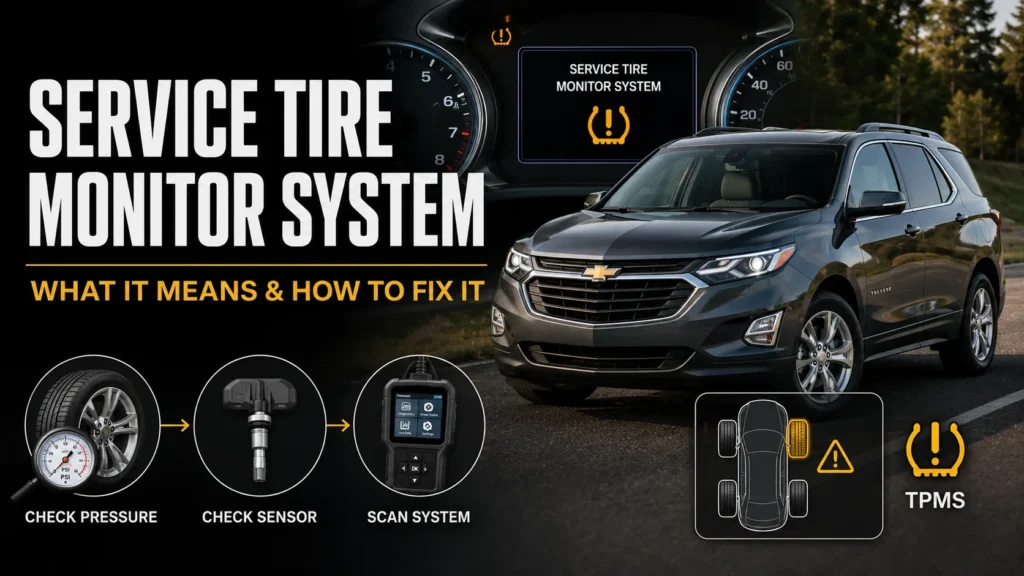
Seeing Service Tire Monitor System on your dashboard can be confusing, especially when all four tires look properly inflated. I would not treat this message the same way as a normal low tire pressure warning. It usually means the Tire Pressure Monitoring System (TPMS) has detected a fault and may not be able to monitor one or more tire pressure sensors correctly.
The good news is that you can do a few simple checks before paying for a repair. I would start with tire pressure, then check the warning light and tire pressure readings. If the message remains, the vehicle may need a TPMS relearn, sensor test, or sensor replacement.
Quick Answer
Service Tire Monitor System usually means there is a problem with the vehicle’s TPMS, rather than simply low air in a tire. A failed sensor, dead sensor battery, damaged sensor, incorrect relearn, or communication problem can cause the message. Check all tire pressures first. If the warning remains, the TPMS may need diagnosis or relearning.
What Does Service Tire Monitor System Mean?
The Service Tire Monitor System message means the vehicle has detected a problem with the system that monitors tire pressure.
TPMS uses sensors and other electronic parts to send tire pressure information to the vehicle. If one or more sensors stop sending usable information, the vehicle may display a service warning.
This message is common on Chevrolet, GMC, Buick, and Cadillac vehicles, although other brands use different wording for similar TPMS faults.
The key point is simple:
The message can indicate a problem with the tire monitoring system itself, not just the air pressure in the tires.
If the system cannot read a tire sensor correctly, you may lose the normal warning that tells you when a tire is losing pressure.
Service Tire Monitor System vs Low Tire Pressure

These two warnings are easy to mix up, but they usually point to different problems.
| Warning | What it usually means | What to do |
| Low Tire Pressure | One or more tires may have low air pressure | Check and adjust tire pressure |
| Service Tire Monitor System | The TPMS has detected a system fault | Check the system and sensors |
| Flashing TPMS light, then solid | Possible TPMS malfunction | Have the system diagnosed |
| Missing pressure reading | A sensor may not be communicating | Check or relearn the sensor |
A normal low-pressure warning means the TPMS is doing its job and has detected low pressure.
A Service Tire Monitor System warning is different. The monitoring system itself may have a problem.
What Does the TPMS Do?

The Tire Pressure Monitoring System, or TPMS, watches tire pressure and alerts you when pressure falls below the vehicle’s set limit.
Many vehicles use a pressure sensor at each wheel. These sensors send information to the vehicle, which then displays pressure readings or warning messages on the dashboard.
This system gives you an extra warning if a tire loses pressure while driving.
It does not replace regular tire checks, though. I would still check tire pressure with a proper gauge and use the pressure listed on the vehicle’s Tire and Loading Information label.
Why Does the Service Tire Monitor System Warning Come On?

There are several possible causes. The message alone does not tell you which part has failed.
A Bad TPMS Sensor
A TPMS sensor can stop working because of age, internal damage, or an electronic fault.
The sensor sits inside or at the wheel assembly, so it can also be damaged during tire removal or installation.
If one sensor stops sending information, the vehicle may show the Service Tire Monitor System message even when the tire itself is holding air normally.
A Dead Sensor Battery
Many TPMS sensors use a built-in battery.
These batteries eventually lose their charge. Since the battery is part of the sensor assembly on many systems, replacing the sensor is often the practical solution when its battery has reached the end of its service life.
A Sensor Needs to Be Relearned
A sensor may work correctly but still fail to communicate with the vehicle if the vehicle has not learned the sensor correctly.
This can happen after:
- Tire rotation
- Tire replacement
- Wheel replacement
- TPMS sensor replacement
- Certain tire service work
A Damaged TPMS Sensor
A sensor can suffer damage during tire mounting, dismounting, or a hard impact.
The tire may look fine from the outside while the sensor has a problem inside the wheel.
This is one reason I would not assume the tire itself is the problem just because the warning appears.
A Communication Problem
The vehicle needs to receive information from the TPMS sensors.
If a sensor stops transmitting or the vehicle cannot receive its signal correctly, the system may set a fault.
A scan tool can help identify whether the problem is with one sensor or the wider TPMS system.
Wrong or Incompatible Sensor
A replacement sensor needs to be compatible with the vehicle.
Installing an incorrect sensor or one that has not been properly configured can prevent the vehicle from receiving the expected information.
This is worth checking if the warning started soon after new tires, wheels, or TPMS sensors were installed.
Tire Service Was Not Followed by the Required Relearn
If the warning appeared shortly after a tire rotation or sensor replacement, I would check whether the required TPMS relearn was completed.
Some vehicles learn sensor positions automatically. Others require a specific procedure or a TPMS activation tool.
There is no single relearn method that works for every Chevrolet or GM vehicle.
What Should You Check First?

I would follow a simple process instead of immediately replacing a sensor.
1. Check All Four Tire Pressures
Use a tire pressure gauge and check all four tires when they are cold.
Use the pressure shown on the Tire and Loading Information label on the driver’s door area, rather than the maximum pressure printed on the tire sidewall.
Also look for:
- A visibly low tire
- A puncture
- A damaged valve stem
- A tire that keeps losing air
If you find low pressure, correct it and check the tire for a leak.
2. Look at the TPMS Warning Light
Pay attention to what the light does when you start the vehicle.
If it stays on solid, low tire pressure may be the issue.
If it flashes for a period and then stays on, that can point to a TPMS system fault.
3. Check the Tire Pressure Readings
If your vehicle displays individual tire pressures, check whether all four tires show a reading.
If one tire shows no reading or a dash instead of pressure, that can help point to a sensor or communication problem.
If all four readings disappear, the problem may involve more than one sensor or another part of the TPMS system.
4. Think About Recent Tire Work
Ask yourself when the warning started.
Did it appear after:
- A tire rotation?
- New tires?
- New wheels?
- A TPMS sensor replacement?
- Tire repair?
- Wheel repair?
If the answer is yes, a relearn or sensor-related issue becomes more likely.
Does Service Tire Monitor System Need a Reset or Relearn?
This is where many guides make the process sound too simple.
A reset and a relearn are not always the same thing.
Adding Air
If the problem is simply low tire pressure, you need to set the tires to the correct pressure.
That is not the same as repairing a TPMS fault.
Resetting the System
Some vehicles have a procedure that allows the system to update or clear its warning after the correct condition has been restored.
The exact process depends on the vehicle.
Relearning the Sensors
A TPMS relearn teaches the vehicle which sensor belongs to each wheel position.
This can be required after certain tire rotations, sensor replacements, or other tire work.
Programming a Sensor
A replacement sensor may also need to be configured so the vehicle can recognize it.
Because these systems vary by model and year, I would not use one generic reset procedure on every Chevrolet, GMC, Buick, or Cadillac.
How to Relearn TPMS Sensors

There is no universal TPMS relearn process for every GM vehicle.
Some models use a TPMS activation tool. Some have a vehicle menu that starts the learning process. Others can learn sensor information during driving.
The safest approach is to use the procedure for your exact:
- Make
- Model
- Model year
- Wheel setup
- TPMS system
If the vehicle requires a TPMS tool and you do not have one, a tire shop can usually perform the relearn.
I would avoid following a procedure written for a different model just because the dashboard message looks the same.
Can You Drive With Service Tire Monitor System On?

You may still be able to drive normally, but I would not ignore the warning.
The main issue is that the TPMS may not be working correctly. That means you may not receive the normal warning if a tire loses pressure.
Before driving, I would manually check all four tire pressures.
Do not continue driving if:
- A tire is visibly damaged
- A tire is losing air
- The vehicle pulls strongly to one side
- Steering feels abnormal
- You hear unusual tire noise
- A tire becomes very soft
If the tires have normal pressure and the vehicle drives normally, arrange TPMS diagnosis rather than leaving the warning unresolved.
How Do You Diagnose a Bad TPMS Sensor?

A TPMS problem often needs more than a visual inspection.
A technician can use a TPMS scan tool to check whether each sensor is transmitting information.
The scan can help identify:
- Sensor ID
- Tire pressure
- Sensor temperature
- Battery condition, where supported
- Sensor communication
- Fault codes
- Relearn status
A bad sensor may still be physically attached to the wheel while failing to send usable data.
This is why replacing a sensor without testing the system first can waste money.
Signs a TPMS Sensor May Be Bad
A sensor problem becomes more likely if:
- One tire pressure reading is missing
- The warning remains after tire pressures are correct
- The warning appeared after a sensor replacement
- The warning appeared after tire work
- A sensor will not complete the relearn
- A scan tool cannot communicate with the sensor
- The sensor battery has reached the end of its service life
One failed sensor can trigger a system warning even when the other three tires and sensors work correctly.
How Much Does It Cost to Fix Service Tire Monitor System?

There is no single repair price because the cause can be simple or more involved.
Your cost may depend on:
- TPMS diagnosis
- Sensor type
- Number of failed sensors
- Sensor replacement
- Tire removal and installation
- Programming
- TPMS relearn
- Labor rates
- Vehicle model and year
A simple relearn may cost much less than replacing a sensor.
If a sensor has failed, you may have to pay for the sensor itself plus tire and service labor.
I would get the system tested before approving multiple sensor replacements. If only one sensor has failed, replacing every sensor may not be necessary.
Why Does the Warning Come Back After a Reset?
If the message disappears and then returns, the reset may not have fixed the actual cause.
For example, the underlying problem could be:
- A weak TPMS sensor battery
- A damaged sensor
- An incorrect sensor
- An incomplete relearn
- A sensor communication fault
- A wiring or module problem
A reset can change the warning state, but it cannot repair a failed sensor.
If the warning keeps returning, I would move from resetting to diagnosis.
What If the Tires Have Normal Pressure?

This is one of the most confusing situations.
You check all four tires and they have the correct pressure, but the dashboard still says Service Tire Monitor System.
That can happen because tire pressure and TPMS health are two different things.
The tires can hold air normally while a sensor has stopped communicating.
In that situation, adding more air will not fix the TPMS fault.
Check the dashboard readings and look at how the TPMS warning behaves during startup. If the warning continues, the sensors or related system may need testing.
Can Cold Weather Cause a Tire Monitor Warning?
Cold weather can lower tire pressure because air contracts as temperature drops.
That can trigger a normal low-pressure warning.
However, cold weather can also expose a TPMS issue that was already developing.
So I would check the actual tire pressure before assuming the sensor has failed.
Can a Tire Rotation Cause Service Tire Monitor System?
It can contribute to a TPMS warning if the vehicle needs to relearn tire positions after the rotation and that process was not completed correctly.
This does not mean every tire rotation will cause a warning.
Some vehicles can learn sensor positions automatically, while others need a specific relearn procedure.
If the warning started right after a tire rotation, I would check the vehicle’s required TPMS relearn process before buying new sensors.
Can New Tires Cause the Warning?
New tires themselves do not automatically mean the TPMS has failed.
The issue can appear after tire installation if:
- A sensor was damaged
- A sensor was replaced
- The sensor is incompatible
- The sensor was not programmed correctly
- A required relearn was not completed
This is why I would tell the tire shop that the vehicle has TPMS before tire work begins.
How to Prevent the Warning From Coming Back
A few simple habits can reduce TPMS problems.
- Check tire pressure regularly.
- Use the pressure listed on the vehicle’s door label.
- Check pressure when the tires are cold.
- Inspect tires for damage.
- Tell the tire shop about the TPMS before tire work.
- Make sure replacement sensors match the vehicle.
- Complete the required TPMS relearn after applicable service.
- Do not ignore a warning that keeps returning.
Final Thoughts
I would treat Service Tire Monitor System as a TPMS fault rather than assuming you simply need more air.
Start with the basics: check all four tire pressures, inspect the tires, look at the TPMS warning behavior, and check whether the vehicle shows pressure readings for each wheel. If the warning appeared after tire work, check whether the sensors need to be relearned.
If the message remains, a TPMS scan can help identify the real cause. That is a better approach than repeatedly resetting the warning or replacing sensors without testing them.
Service Tire Monitor System FAQs
Will adding air fix Service Tire Monitor System?
It can fix a normal low-pressure warning, but it will not usually repair a TPMS system fault. If the Service Tire Monitor System message remains after the tires have the correct pressure, the system may need diagnosis.
How do I know if a TPMS sensor is bad?
A missing tire pressure reading, failed relearn, repeated warning, or failed communication test can point to a bad sensor. A TPMS scan tool can give a more reliable answer than guessing.
Does a tire rotation require TPMS relearning?
Some vehicles require the sensor positions to be relearned after a tire rotation. Others can learn them automatically. Check the procedure for your exact vehicle.
Can I drive if the Service Tire Monitor System message stays on?
You may be able to drive if the tires have the correct pressure and the vehicle handles normally, but the TPMS may not warn you about a pressure loss. I would have the system checked rather than ignoring the message.
Does a new TPMS sensor need to be programmed?
It may need programming, activation, or relearning depending on the vehicle and sensor. The exact process varies by model and year.
Can a TPMS sensor battery be replaced?
Many TPMS sensors use an internal battery that is not meant to be replaced separately. When the sensor battery reaches the end of its life, replacing the sensor is often the practical repair.
Why does my tire pressure look normal but the warning stays on?
Normal tire pressure does not prove that the TPMS is working. A sensor can fail while the tire continues to hold the correct amount of air.