Skip to content

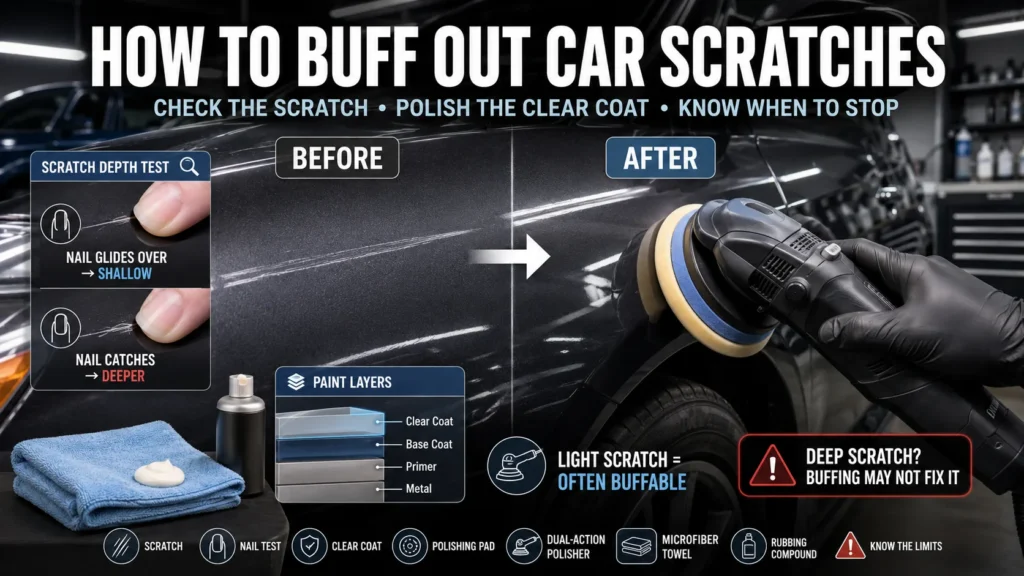
A scratch on your car does not always mean you need a body shop or a new paint job. Many light scratches sit only in the clear coat and can be improved or removed with the right polishing method.
The key is to check the scratch before you start. I recommend finding out how deep it is, then choosing the least aggressive repair method that can do the job. If the scratch has gone through the clear coat and into the paint, primer, or metal, buffing alone will not restore the missing material.
Quick Answer: Can You Buff Out Scratches on a Car?
Yes, you can buff out many light car scratches if they are limited to the clear coat. A scratch that does not catch your fingernail is usually a good candidate for polishing or compound. Deep scratches that reach the color coat, primer, or metal need touch-up paint or professional repair.
How to Tell If a Car Scratch Can Be Buffed Out

Before I put any compound or polish on a scratch, I would first check its depth. This can save you time and help prevent unnecessary clear coat removal.
Try the Fingernail Test

Clean the area first so dirt does not affect the test.
Then gently run your fingernail across the scratch, not along it.
If your nail glides over the mark without catching, the scratch is likely shallow and sits within the clear coat. These scratches are usually the best candidates for buffing or polishing.
If your fingernail catches in the groove, the scratch may have gone deeper into the paint. Buffing may reduce its appearance, but trying to remove the entire groove can take away too much clear coat.
The fingernail test is useful, but it is not a perfect depth measurement.
Look at the Scratch Under Good Lighting
Move the car into a shaded area with strong, even light or use a bright inspection light.
Look closely at the scratch.
A light white or hazy mark that changes with the angle of the light can be a clear coat defect. If you can see a different color inside the scratch, the damage may have reached the base coat.
Gray primer or bare metal is a clear sign that the scratch is deeper than a normal polishing job can fix.
Try a Simple Water Check

A small amount of clean water can help you judge a scratch.
Wet the area and look at it from different angles. If the scratch becomes much less visible while the surface is wet, it may be a shallow clear coat defect.
This is only a visual clue. It does not tell you the exact depth of the damage.
What Are the Different Types of Car Scratches?
Car paint has several layers. From the outside, you generally have clear coat, base coat or color, primer, and the underlying panel.
The deeper the scratch goes, the less likely buffing is to provide a complete repair.
| Scratch type | What you may see | Can buffing fix it? | Best approach |
| Light surface mark | Very fine line or haze | Usually | Polish or scratch remover |
| Clear coat scratch | White or hazy line | Often | Compound and polish |
| Base coat scratch | Car color is damaged | No, not fully | Touch-up paint and correction |
| Primer scratch | Gray or light primer visible | No | Paint repair |
| Bare metal scratch | Metal visible | No | Professional repair |
| Paint transfer | Color from another object | Often | Clean and polish first |
Clear Coat Scratches
The clear coat is the glossy outer layer of the paint system.
Many light scratches stay inside this layer. Because the colored paint underneath is still intact, controlled polishing can level the surrounding clear coat and reduce the visible defect.
These are the scratches I would consider first for DIY buffing.
Base Coat or Paint Scratches
If the scratch has gone through the clear coat and damaged the colored paint, polishing cannot put that missing paint back.
A scratch remover may make the edges less noticeable, but a complete repair usually requires touch-up paint followed by suitable finishing work.
Primer Scratches
If you see gray or light-colored primer inside the scratch, the damage has gone deeper.
Buffing is not the right fix. More polishing can remove additional clear coat around the damaged area without replacing the missing paint.
Bare Metal Scratches
Bare metal means the scratch has gone through several paint layers.
Do not keep buffing in an attempt to make this type of scratch disappear. It needs paint repair, and leaving exposed metal untreated can create additional problems over time.
Paint Transfer and Scuffs
Not every mark on your car is a true scratch.
If another vehicle, shopping cart, wall, or object leaves its paint on your car, you may be looking at paint transfer.
Cleaning and careful polishing can sometimes remove this type of mark without needing touch-up paint.
What You Need to Buff Out a Car Scratch

For a small clear coat scratch, you do not need a large collection of tools.
I would start with:
- Car wash soap
- Clean microfiber towels
- Automotive scratch remover
- Polishing compound
- Finishing polish
- Foam applicator pad
- Clean polishing pads
- Painter’s tape
- DA polisher, if using a machine
- Bright inspection light
You do not always need both compound and polish. Start with the least aggressive product that may solve the problem.
If a mild polish works, there is no reason to move to a stronger compound.
How to Buff Out Car Scratches by Hand

Hand polishing is a good starting point for a small, light scratch because you have more control over the amount of correction.
Step 1: Wash the Car
Start with a clean surface.
Wash the affected panel with automotive car wash soap and clean water. Dirt or grit left on the paint can create more scratches while you work.
Rinse the panel well.
Step 2: Dry the Panel Completely
Use a clean microfiber drying towel.
Make sure the area is completely dry before applying your polishing product.
Work in a shaded area rather than on hot paint in direct sunlight.
Step 3: Inspect the Scratch
Perform the fingernail test and examine the scratch under good lighting.
If it catches your nail or shows primer or metal, do not try to remove it by repeatedly buffing the area.
Step 4: Mask Nearby Trim
Use painter’s tape to protect nearby plastic trim, rubber seals, badges, and sharp edges.
This also helps you keep your work area controlled.
Step 5: Test the Product
Do not immediately cover the entire scratch with compound.
Choose a small section and apply a small amount of a mild scratch remover or polish.
Work the area and wipe it clean.
Check the result before continuing.
This test tells you whether the product is working and helps prevent unnecessary paint removal.
Step 6: Apply the Scratch Remover or Polish
Put a small amount of product on a clean foam applicator.
Work a small section of the scratch with moderate, controlled pressure.
Follow the product’s instructions for working time and application method.
Do not use excessive force.
Step 7: Wipe and Inspect
Use a clean microfiber towel to remove the remaining product.
Look at the area under good lighting.
If the scratch has become less visible, you are moving in the right direction.
Step 8: Repeat Only If Needed
If the first pass does not fully correct the scratch, you can make another controlled pass.
Do not keep polishing the same spot over and over without checking the result.
Your clear coat is a limited layer. The goal is to remove as little as possible while getting the improvement you need.
Step 9: Finish With Polish
If you used a stronger compound, a finishing polish can help refine the surface and restore gloss.
Use a clean pad or applicator.
Work the area gently and wipe it clean when finished.
Step 10: Protect the Paint
After the scratch has been corrected, protect the paint with a suitable wax, sealant, or other paint protection product.
This does not repair the scratch. It helps protect the corrected surface from future contamination and wear.
How to Buff Out Scratches With a DA Polisher

A dual-action, or DA, polisher can correct clear coat defects more quickly than hand polishing.
It also gives you a more consistent motion across the panel.
If you have never used a machine polisher, start with a mild polish and a less aggressive pad.
Basic DA Polishing Process
- Wash and dry the panel.
- Inspect the scratch.
- Mask nearby trim.
- Choose a mild polish and pad.
- Test a small area.
- Spread the product over a small section.
- Work the machine with controlled passes.
- Keep the machine moving.
- Wipe the area clean.
- Inspect the result.
- Increase product or pad aggressiveness only if needed.
Do not hold the machine in one place for too long.
Heat and excessive clear coat removal can damage the paint.
If you are new to machine polishing, practice on a less important panel or use a professional detailer for valuable or difficult paint.
Can You Buff Out Deep Scratches?

Usually, no.
Buffing works by removing or leveling a very small amount of the surrounding clear coat. It cannot replace paint that has already been removed.
If a scratch reaches the base coat, primer, or bare metal, you need a different repair method.
For example:
Clear coat damage: compound and polish may work.
Base coat damage: touch-up paint may be needed.
Primer or metal damage: paint repair or professional body work may be needed.
Trying to solve a deep scratch with more aggressive buffing can make the surrounding area worse.
Can Toothpaste Buff Out Car Scratches?
Toothpaste contains mild abrasive ingredients, which is why this DIY method is often suggested for light scratches.
However, regular toothpaste is not made for automotive paint correction.
It may slightly improve the appearance of a very fine surface mark, but a dedicated automotive polish or scratch remover gives you better control.
I would use an automotive product rather than relying on toothpaste for car paint.
Can Baking Soda Remove Car Scratches?
Baking soda is sometimes suggested as a homemade scratch remover.
I would not use it as my first choice for automotive paint.
A proper automotive polish is made to work with painted surfaces and gives you more predictable results.
Baking soda may also create an uneven finish if it is rubbed aggressively against the paint.
Can a Magic Eraser Remove Car Scratches?
I would avoid using a Magic Eraser on automotive paint.
Magic Erasers are abrasive. They can remove more than you expect and may leave the paint looking dull or hazy.
A product made for automotive paint correction is a safer choice.
Buffing vs Polishing vs Rubbing Compound
These terms are often used as if they mean the same thing, but there are differences.
| Method | Main purpose | Relative cut | Good for |
| Polish | Refine the finish | Low | Fine marks and light defects |
| Scratch remover | Small paint defects | Low to medium | Light clear coat scratches |
| Rubbing compound | Remove more noticeable defects | Medium to high | Deeper clear coat defects |
| Buffing | General correction process | Depends on product and pad | Clear coat correction |
| Touch-up paint | Replace missing paint | Not applicable | Deeper scratches |
| Wet sanding | Level severe defects | High | Advanced paint correction |
I recommend starting with the least aggressive option that can solve the problem.
There is no benefit in removing more clear coat than necessary.
Common Buffing Mistakes to Avoid
Buffing a Dirty Panel
Dirt and grit can create additional scratches.
Always clean the surface before polishing.
Using Too Much Compound
More product does not automatically mean better results.
Use the amount recommended by the product manufacturer.
Starting With an Aggressive Compound
A strong compound may remove defects faster, but it also removes more clear coat.
Start mild and increase the level of correction only when necessary.
Applying Too Much Pressure
Heavy pressure is not a shortcut to better correction.
Use controlled pressure and let the product and pad do the work.
Staying in One Spot Too Long
Keeping a machine polisher in one place can build heat and remove too much material.
Keep the machine moving across the working area.
Skipping the Test Spot
A test spot gives you useful information before you work on the entire panel.
It can show whether your chosen product is strong enough or more aggressive than needed.
Trying to Buff Through the Clear Coat
If the scratch has reached the base coat, primer, or metal, more buffing will not replace the missing paint.
Stop and choose the correct repair method.
When Should You Stop Buffing?
Stop polishing if:
- Your fingernail catches deeply in the scratch
- You can see primer
- You can see bare metal
- The paint becomes unusually hot
- The finish starts becoming hazy
- The scratch does not improve after reasonable correction
- You are unsure how much clear coat remains
The goal is correction, not removing as much paint as possible.
If you are uncertain, it is better to stop than to keep cutting the clear coat.
When Should You Get Professional Scratch Repair?
Professional help makes sense for deep or complicated damage.
Consider a professional detailer or body shop if:
- The scratch reaches bare metal
- Primer is visible
- A large area is damaged
- Several panels are scratched
- The panel has unusual or difficult paint
- You cannot improve the scratch with mild correction
- The scratch came from a collision
- You are not comfortable using a machine polisher
A professional can assess the paint and decide whether it needs correction, touch-up paint, wet sanding, or repainting.
How to Prevent New Car Scratches
Once you correct a scratch, good washing habits can help prevent new ones.
Use Clean Microfiber Towels
Dirty towels can carry grit across the paint.
Use clean towels and separate towels for different parts of the vehicle.
Wash With Proper Car Soap
Avoid using harsh household cleaners that are not made for automotive paint.
Avoid Dirty Washing Tools
A dirty wash mitt or brush can drag particles across the surface.
Rinse your tools regularly during the wash.
Dry the Car Carefully
Do not drag a dirty or dry towel across the paint.
Use a clean microfiber drying towel and light pressure.
Consider Paint Protection
Wax, sealants, ceramic coatings, and paint protection film can help reduce exposure to contamination and everyday wear.
They cannot make paint scratch-proof, but they can add another layer of protection.
How Long Does It Take to Buff Out a Car Scratch?
A small clear coat scratch may take only a short time to correct by hand.
The actual time depends on:
- Scratch size
- Scratch depth
- Paint hardness
- Product used
- Hand or machine application
- Number of correction passes
- Amount of surface preparation
A deep scratch that needs touch-up paint or body work will take much longer than a small clear coat mark.
Does Buffing Permanently Remove a Scratch?
It can permanently remove some shallow clear coat scratches because the damaged surface is physically corrected.
However, some products may only reduce the appearance of a scratch or temporarily fill it.
If the scratch has removed paint, buffing cannot permanently replace that missing material.
Can Car Wash Scratches Be Buffed Out?
Many fine wash marks and swirl marks are shallow clear coat defects.
These can often be improved with polishing or paint correction.
The first step is still to inspect the depth. If the marks catch your fingernail or have damaged the color coat, a more involved repair may be needed.
Will Buffing Remove Swirl Marks Too?
Yes, light swirl marks are usually within the clear coat and can often be improved through polishing or paint correction.
The same basic rule applies: use the least aggressive method that gives you the result you want.
How Many Times Can You Buff the Same Area?
There is no fixed number that applies to every car.
Every polishing pass removes some clear coat, depending on the product, pad, machine, pressure, and paint.
That is why I would avoid repeated correction without a clear reason.
If a defect does not improve after reasonable polishing, it may be deeper than the clear coat.
Can You Buff Scratches From Plastic Car Trim?
Not with the same method used for painted metal panels.
Plastic trim can have a different finish, texture, and coating.
Check the material before applying a polishing compound. Textured or matte plastic can be permanently changed by abrasive products.
Does Wax Remove Car Scratches?
Wax generally does not remove scratches.
It may temporarily reduce how visible a very fine mark looks by filling or changing how light reflects from the surface.
A true clear coat correction requires polishing or another suitable paint correction method.
Final Answer: How to Buff Out Car Scratches
The best way to buff out car scratches is to check the scratch depth before you start.
If your fingernail glides across a light mark and the damage appears limited to the clear coat, you can usually start with a mild automotive scratch remover or polish. Clean the panel, test the product, work a small area, inspect the result, and only increase the correction level if needed.
If the scratch catches your fingernail or exposes the base coat, primer, or metal, buffing alone will not fix it. In that case, touch-up paint, paint correction, or professional repair may be the better choice.
The main rule I follow is simple: remove as little clear coat as possible while getting the improvement you need.
FAQs
Can WD-40 remove car scratches?
It may hide light marks temporarily, but it does not repair scratched paint.
Does car wax hide scratches?
Wax can make very fine scratches less noticeable, but it does not remove them.
Can scratches come back after buffing?
Yes, if the scratch was only masked or if the paint gets scratched again.
Can you buff scratches from a car door handle?
Light marks around a door handle can often be polished if they are only in the clear coat.
Does polishing damage car paint?
Proper polishing is generally safe, but excessive correction can remove too much clear coat.
Can rain damage a car scratch?
Rain itself usually does not deepen a scratch, but moisture can affect exposed paint or metal.
Can a car scratch spread?
A scratch does not normally spread by itself, but exposed paint edges can suffer more damage from use and weather.