Skip to content

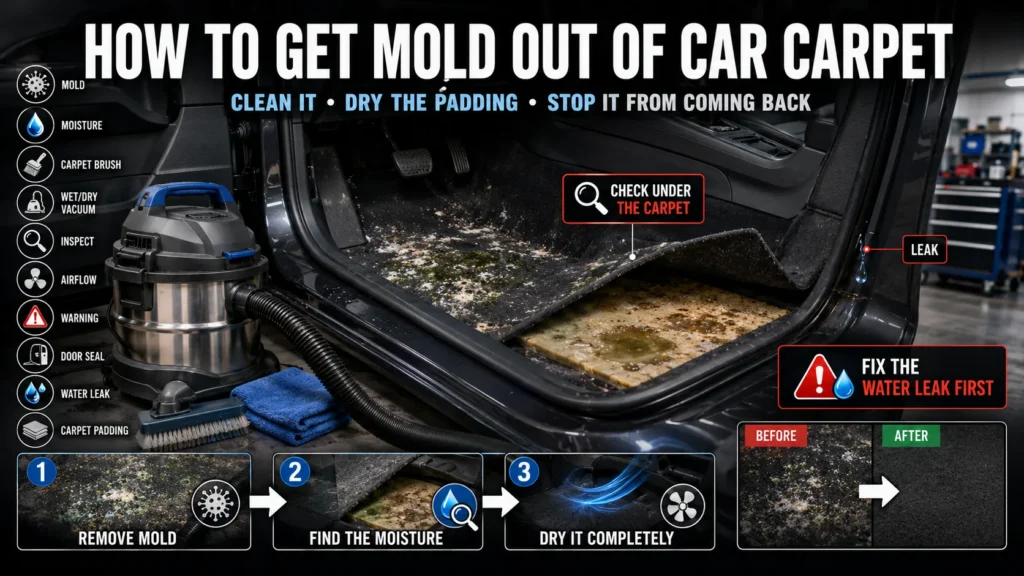
Mold in car carpet is more than an ugly stain. It can leave a strong musty smell, spread into carpet padding, and keep coming back if moisture remains underneath the surface.
I recommend treating the moisture source first. Then remove the visible mold, clean the carpet, extract as much moisture as possible, and dry the carpet and padding completely. If mold has spread deep into the padding or covers a large area, professional cleaning may be the safer choice.
Quick Answer: How Do You Get Mold Out of Car Carpet?
To get mold out of car carpet, first find and fix the moisture source. Remove the floor mats, ventilate the vehicle, use suitable protective gear, clean the affected carpet with a carpet-safe mold cleaner, gently scrub it, and extract the moisture with a wet/dry vacuum. Dry the carpet and padding completely to help stop mold from returning.
What Causes Mold to Grow in Car Carpet?

Mold needs moisture to grow. A car carpet can stay damp longer than it looks, especially when water gets below the carpet and into the padding.
Common causes include:
- Water leaks around doors or windows
- Damaged weatherstripping
- Sunroof drain problems
- Windshield seal leaks
- Wet floor mats
- Spilled drinks
- Flooding
- Wet shoes, clothing, or equipment
- Air conditioning drain problems
- High humidity inside the vehicle
- Water trapped under the carpet
A small leak can be enough to create a mold problem if the carpet stays damp for a long time.
That is why I would not start with a cleaning spray alone. If water keeps getting into the car, the mold can return after you clean it.
How to Tell If Your Car Carpet Has Mold

Visible mold is the easiest sign to spot, but it is not the only one.
You may notice:
- White, green, black, or brown spots
- Fuzzy growth on the carpet
- A strong musty smell
- Damp or wet carpet
- Discoloration around floor mats
- Mold around carpet edges
- Mold underneath the carpet
- A smell that returns after cleaning
A musty smell can be a warning that moisture or mold is hidden below the surface.
Color alone cannot tell you what type of mold you have. If you see unusual growth or the problem covers a large area, treat it as a mold-removal issue rather than trying to identify the exact species yourself.
Is It Safe to Remove Mold From Car Carpet Yourself?

Small areas may be manageable as a DIY cleaning job, but you should take basic precautions.
Mold can release spores when you disturb it. I recommend wearing gloves, eye protection, and a suitable respirator or mask while cleaning.
Work in a well-ventilated area. Opening the vehicle doors and windows can improve airflow while you work.
If the vehicle has extensive mold growth, flood damage, or mold in several parts of the interior, professional remediation may be a better option.
Also, do not mix cleaning chemicals. Combining products can create dangerous fumes.
What You Need to Remove Mold From Car Carpet
You do not need a huge collection of cleaning products.
For a basic cleaning job, gather:
- Protective gloves
- Eye protection
- Suitable mask or respirator
- HEPA-filter vacuum if available
- Soft or medium carpet brush
- Microfiber towels
- Carpet-safe mold cleaner
- Wet/dry vacuum or carpet extractor
- Clean water if the product requires rinsing
- Fans or an air mover
- Dehumidifier if available
You can also find products such as white vinegar, baking soda, and hydrogen peroxide in DIY mold-cleaning guides. However, I would not use every product at once.
Choose one suitable cleaning method, test it on a hidden section first, and follow the product directions.
How to Get Mold Out of Car Carpet Step by Step

Step 1: Find and Fix the Moisture Source
Before cleaning the mold, look for the reason the carpet became wet.
Check:
- Door seals
- Window seals
- Sunroof drains
- Windshield area
- Trunk seals
- Floor mats
- HVAC drain area
- Areas under the carpet
- Spare tire well
If you recently spilled water or another drink, the cause may be obvious. If the carpet becomes wet again without a clear reason, look for a leak.
This step matters because cleaning mold without stopping the moisture problem can lead to repeat growth.
Step 2: Remove the Floor Mats and Loose Items
Take the floor mats out of the vehicle.
Remove bags, bottles, seat covers, tools, and anything else sitting near the affected area.
Clean the mats separately if they also have mold. If a heavily contaminated item cannot be cleaned properly, replacing it may make more sense.
Removing these items gives you better access to the carpet and helps you find hidden moisture.
Step 3: Ventilate the Vehicle
Park the vehicle in a suitable open area and open the doors and windows.
Good airflow helps reduce trapped humidity and gives you a better work area.
Do not sit inside a closed vehicle while disturbing mold.
Step 4: Vacuum the Affected Area Carefully
If you have a HEPA-filter vacuum, use it to remove loose debris and surface contamination.
Avoid using a regular household vacuum if it can release fine particles back into the air.
Work carefully rather than aggressively brushing the mold before you have contained loose material.
After vacuuming, handle the vacuum contents according to the manufacturer’s instructions and clean the equipment properly.
Step 5: Apply a Carpet-Safe Mold Cleaner
Choose a product that is suitable for automotive carpet or the specific carpet material.
Before treating the whole area, test a small hidden spot. Some cleaners can change the color of carpet fibers.
Apply enough product to treat the affected fibers without unnecessarily soaking the carpet padding.
Follow the product’s recommended dwell time. Do not assume that leaving a cleaner on the carpet longer will make it work better.
Step 6: Scrub the Carpet Gently
Use a soft or medium carpet brush to loosen mold and residue from the fibers.
Work in small sections.
Avoid aggressive scrubbing because it can damage carpet fibers and spread contaminated material around the interior.
If the mold has reached deep into the carpet, surface scrubbing may not be enough. That is when you need to inspect the material underneath.
Step 7: Extract the Moisture
After cleaning, use a wet/dry vacuum or carpet extractor to remove the dirty liquid and as much moisture as possible.
This is one of the most useful steps in the process.
Simply leaving a wet carpet inside the vehicle can create another mold-friendly environment.
Make several extraction passes over the affected area. Pay extra attention to places where water may have collected.
Step 8: Check the Carpet Padding
Car carpet often has padding underneath it. This layer can hold moisture even when the carpet surface feels fairly dry.
If possible, lift an edge of the carpet and inspect underneath.
Look for:
- Damp padding
- Mold growth
- Water stains
- Musty odor
- Wet floor material
- Signs of an ongoing leak
If the padding is heavily contaminated or remains wet, cleaning only the top surface may not solve the problem.
The padding may need to be dried separately or replaced.
Step 9: Dry the Carpet and Padding Completely
Drying is one of the most important parts of car mold removal.
Use a combination of:
- Wet/dry vacuum extraction
- Air movement
- Open doors
- Fans or an air mover
- Dehumidification
If you can lift the carpet safely, allow air to reach both the carpet and the material underneath.
Do not rely only on heat or sunlight. A warm surface can still have damp padding underneath.
The carpet should feel completely dry before you put the interior back together.
Step 10: Check for Remaining Mold and Odor
Once everything is dry, inspect the area again.
Look at:
- Carpet fibers
- Carpet edges
- Padding
- Floor seams
- Under floor mats
- Nearby upholstery
If mold remains, repeat the cleaning process according to the cleaner’s directions.
If the musty odor remains even after cleaning and drying, look for hidden moisture or contamination elsewhere in the vehicle.
How to Remove Mold From Carpet Padding

Carpet padding deserves special attention because it can hold moisture below the visible carpet.
This is one of the main reasons a car may smell clean for a short time and then develop a musty odor again.
If the padding is damp, lift the carpet where practical and inspect it.
For light contamination, proper cleaning and complete drying may be enough. For heavily contaminated padding, replacement can be more practical than trying to clean every part of it.
If the vehicle suffered flood damage, I would be especially cautious. Water can reach areas that are difficult to inspect and dry.
What Can You Use to Kill Mold on Car Carpet?

There are several cleaning options, but they are not interchangeable.
| Cleaning method | Best use | Important point |
| Automotive mold cleaner | Targeted mold treatment | Follow the label directions |
| White vinegar | Some fabric surfaces | Test a hidden area first |
| Hydrogen peroxide | Some light-colored materials | May cause discoloration |
| Baking soda | Odor control | Does not replace mold removal |
| Carpet cleaner | General carpet cleaning | Extract and dry the carpet afterward |
I would avoid using a long list of chemicals on the same carpet.
Test your chosen cleaner first and never mix cleaning products unless the manufacturer specifically says they can be combined.
Can You Use Bleach on Car Carpet?
I would not make bleach the first choice for car carpet.
Bleach can discolor fabric and may damage some interior materials. It also does not solve the moisture problem that allowed the mold to grow.
A carpet-safe mold treatment or suitable automotive cleaner is usually a better starting point.
Never mix bleach with vinegar, ammonia, or other cleaning products.
How to Get Mold Smell Out of Car Carpet
A musty smell usually needs more than an air freshener.
Start by removing the mold and fixing the moisture source.
Then:
- Clean the affected carpet.
- Extract the cleaning solution and moisture.
- Dry the carpet and padding completely.
- Clean nearby surfaces.
- Check under the carpet.
- Look for hidden leaks.
- Use an odor absorber if needed.
Baking soda or activated charcoal may help with leftover odors after the mold and moisture problem has been addressed.
If you simply cover the smell with fragrance, the underlying problem can remain.
Why Does Mold Keep Coming Back in My Car?
If mold returns after cleaning, something is probably being missed.
Common reasons include:
- A water leak is still active
- The carpet padding is still damp
- Mold remains underneath the carpet
- Wet floor mats keep adding moisture
- A sunroof drain is clogged
- A door or window seal is leaking
- The HVAC system is introducing moisture
- The carpet was cleaned but not dried completely
- Mold has spread to another interior area
If the smell returns soon after cleaning, I would stop adding more cleaner and look for the moisture source.
How to Prevent Mold From Coming Back

Once you remove mold from car carpet, keeping the interior dry is the main goal.
Fix Water Leaks
Inspect door seals, window seals, the windshield area, sunroof drains, and trunk seals if you suspect water is entering the vehicle.
Dry Spills Quickly
Do not leave wet carpet to dry on its own.
Blot the spill, extract the moisture, and allow the area to dry completely.
Remove Wet Floor Mats
Take wet mats out of the car and dry them separately.
Keep the Interior Ventilated
Good airflow can help reduce trapped moisture, especially after the vehicle gets wet.
Check Under the Carpet After Water Intrusion
If water has entered the vehicle, check underneath the carpet when possible.
The surface may feel dry while the padding remains damp.
Keep an Eye on Musty Odors
A returning musty smell can be an early warning that moisture or mold is still present.
Can You Remove Mold From Car Carpet Naturally?
Some DIY guides use white vinegar or baking soda for car carpet mold.
White vinegar may help with some mold-cleaning jobs, but carpet is a porous material and the treatment must reach the affected area without leaving the material wet for too long.
Baking soda is more useful for odor control than as a complete mold-removal solution.
If you use any home cleaning method, test it on a hidden area first and make sure the carpet can dry fully afterward.
How Long Does Wet Car Carpet Take to Become a Mold Problem?
There is no single time limit that applies to every vehicle.
Warm temperatures, trapped moisture, humidity, poor airflow, and the material itself can all affect mold growth.
That is why I would not wait several days to deal with wet car carpet. Dry it as soon as possible and find out why it became wet.
When Should You Replace Moldy Car Carpet?
Cleaning may be enough for a small surface problem.
Replacement becomes more reasonable when:
- The carpet padding is heavily contaminated
- Mold keeps returning
- The carpet has been soaked by floodwater
- The backing is damaged
- A strong odor remains after proper cleaning
- The affected area is extensive
- The carpet cannot be dried properly
If the carpet is badly contaminated, replacing the affected padding may be more effective than repeatedly treating the surface.
When Should You Call a Professional?
DIY cleaning may not be the best choice for every mold problem.
Consider professional help if:
- Mold covers a large area
- The vehicle has flood damage
- Mold has reached deep into the padding
- Mold keeps returning
- You cannot find the moisture source
- The HVAC system may be contaminated
- A strong odor remains after cleaning
- You cannot safely perform the cleanup
A professional can also inspect areas that are difficult for a car owner to reach.
Final Take
The best way to get mold out of car carpet is to deal with the whole problem, not just the visible spots.
First, find and fix the moisture source. Then protect yourself, remove loose contamination, clean the carpet with a suitable product, extract the moisture, inspect the padding, and dry everything completely.
If mold keeps returning, the padding stays wet, or the vehicle has extensive or flood-related contamination, surface cleaning may not be enough.
The main thing I would keep in mind is simple: clean the mold, remove the moisture, and dry the carpet and padding completely.
FAQs
Does sunlight kill mold in car carpet?
Sunlight can help dry damp materials, but it should not be treated as a complete mold-removal method.
Can mold grow under car carpet?
Yes. Carpet padding can trap moisture and allow mold to grow below the visible surface.
Can a regular vacuum remove mold from car carpet?
A regular vacuum may spread fine mold particles. A HEPA-filter vacuum is a better choice for loose contamination.
Does steam cleaning remove mold from car carpet?
Steam cleaning can clean carpet, but trapped moisture still needs to be extracted and the carpet must dry completely.
Will replacing floor mats stop mold?
It can help if the mats are contaminated, but it will not fix mold growing underneath the carpet.
Can mold damage the car floor?
Long-term moisture and mold can contribute to damage to carpet backing, padding, and other interior materials.
How do I know if mold reached the carpet padding?
A damp feel, musty smell, staining, or visible growth around lifted carpet edges can indicate contamination below the surface.