Skip to content
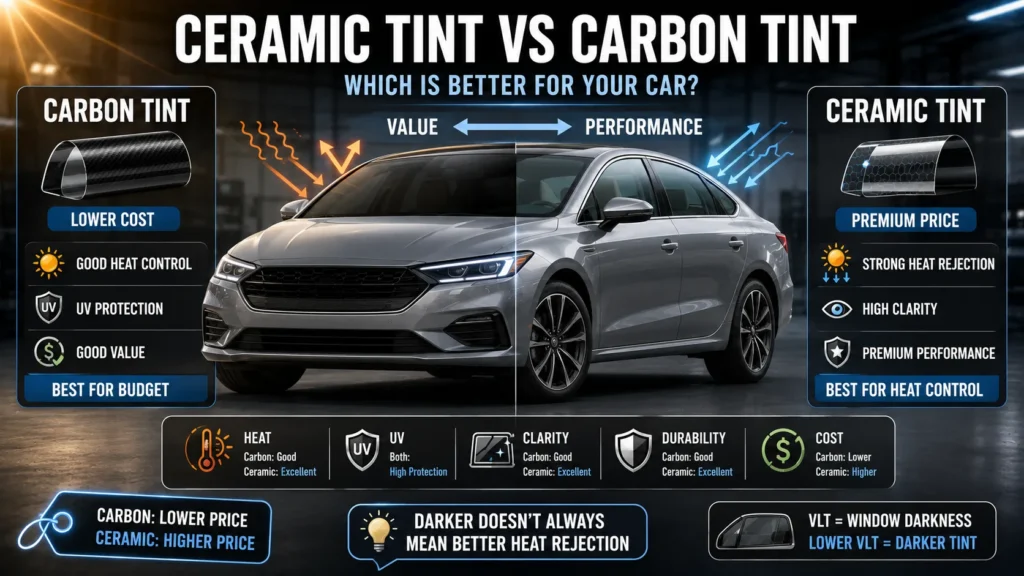
Ceramic tint is usually the better choice for maximum heat rejection, clarity, and long-term performance. Carbon tint costs less and still gives good heat and UV protection. If I were choosing between the two, I would pick carbon for a lower-cost upgrade and ceramic if cabin heat, outdoor parking, and long-term comfort matter most.
Ceramic Tint vs Carbon Tint at a Glance
If you are comparing ceramic tint vs carbon tint, the biggest difference is the material used in the film and how it handles solar energy.
Carbon tint uses carbon particles, while ceramic tint uses tiny ceramic particles. Both are non-metallic films, so neither should normally cause the signal problems associated with some older metallic window films.
| Feature | Carbon Tint | Ceramic Tint |
| Material | Carbon particles | Nano-ceramic particles |
| Heat rejection | Good | Excellent |
| Infrared rejection | Moderate to high, depending on film | Generally higher |
| UV protection | Very high on quality films | Very high on quality films |
| Optical clarity | Good | Excellent |
| Appearance | Often darker and more matte | Often more natural and clear |
| Signal interference | No metal, so generally signal-friendly | No metal, so generally signal-friendly |
| Durability | Good | Excellent |
| Price | Lower | Higher |
| Best for | Value and daily use | Maximum heat control and long-term comfort |
Exact performance can vary a lot between brands, film series, VLT levels, and testing methods. I would never compare two tint products based on one heat-rejection number alone.
What Is Carbon Tint?

Carbon tint is an automotive window film that uses carbon particles in its construction. The carbon gives the film a dark, non-reflective appearance while helping reduce sunlight, glare, and heat entering the vehicle.
It is a step above basic dyed tint for many buyers because quality carbon films can offer better color stability and heat control. Carbon tint is also generally less expensive than ceramic film, which makes it a popular choice for drivers who want a good balance between price and performance.
How Carbon Tint Works
Carbon film mainly helps by absorbing solar energy and limiting the amount of light and heat that passes through the glass.
The exact performance depends on the film. Some carbon products can reject a meaningful amount of infrared heat, but the reported figures vary widely from one product to another.
This is why I would ask an installer for the actual film series rather than simply asking whether they use carbon tint.
Benefits of Carbon Tint
Carbon tint can make sense if you want:
- A lower installation price
- A darker, more private appearance
- Good glare reduction
- Strong UV protection from a quality film
- Better heat control than basic tint
- A non-metallic film
- Good color stability
- A solid option for everyday driving
For someone who mainly wants better privacy and a cooler cabin without paying for a premium film, carbon can be a sensible choice.
What Is Ceramic Tint?

Ceramic tint uses very small ceramic particles in the film. These particles are engineered to manage different parts of the solar spectrum, especially infrared energy.
That gives ceramic film its main selling point: stronger heat control without needing an extremely dark tint. Ceramic films can also provide high optical clarity and strong UV protection.
How Ceramic Tint Works
Ceramic film uses non-metallic ceramic particles to manage solar energy passing through the glass. Premium products are designed to reject a larger share of infrared energy than many carbon films.
That does not mean every ceramic film will outperform every carbon film. Film quality, VLT, construction, and testing method all matter.
This is one reason I would look at the film’s published specifications before paying a premium simply because the word ceramic appears on the package.
Benefits of Ceramic Tint
Ceramic tint can offer:
- Strong heat rejection
- High infrared rejection
- Excellent UV protection
- Good glare reduction
- Clear optical performance
- Stable color
- Non-metallic construction
- Good signal compatibility
- Long service life when properly installed
The biggest reason to choose ceramic is usually heat control rather than darkness.
What Is the Difference Between Carbon and Ceramic Tint?
The main difference between carbon and ceramic tint is their material and how the film handles solar energy.
Carbon film uses carbon particles and generally sits in the mid-range part of the market. Ceramic film uses ceramic particles and is usually sold as a premium product with stronger heat-control performance.
Here is how the two compare in the areas that matter most.
Carbon vs Ceramic Tint for Heat Rejection

Heat rejection is usually the biggest reason people consider ceramic tint.
Carbon tint can reduce heat, but ceramic generally offers stronger infrared control. Current product comparisons show wide performance ranges for both categories, which is why I would avoid treating one percentage as a universal figure for every carbon or ceramic film.
The important point is simple:
Ceramic generally gives you better heat control than carbon when you compare quality products at similar VLT levels.
This can matter a lot if your car sits outside during the day.
For example, if you regularly get into a car that has been sitting in direct sunlight for hours, the extra heat rejection from a good ceramic film can make the drive more comfortable.
Carbon can still be enough for a driver who parks in a garage, spends little time in direct sun, or mainly wants privacy and glare reduction.
Does Ceramic Tint Block More UV Than Carbon?
Both quality carbon and ceramic films can provide very high UV protection.
This is an area where I would not assume that ceramic automatically wins just because it costs more. The actual product specifications matter.
UV protection can help reduce exposure inside the vehicle and may also help protect interior materials from long-term sun damage.
The bigger difference between carbon and ceramic is usually infrared heat control, rather than UV protection. Current comparisons commonly report high UV blocking for both film types.
So if UV protection is your only reason for upgrading to ceramic, I would first check the specifications of the carbon film you are considering.
Carbon vs Ceramic Tint Appearance
Both films can give a car a clean, darker appearance.
Carbon tint often has a deeper or more matte look. Ceramic tint is commonly described as having a more natural appearance and strong optical clarity.
At the same VLT, however, the two films can look quite similar from outside.
That leads to an important point:
Darker tint does not automatically mean better heat rejection.
A lighter ceramic film can provide strong solar control while still allowing more visible light through the glass.
What Is VLT?
VLT stands for Visible Light Transmission.
It tells you how much visible light passes through the window.
A higher VLT means more visible light passes through and the tint looks lighter.
A lower VLT means less visible light passes through and the tint looks darker.
For example:
- 70% VLT = light tint
- 50% VLT = moderate tint
- 35% VLT = darker tint
- 20% VLT = very dark tint
- 5% VLT = extremely dark tint
The exact appearance can change based on the factory glass and the film itself.
VLT also matters for local window tint laws, so I would check the rules in your state before choosing a shade.
Does Darker Tint Mean Better Heat Rejection?

No.
This is one of the most common mistakes buyers make.
A darker film blocks more visible light, but darkness and heat rejection are separate measurements.
A premium ceramic film can provide strong infrared heat control without being extremely dark. That is one reason ceramic can be useful for drivers who want comfort without making the windows excessively dark.
When comparing films, I would look at:
- VLT
- Infrared rejection
- Total Solar Energy Rejection
- UV protection
- Optical clarity
- Manufacturer specifications
Do not judge a film only by how dark it looks.
Carbon vs Ceramic Tint: UV, IR, and TSER Explained
Tint specifications can get confusing because manufacturers use different terms.
UV Protection
UV protection refers to the film’s ability to block ultraviolet radiation.
Good automotive window films can provide very high UV blocking.
Infrared Rejection
Infrared, or IR, is part of the solar energy associated with the heat you feel.
Ceramic films are generally built to provide stronger infrared heat control than carbon films, although the actual result depends on the exact product.
Total Solar Energy Rejection
TSER refers to the total amount of solar energy rejected by a film-and-glass system.
This is useful because solar energy includes more than infrared radiation.
Here is the key point: do not compare an IR percentage from one brand with a TSER percentage from another and assume they measure the same thing.
The test method and conditions matter.
Carbon vs Ceramic Tint Cost

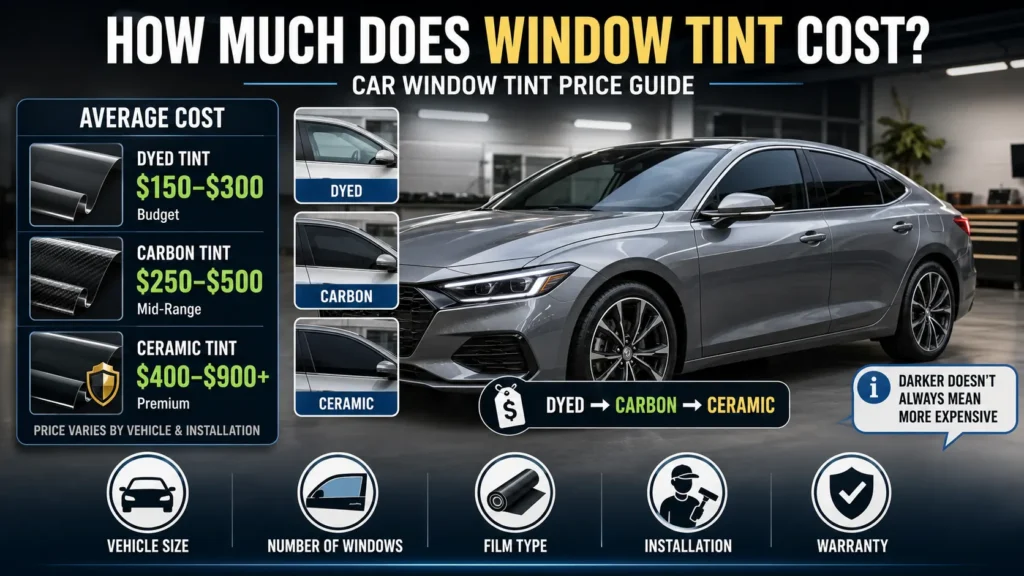
Carbon tint is usually cheaper than ceramic tint.
Current comparison pages commonly place full-car carbon installations in the lower price range and ceramic installations in the premium range, but prices vary by vehicle, film series, installer, number of windows, and location.
As a rough planning range, you may see:
| Tint Type | Typical Full-Car Range |
| Carbon | About 250–600 |
| Ceramic | About 400–900+ |
These are planning figures, not fixed prices.
A large SUV with more glass can cost more than a small sedan. Removing old tint can also increase the final bill.
The film series matters too. A basic carbon film and a premium carbon film are not necessarily equal. The same applies to ceramic.
Is Ceramic Tint Worth the Extra Money?
For some drivers, yes.
For others, carbon is the better value.
I would look at how you actually use your vehicle.
Ceramic is easier to justify if:
- Your car sits outside in direct sunlight
- You live somewhere with intense summer heat
- You have long daily drives
- You want stronger heat control
- You care about clear visibility
- You plan to keep the car for many years
- You want a premium film
- You want strong performance without relying on very dark tint
If your car stays in a garage most of the time and your main goals are privacy, appearance, glare reduction, and reasonable heat control, carbon may give you enough performance without the higher price.
When Carbon Tint Makes More Sense
Carbon tint is worth considering if your budget matters.
It can give you a meaningful upgrade over basic window film without moving into the highest price category.
You Have a Limited Budget
If you need to keep the installation cost down, carbon can be a good middle ground.
You still get a darker appearance, glare reduction, UV protection, and useful heat control from a quality product.
Your Car Is Usually Parked in a Garage
If your vehicle spends most of its time away from direct sunlight, you may not get enough extra benefit from ceramic to justify the added price.
You Want a Dark, Matte Look
Carbon films are often chosen for their darker, non-reflective appearance.
If that is the look you want, carbon can fit the goal well.
You Want Good Value
For many daily drivers, carbon sits in a useful middle position.
It gives more than a basic dyed film without reaching the price of premium ceramic products.
When Ceramic Tint Is the Better Choice
Ceramic becomes easier to justify when heat is your main concern.
You Park Outside
If your car sits in direct sun for several hours most days, stronger heat control can make a real difference to cabin comfort.
You Live in a Hot Climate
In areas with long, hot summers, the extra infrared rejection can be more valuable.
You Have Long Commutes
The longer you spend inside your car, the more you may notice the difference between a basic film and a premium heat-rejection film.
You Want Maximum Heat Control
If reducing cabin heat is your top goal, I would put ceramic ahead of carbon.
You Plan to Keep the Car for Years
A higher upfront cost can make more sense if you expect to keep the vehicle for a long time.
You get to use the film’s benefits for many years instead of paying for a premium upgrade on a car you plan to sell soon.
Do Carbon and Ceramic Tint Affect GPS or Phone Signals?
Quality carbon and ceramic films are generally non-metallic, so they should not create the signal interference associated with some metallic films.
This means they are generally compatible with:
- GPS
- Mobile phones
- Bluetooth
- Radio
- Satellite radio
- Keyless entry systems
Still, I would ask the installer which exact film they use. The word carbon or ceramic alone does not tell you everything about the product.
Which Tint Lasts Longer: Carbon or Ceramic?
Ceramic generally has the edge in long-term performance and color stability, but the actual service life depends on film quality, installation, exposure, and care.
Carbon film can also remain stable for years when you choose a quality product and have it installed correctly.
The adhesive and installation matter just as much as the film category.
A poor installation can cause:
- Bubbling
- Peeling
- Dust contamination
- Uneven edges
- Premature failure
That is why I would look at both the film warranty and the installer’s workmanship warranty.
Does the Installer Matter?
Yes.
Even an excellent window film can look bad if the installation is poor.
Before booking, I would ask:
- What film brand and series are you using?
- What VLT options are available?
- What are the film’s heat-rejection specifications?
- What warranty comes with the film?
- Does the price include all windows?
- Is old tint removal included?
- How long does the installation take?
- How long should the windows stay closed after installation?
Look closely at the installer’s previous work too.
Clean edges, clear glass, minimal dust, and a smooth finish are signs worth looking for.
How to Compare Carbon and Ceramic Tint Quotes
Do not compare quotes by price alone.
A $300 carbon installation and a $500 carbon installation may use very different films.
When I compare tint quotes, I would check these points:
1. Film Manufacturer
Ask for the actual brand.
2. Film Series
A brand can have several film lines with different performance levels.
3. VLT
Make sure you know how dark the film will be.
4. Heat-Rejection Data
Ask whether the quoted heat number refers to IR rejection, TSER, or another measurement.
5. UV Protection
Ask for the film’s published UV protection rating.
6. Windows Included
Find out whether the quote covers:
- Front windows
- Rear windows
- Rear windshield
- Quarter windows
- Sunroof
7. Old Tint Removal
If you already have tint, removal may cost extra.
8. Warranty
Ask what the film warranty covers and whether installation workmanship has separate coverage.
Carbon vs Ceramic Tint: Which Should You Choose?

Here is the simple way I would make the decision.
| Your Main Priority | Better Choice |
| Lowest price | Carbon |
| Good value | Carbon |
| Dark, matte appearance | Carbon |
| Basic heat control | Carbon |
| Maximum heat rejection | Ceramic |
| Hot climate | Ceramic |
| Outdoor parking | Ceramic |
| Long daily commute | Ceramic |
| Premium clarity | Ceramic |
| Long-term ownership | Ceramic |
If price is the main concern, I would choose a quality carbon film over a cheap, unknown film simply because it is labeled ceramic.
If heat control is the main concern and the budget allows it, I would choose a reputable ceramic film.
The exact film matters more than the category name alone.
Final Verdict: Ceramic or Carbon Tint?
For most buyers, the choice comes down to value versus performance.
Carbon tint is the better choice if you want good heat and UV protection, a darker appearance, and a lower installation price.
Ceramic tint is the better choice if you want stronger infrared heat rejection, excellent clarity, and premium long-term performance.
If I had a car that spent most of the day outside in strong sun, I would lean toward ceramic. If I mainly wanted privacy and a cooler cabin while keeping the price reasonable, I would go with carbon.
The smartest move is to compare the actual film specifications, not just the words carbon and ceramic on the shop’s price list.
FAQs
Can I put ceramic tint over carbon tint?
It is usually better to remove the old film before installing a different film. Applying new tint over existing tint can affect the final appearance, adhesion, and warranty.
Can you tell carbon and ceramic tint apart by looking at them?
Not reliably. At the same VLT, they can look very similar. The material and performance specifications are a better way to tell them apart.
Does ceramic tint make the car cooler at night?
Ceramic tint mainly helps with solar heat from sunlight. At night, there is little solar heat to block, so the main benefit is reduced glare and privacy rather than major cooling.
Does carbon tint fade or turn purple?
Quality carbon tint is made to resist the fading associated with cheap dyed films. Low-quality products can still have durability problems, so the film brand and warranty matter.
Can ceramic tint be too dark to see through?
Yes. Ceramic refers to the film technology, not its darkness. You can buy ceramic film in different VLT levels, including relatively light shades.
Does ceramic tint make air conditioning work less?
A good heat-rejection film can reduce solar heat entering the cabin, which may make it easier to maintain a comfortable interior. It does not replace the need for a properly working air-conditioning system.
Is expensive carbon tint better than cheap ceramic tint?
Not automatically. A reputable carbon film with clear specifications may be a better purchase than a low-quality product sold simply as ceramic. Compare the actual film data and warranty.
Can I upgrade from carbon tint to ceramic later?
Yes, but the old film will usually need to be removed before the new film is installed. Ask the installer about removal cost and any effect on the glass or existing defroster lines.
Does ceramic tint protect the dashboard and seats?
It can reduce the amount of UV and solar energy reaching the interior, which may help protect interior materials from long-term sun exposure. The amount of protection depends on the film.
How long should I wait before rolling down windows after tint installation?
The curing time depends on the film, weather, humidity, and installation conditions. Your installer should give you the exact waiting period for the product used.
Is ceramic tint always better than carbon tint?
No. Ceramic generally offers higher heat-control performance, but carbon can be the better choice for someone who wants good performance at a lower price.
Does carbon tint provide good heat rejection?
Yes, a quality carbon film can reduce heat noticeably. It generally does not match the heat-rejection performance of premium ceramic films, but it can provide good value for everyday driving.