Skip to content
Modern cars are pretty smart, but they still rely on some old-school physics to run right. Your engine is basically a giant air pump that needs a perfect mix of air and gas to stay happy. When you get a vacuum leak, it throws that whole balance out of the window. Think of it like trying to drink through a straw that has a tiny hole in the side. You end up getting way more air than you wanted, and that makes things run rough. This guide will walk you through everything you need to know about fixing these pesky air leaks.
Introduction to Vacuum Systems and Their Critical Functions
The vacuum system in your ride is like its nervous system, helping everything communicate and move. It is not just about the engine; it powers your brakes and even your AC vents. If that pressure drops, your car starts acting like it has a mind of its own. Understanding how this works is the first step to becoming a driveway mechanic hero.
The Engine as a Vacuum Pump
Your engine creates a vacuum naturally every time it takes a breath. As the pistons move down, they create a low-pressure area inside the cylinders. This suction pulls in the air and fuel needed for the next big bang. Without this constant pull, your car simply would not have the muscle to get down the road.
- Piston Motion: The downward stroke of the piston creates a void that atmospheric pressure tries to fill.
- Intake Manifold: This part acts as a distribution center for the vacuum pressure created by the pistons.
- Atmospheric Pressure: The air outside is always trying to push its way into the low-pressure zones inside your engine.
The Role of Negative Pressure
Negative pressure is just a fancy way of saying vacuum, and it does a ton of heavy lifting. It helps regulate your fuel pressure so your injectors spray just the right amount. It even helps clean up the environment by pulling fumes back into the engine to be burned. Most people don’t realize how much their car relies on this invisible force until it disappears.
- Brake Assistance: The vacuum booster makes it so you don’t have to stand on the pedal to stop.
- Emission Control: Vacuum lines pull gases from the crankcase and gas tank to keep the air clean.
- Transmission Control: Older cars use vacuum to know exactly when to shift gears smoothly.
The Metered Air Concept
Your car has a computer called the PCM that acts as the brain for the whole operation. It uses a mass airflow sensor (MAF) to count every single molecule of air entering the engine. Once it knows the air count, it tells the fuel injectors exactly how much gas to spray. This careful counting is what keeps your engine running smooth and your gas mileage high.
- MAF Sensor: This little guy sits in your air intake and measures the speed and volume of air.
- Precision Timing: The computer adjusts fuel delivery in milliseconds based on the MAF data.
- Stoichiometric Ratio: The target is a perfect mix of 14.7 parts air to 1 part fuel.
Defining the Vacuum Leak
A vacuum leak happens when air sneaks into the engine through a hole or a bad seal. This air is called unmetered air because the MAF sensor never saw it coming. Because the computer does not know about this extra air, it does not add the extra gas needed. The result is a mess that makes your engine stumble and your dashboard light up like a Christmas tree.
- Unmetered Entry: Air enters through cracks in hoses or gaps in gaskets rather than the main intake.
- Bypassing Sensors: Because the leak is after the sensor, the computer is totally in the dark.
- System Disruption: Even a tiny pinhole can cause huge problems for your engine’s idle and power.
The Science of the Air-Fuel Ratio Imbalance
When that extra air gets in, the chemistry inside your engine goes totally sideways. The explosion inside the cylinders needs a very specific recipe to work correctly. If you mess with the ingredients, you end up with a lot of heat and very little power. Understanding the science helps you see why a small piece of rubber is so important.
Lean vs. Rich Conditions
A lean condition means you have too much air and not enough gas in the mix. This is the classic result of vacuum leaks because they add air without the computer’s permission. A rich condition is the opposite, where there is too much gas, which usually smells like rotten eggs. Lean mixtures burn much hotter and can actually melt parts inside your engine if you aren’t careful.
- Oxygen Excess: Too much oxygen prevents the fuel from burning at the right speed.
- Combustion Temperature: Lean mixtures spike the heat, which can damage valves and spark plugs.
- Performance Loss: Without enough fuel to match the air, the engine loses its “oomph”.
The Computer’s Response
The computer is not totally helpless; it uses oxygen sensors to check the exhaust. When it sees too much oxygen, it realizes there is a leak somewhere. It tries to fix the problem by forcing the injectors to stay open longer to add more fuel. This “limp mode” or compensation helps the car run, but it is not a permanent fix.
- O2 Sensor Feedback: The exhaust sensors act as a “tattletale” to the PCM.
- Fuel Trim Adjustment: The computer raises the fuel levels to try and balance the extra air.
- Adaptive Learning: The car tries to “learn” how to run with the leak, but it eventually hits a limit.
Impact on Combustion
The actual explosion inside your engine changes when a vacuum leak is present. Instead of a smooth, controlled burn, you might get a jagged, uneven fire. This can cause the engine to shake or make a pinging noise called detonation. Over time, this rough combustion can literally shake the engine apart or crack the pistons.
- Detonation: The fuel ignites too early or too fast because of the extra heat.
- Misfires: Sometimes the mix is so lean that it won’t ignite at all, causing a stumble.
- Pressure Spikes: Uneven burning creates stress on the engine’s internal bearings.
Short-Term vs. Long-Term Fuel Trims
Your mechanic will look at something called fuel trims to diagnose the problem. Short-term fuel trim is what the computer is doing right this second to stay running. Long-term fuel trim shows the history of how much extra gas the car has been needing. If these numbers are high, you definitely have a vacuum leak that needs your attention.
- STFT: This number bounces around quickly as you drive down the road.
- LTFT: A high positive number here is a “smoking gun” for an air leak.
- Diagnostic Clues: These numbers tell the tech if the leak is big or small.
Comprehensive Symptoms of an Automotive Vacuum Leak

You don’t need a PhD to know when your car is acting up. Most vacuum leaks give off very specific vibes that you can catch early. If you pay attention to how your car feels and sounds, you can save a lot of cash. Let’s break down the most common red flags you will see on the road.
Engine Performance and Driveability
The most annoying part of a vacuum leak is how it ruins your driving experience. Your car might feel like it’s gasping for air or struggling to get out of its own way. These performance issues usually get worse when you are stopped at a light. If your car feels like it’s having a bad day, a leak is likely the culprit.
- Rough Idle: The engine shakes or vibrates when you are sitting still.
- RPM Fluctuations: The needle on your dash might bounce up and down for no reason.
- Sputtering: The car feels like it is about to die when you slow down.
High or Sporadic Idle RPM
A strange symptom of vacuum leaks is when the engine revs up while you’re parked. This happens because the leak is letting in air just like your throttle pedal would. The computer gets confused and tries to keep the engine from stalling by raising the speed. It can be pretty scary if the car starts revving on its own at a stop.
- Unintended Acceleration: The engine stays at a high RPM even when your foot is off the gas.
- Tachometer Spikes: You see the RPM needle jump around erratically.
- Surging: The car feels like it wants to lung forward while you have the brake pressed.
Engine Hesitation and Stumbling
When you hit the gas, you want the car to go, not pause and think about it. A vacuum leak causes a delay because the air-fuel mix is all messed up. It feels like the car is “tripping” over itself before it finally picks up speed. This can be dangerous when you are trying to merge onto a busy highway.
- Delayed Response: There is a noticeable gap between pressing the pedal and the car moving.
- Flat Spots: The engine might lose power at a specific point in the rev range.
- Hiccuping: The engine makes a small popping or jerking sound during acceleration.
Stalling at Low Speeds
There is nothing more embarrassing than your car dying in the middle of a parking lot. Vacuum leaks are notorious for killing the engine when the RPMs are low. At low speeds, the leak represents a larger percentage of the total air entering the engine. This makes it much harder for the computer to keep the fire going.
- Low Speed Dying: The car shuts off when you are coasting or turning.
- Restart Issues: The car might be hard to start back up after it stalls.
- Power Steering Loss: When the engine dies, your steering gets very heavy, which is scary.
Significant Power Loss
If your car feels like it’s towing a house, you might have a major leak. Without the right mix of fuel and air, your engine can’t produce the torque you need. This is especially obvious when you are climbing a hill or carrying passengers. It turns your snappy ride into a slow and sluggish turtle.
- Sluggishness: The car takes forever to reach highway speeds.
- Reduced Torque: You have to push the pedal much further to get the same results.
- Engine Strain: You can hear the engine working harder but see no results on the speedo.
Sensory and Visual Warning Signs
Sometimes your car will literally tell you where the problem is if you listen. You don’t always need tools to find a leak; your ears and eyes are great sensors. Knowing what to look for can help you spot a crack before it becomes a total breakdown. Don’t ignore those weird noises coming from under the hood.
- Whistling: A high-pitched sound that changes when you rev the engine.
- Hissing: The classic sound of air being sucked through a tiny crack.
- Visual Cracks: Seeing old, dry-rotted rubber hoses that look like they are crumbling.
Audible Hissing and Whistling
A vacuum leak creates a very specific sound, much like a leaking tire. Because the engine is under high suction, air rushing into a hole makes a whistle. You can often find the leak just by moving your ear around the engine bay while it idles. It sounds exactly like the “sucking” noise from a household vacuum.
- Directional Sound: The noise will get louder as you get closer to the bad hose.
- Tone Changes: The pitch often gets higher as the engine sucks harder.
- Squealing: Sometimes a leaking gasket can make a high-pitched squeal that sounds like a belt.
The Check Engine Light (MIL)
That little orange engine icon on your dash is your car’s way of asking for help. When the computer sees the fuel trims going crazy, it turns that light on. You can use a cheap scanner to read the codes and see what is wrong. Most vacuum leaks show up as “system too lean” codes.
- Code P0171: This is the most common code for a lean condition on bank one.
- Code P0174: This means bank two is also running too lean due to a leak.
- Dashboard Warnings: Don’t just clear the code; you need to fix the actual leak.
Visual Emission Cues
In some cases, you might actually see the leak manifesting as smoke or mist. This is more common in industrial pumps, but it can happen in cars too. If you see a weird vapor or oil spray near a hose, that’s a huge clue. It means the pressure is escaping and taking some fluids or contaminants with it.
- Oil Mist: Seeing a light coating of oil around a specific vacuum fitting.
- Exhaust Smoke: The lean condition can cause the exhaust to look different than usual.
- Discoloration: High heat from a lean mix can discolor parts of the intake manifold.
Dashboard Fluctuations
Your gauges are your windows into the engine’s soul, so keep an eye on them. If the tachometer needle is jumping around, your engine’s idle is unstable. Even if you can’t feel it yet, the gauges will show the struggle. A steady needle means a happy engine, so any movement is a sign of trouble.
- Bouncing Needle: The RPM gauge moves up and down like a yo-yo.
- Erratic Movement: The needle flickers instead of moving smoothly with the gas.
- Inaccurate Readings: Sometimes the leak makes the gauges act totally haywire.
Secondary System Failures
Vacuum leaks don’t just stay in the engine; they spread to other systems. Since many parts of your car use that suction, they all start to fail. This is often how people realize they have a problem in the first place. It’s a chain reaction that can make your whole car feel like a lemon.
Brake Pedal Stiffness
This is the scariest symptom of a vacuum leak by far. Your brake booster uses vacuum to help you push the master cylinder. If the booster or its hose leaks, your brake pedal will feel like a brick. You will have to push much harder just to slow down a little bit.
- Hard Pedal: The brake pedal doesn’t move easily and feels very firm.
- Increased Stopping Distance: It takes way longer to bring the car to a halt.
- Safety Hazard: This is a major risk and needs to be fixed immediately.
Poor Fuel Economy
You would think less gas would save you money, but the opposite is true. Because the car is running inefficiently, you end up flooring it more often. Also, the computer overcompensates by dumping in extra fuel to prevent damage. You will find yourself visiting the gas station way more than usual.
- Gas Mileage Drop: You notice a significant dip in your miles per gallon.
- Inefficient Burn: Half the gas you pay for is being wasted by the bad mix.
- Wallet Drain: Fixing a $10 hose could save you hundreds in gas every year.
Transmission Shifting Issues
On many classic cars, the transmission uses vacuum to know when to shift. A leak can cause the car to hold gears too long or shift very harshly. It might feel like the car is “clunking” every time it changes speed. Modern cars use sensors, but even they can be affected by the engine’s struggle.
- Late Shifts: The engine revs really high before the car finally changes gears.
- Hard Shifting: The car jerks forward violently when it finds the next gear.
- Vacuum Modulator: This little part is usually the culprit on older automatic cars.
Climate Control Malfunctions
Ever notice your AC only blows out of the defrost vents when you go uphill? That is a classic sign of a vacuum leak in your dashboard. Many cars use vacuum actuators to move the doors that direct airflow. When the vacuum drops under load, the doors spring back to their default “safe” position.
- Default to Defrost: The air stops coming out of the front vents suddenly.
- Hissing in the Dash: You can actually hear the leak inside the cabin of the car.
- Temperature Spikes: The blend door might slip, letting hot air in when you want cold.
Common Causes and Sources of Vacuum Leaks
Now that you know what a leak feels like, let’s look at where they hide. Time and heat are the biggest enemies of your car’s vacuum system. Most of these parts are made of rubber or plastic that just doesn’t last forever. Knowing the “usual suspects” makes the hunt a lot easier.
Rubber and Plastic Component Degradation

Rubber is great for hoses, but it hates the heat under your hood. Over the years, it gets hard and starts to crack like a dry desert. Plastic parts can also get brittle and snap if you even look at them wrong. This degradation is the number one cause of vacuum leaks in older vehicles.
- Dry Rot: The rubber loses its oils and becomes stiff and flaky.
- Heat Cycles: The constant heating and cooling causes materials to expand and shrink until they fail.
- Vibration: The engine’s natural shaking can rub hoses against sharp metal parts.
Brittle Vacuum Hoses
Hoses are the “pipes” of the vacuum system, and they go everywhere. A hose that felt like a wet noodle when it was new will feel like a stick 10 years later. Once they are brittle, they crack at the ends where they plug into fittings. Just touching an old hose can sometimes cause it to crumble in your hands.
- End Cracking: The most common leaks are right where the hose meets the engine.
- Internal Collapsing: Sometimes a hose looks fine on the outside but is blocked on the inside.
- Kinking: Old hoses can soften too much and fold over, cutting off the vacuum.
Plastic Connector Cracking
Many cars use plastic T-joints and elbows to route vacuum lines. These little bits of plastic get very brittle from the engine’s intense heat. They often develop tiny hairline cracks that are almost impossible to see with the naked eye. A broken plastic tee can disable multiple systems at once.
- T-Joint Failure: These split right down the middle, leaking from the seam.
- Elbow Snaps: The curved pieces often break if the engine moves too much on its mounts.
- Rigid Line Leaks: Long plastic lines can crack if they aren’t clipped down properly.
Gasket and Seal Failures
Gaskets are the “glue” that keeps the metal parts of your engine airtight. When these seals fail, air rushes in between the heavy metal components. These are much harder to find than a simple broken hose. If your hoses look good but the car runs bad, it is time to check the gaskets.
- Material Fatigue: Gaskets shrink over time and lose their ability to seal.
- Improper Torque: If the bolts aren’t tightened right, the gasket won’t sit flat.
- Contamination: Oil leaks can eat away at rubber gaskets and cause them to fail.
Intake Manifold Gaskets
This is a big one that causes major performance headaches. The intake manifold sits on top of the engine and carries air to the cylinders. If the gasket between the manifold and the head fails, you get a massive leak. This often causes a misfire on just one or two cylinders.
- Internal Leaks: Sometimes the gasket leaks air from the crankcase into the intake.
- Coolant Mixing: In some cars, a bad intake gasket can let coolant into the engine.
- Labor Intensive: This is a big job that usually requires taking the top of the engine apart.
Throttle Body Gaskets
The throttle body is the main “gate” that lets air into your engine. It has a gasket where it bolts onto the intake manifold. If this seal goes bad, it’s like leaving the front door of your house wide open. It usually causes a very high and unstable idle speed.
- Mounting Bolts: Sometimes these just get loose and need a quick turn with a wrench.
- Cleaning Damage: Using harsh chemicals to clean the throttle body can sometimes ruin the seal.
- Easy Fix: This is usually a much easier gasket to replace than the intake manifold one.
Fuel Injector O-Rings
Your fuel injectors are held into the engine by tiny rubber rings. These rings keep the vacuum inside the engine and the gas inside the fuel rail. If they get old and flat, air will leak directly into the cylinder head. This is a sneaky leak that often gets overlooked by amateur mechanics.
- Spray Test: Spraying a little water near the injectors can help find these leaks.
- Fuel Smell: Sometimes you will smell raw gas if these rings are totally shot.
- Inexpensive Part: The rings cost pennies, but they do a huge job.
Auxiliary System Failures
Your engine has several helpers that all use vacuum to keep things clean and efficient. If one of these parts breaks, it creates a leak that can be hard to track down. These systems are mostly for emissions, so they are often the cause of failed inspections. Let’s look at the most common auxiliary culprits.
EGR (Exhaust Gas Recirculation) Valves
The EGR valve helps lower your engine’s temperature by recycling a bit of exhaust. It is supposed to stay closed when you are idling. If it gets stuck open or has a leaky diaphragm, it’s like having a permanent vacuum leak. It makes the car run very rough at stoplights.
- Carbon Buildup: Soot from the exhaust can jam the valve in the open position.
- Vacuum Line: The tiny hose that controls the valve often cracks and leaks.
- Check Engine Codes: A bad EGR usually triggers a specific “insufficient flow” or “lean” code.
PCV (Positive Crankcase Ventilation) Systems
The PCV system pulls nasty fumes out of your oil and burns them in the engine. It uses a special valve that regulates the vacuum flow. If the valve gets stuck or the big rubber hose cracks, you get a huge leak. This is one of the most common causes of a “hissing” sound under the hood.
- The Shake Test: A good PCV valve should rattle when you shake it.
- Oil Consumption: A bad PCV system can actually cause your car to burn more oil.
- Simple Swap: Replacing this valve is usually a 5-minute job that costs under $20.
Brake Booster Diaphragms
Inside your brake booster is a large rubber sheet called a diaphragm. If this sheet gets a tear, the booster will suck air directly into the engine when you hit the brakes. You might hear a “whoosh” sound under the dashboard every time you stop. This is a double-whammy because it ruins your brakes and your engine’s idle.
- Pedal Drop: The engine RPM might change significantly when you press the brake.
- Internal Leak: Because the leak is inside the booster, you can’t see it from the outside.
- Major Safety Issue: Don’t mess around with a bad brake booster; get it fixed ASAP.
Evaporative Emission (EVAP) System
The EVAP system keeps gas fumes from escaping your tank and polluting the air. It uses a purge valve to let those fumes into the engine at the right time. If the valve stays open or the lines to the charcoal canister crack, air leaks in. This is a frequent cause of the “check gas cap” light on many cars.
- Purge Valve Stuck: This lets air in when the engine is not ready for it.
- Long Hoses: The lines run all the way to the back of the car, giving them many spots to leak.
- Emissions Test: A leak here will almost always cause you to fail your state inspection.
Advanced Theory: Forced Induction and Vacuum Leaks

If you have a turbo or a supercharger, things get a little more complicated. These engines don’t just use vacuum; they also use “boost” or positive pressure. This means a leak can act differently depending on how fast you are going. It is a whole different ballgame for gearheads who like to go fast.
Turbocharged and Supercharged Engines
In a normal engine, the intake manifold is always under vacuum. In a turbo car, the manifold is under vacuum when you cruise, but under pressure when you floor it. This means a crack in a hose will suck air “in” at a red light but blow air “out” when you’re racing. It makes finding the leak a bit of a puzzle.
- Vacuum vs. Boost: The same hole can cause a lean condition or a loss of power depending on the throttle.
- Check Valves: Turbo cars use one-way valves to keep pressure from going where it shouldn’t.
- Extra Complexity: There are twice as many hoses and pipes to check in a forced induction setup.
Intercooler Piping Leaks
Turbo cars use an intercooler to chill the air before it enters the engine. The big pipes that connect the turbo to the intercooler are prime spots for leaks. We call these “boost leaks” rather than vacuum leaks. If a clamp gets loose, all that precious power just blows out into the air instead of into your cylinders.
- Coupler Failure: The rubber connectors can blow off under high pressure.
- Whooshing Sound: A boost leak sounds like a giant hair dryer blowing under your hood.
- Rich Mix: Since the air is lost “after” the sensor, the engine runs way too rich and blows black smoke.
Wastegate and Blow-off Valve (BOV) Operation
These two parts are the “security guards” for your turbo system. They are controlled by vacuum and pressure lines to keep the engine from blowing up. If the small lines going to these parts leak, your car could make too much boost or no boost at all. It is critical to keep these lines in perfect shape for engine safety.
- Overboosting: A leak in the wastegate line can let the turbo spin too fast, which is dangerous.
- BOV Flutter: If the blow-off valve line leaks, you will hear a “chopping” sound when you let off the gas.
- Precision Control: These lines are often high-quality silicone to handle the extra stress.
Professional Diagnostic Methods and Leak Detection
Finding a leak can be like finding a needle in a haystack. You can spend hours guessing, or you can use the right tools to find it in minutes. Professionals have a few tricks up their sleeves that make the job much easier. Here is how the pros find even the tiniest pinhole leaks.
Visual and Manual Inspections
Before you get out the fancy machines, just use your hands and eyes. A lot of vacuum leaks are obvious if you actually look for them. You want to get in there and physically touch the hoses to see if they feel right. Sometimes a hose has just popped off its fitting and needs to be pushed back on.
- Flex Testing: Gently bend the hoses to see if any hidden cracks open up.
- Connection Check: Make sure every hose is tight and the clamps are actually clamping.
- Listen Closely: Use a piece of garden hose as a makeshift stethoscope to pinpoint hissing.
The Smoke Test Method

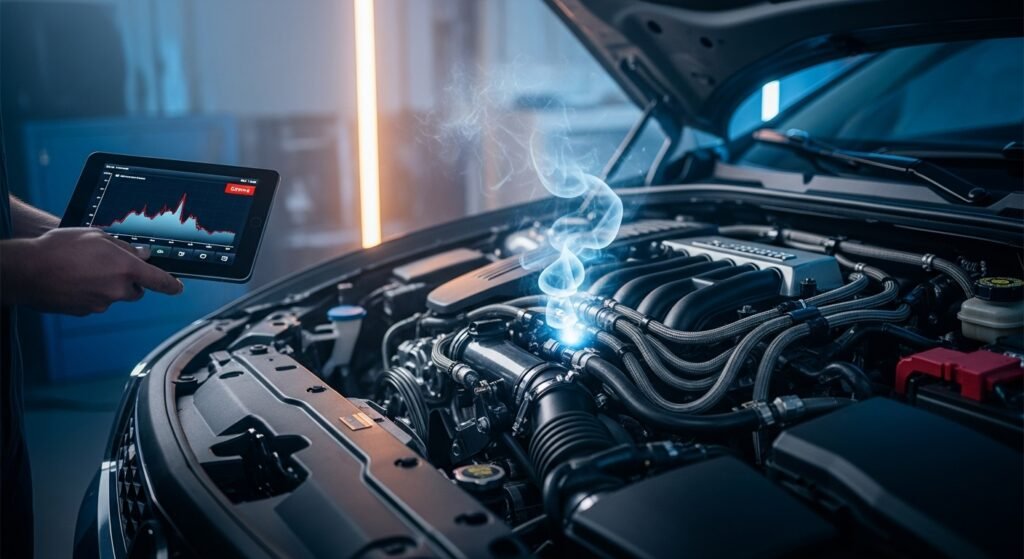
This is the “gold standard” for finding vacuum leaks. A special machine pumps thick, harmless smoke into your engine’s intake system. Since the smoke is under light pressure, it will come out of any hole, no matter how small. It makes finding a leak as easy as watching for a puff of white smoke.
- Total System Coverage: Smoke travels everywhere, even into spots you can’t see.
- Dye Integration: Some smoke machines use UV dye that leaves a mark where the leak is.
- Engine Off: This test is done with the engine off, so it is very safe for the mechanic.
Ultrasonic Leak Detection
In a busy shop or a factory, you can’t always hear a tiny hiss over the background noise. Ultrasonic detectors use a microphone that only hears very high-pitched sounds. They translate that “ultrasound” into a noise a human can hear through headphones. It is like having super-hearing for air leaks.
- Industrial Use: This is great for large vacuum pumps and compressed air systems.
- Frequency Filtering: The tool ignores low-frequency engine noise and only hears the leak.
- Pinpoint Accuracy: You can find a leak from several feet away using this technology.
Solvent and Fluid Testing
This is an old-school trick that still works great today. While the engine is running, you spray a little fluid or gas around the suspected leak area. If there is a leak, the engine will suck in the fluid and the RPM will change. It is a very fast way to check gaskets and hose connections.
- Soapy Water: The safest way; look for bubbles when checking pressurized parts.
- Carburetor Cleaner: A classic choice, but you have to be very careful with fire.
- Propane Torch: Using an unlit torch to release gas near the leak is another common pro move.
Vacuum Gauge and Pressure-Rise Testing
Sometimes you need to see exactly how much suction you have. A vacuum gauge plugs into the engine and gives you a reading in inches of mercury. A steady, high reading means the engine is healthy. If the needle is bouncing or low, you have a mechanical problem or a leak.
- Static Test: Checking the vacuum level at a steady idle speed.
- Pressure-Rise: In industrial settings, they watch how fast a vacuum system loses its suction.
- Diagnostic Roadmap: The way the needle moves tells the story of what is wrong inside.
Identifying Leaks in Industrial Vacuum Pump Systems
Vacuum leaks aren’t just for cars; they are a huge deal in factories too. Big vacuum pumps are used for everything from making microchips to packing food. These systems are much larger and have their own set of unique problems. If an industrial pump leaks, it can cost a company thousands of dollars in lost time.
- Massive Suction: Industrial systems operate at much higher vacuum levels than car engines.
- Complex Piping: Miles of pipes mean there are thousands of spots for a leak to start.
- Continuous Duty: These pumps run 24/7, which puts a lot of stress on the seals.
Physical Damage and External Impacts
In a factory, things get bumped and banged all the time. A forklift hitting a pipe or a heavy tool falling can easily cause a structural leak. Even a small dent in a vacuum tank can lead to a “pinhole” that ruins the vacuum level. Regular walks around the equipment are needed to spot this kind of damage.
- Corroded Tanks: Old steel tanks can rust from the inside out and develop leaks.
- Vibration Damage: Industrial machines shake so much they can actually crack their own welds.
- Loose Fittings: Constant vibration eventually backs out even the tightest bolts.
Thermal Stress and Overheating
Industrial pumps generate a lot of heat while they work. If the cooling system fails, the pump gets so hot that the metal starts to warp. Once the metal isn’t perfectly flat, the gaskets can’t do their job anymore. Overheating is a leading cause of sudden, catastrophic vacuum loss in factories.
- Warped Flanges: The flat ends of pipes get bent out of shape from the heat.
- Seal Hardening: High heat turns soft rubber seals into hard, brittle plastic.
- Lubrication Breakdown: Hot oil gets thin and stops sealing the internal parts of the pump.
Internal Seal Degradation
Inside every vacuum pump are specialized seals that keep the air out. Over thousands of hours, these seals simply wear out from friction. You might see oil mist coming out of the exhaust port when these internal seals start to fail. It’s like an old engine burning oil; it’s a sign that the end is near.
- O-Ring Flattening: Round seals get squashed over time and stop working.
- Material Choice: Using the wrong seal material for the chemicals being pumped causes fast failure.
- Shaft Seal Wear: The spinning part of the pump is the hardest place to keep airtight.
Lubrication Issues
Oil is not just for preventing wear; it actually helps seal the vacuum. If the oil level gets low, air can slip past the moving parts. Dirty oil can also contain grit that scratches the internal surfaces of the pump. Keeping the oil clean and full is the easiest way to prevent industrial vacuum leaks.
- Sealing Oil: A thin film of oil acts as a final barrier against incoming air.
- Contamination: Moisture in the oil can turn into steam and ruin the vacuum.
- Pump Rumbling: Low oil levels often cause a loud, growling sound from the pump.
The Dangers of Ignoring a Vacuum Leak
Some people think a little hissing sound is no big deal, but they are wrong. A vacuum leak is like a slow-moving virus for your car. If you don’t fix it, it will eventually cause much more expensive parts to fail. It is always cheaper and safer to fix a leak as soon as you find it.
- Escalating Costs: A $5 hose today could become a $2,000 engine rebuild next year.
- Reliability Issues: The car will eventually leave you stranded at the worst possible time.
- Safety Risks: Your ability to stop and steer can be directly affected by a leak.
Catalytic Converter Damage
Your catalytic converter is a very expensive part that cleans your exhaust. When you have a vacuum leak, the engine runs lean, which makes the exhaust very hot. Then the computer dumps in extra fuel to compensate, which can burn inside the converter. This extra heat can literally melt the ceramic core inside, plugging up your exhaust.
- Meltdown: The internal honeycomb structure collapses from the intense heat.
- Rotten Egg Smell: A damaged converter often smells like sulfur or garbage.
- Replacement Cost: New converters can cost thousands of dollars to replace.
Engine Overheating
A lean engine is a hot engine, and that is never a good thing. The extra oxygen makes the fuel burn much faster and hotter than it should. This heat transfers to your cylinder heads and cooling system. If it gets bad enough, you could blow a head gasket or even crack the engine block.
- Coolant Stress: Your radiator has to work much harder to keep up with the extra heat.
- Piston Damage: Extreme heat can cause the pistons to expand too much and scuff the cylinders.
- Pre-Ignition: The heat can cause the fuel to explode before the spark plug even fires.
Safety Risks
We’ve already talked about the hard brake pedal, and that is the biggest risk. But a vacuum leak can also cause your car to stall while you are in the middle of a turn. When the engine dies, you lose your power steering too. Trying to steer a dead car through a busy intersection is a nightmare you want to avoid.
- Brake Failure: Losing your vacuum assist can make it nearly impossible to stop quickly.
- Sudden Stalling: The car dying in traffic can lead to a serious rear-end collision.
- Loss of Control: A surging engine can make the car jump forward unexpectedly in a parking lot.
Failed Emissions Testing
If you live in a place with smog checks, a vacuum leak is a guaranteed “fail”. The leak causes your engine to produce high levels of Nitrogen Oxide (NOx). Even if your car feels okay, the testing machine will see the high emissions and reject you. You won’t be able to register your car until the leak is fixed and the code is gone.
- NOx Emissions: High combustion temperatures create this harmful gas.
- Hydrocarbons: Misfires caused by the leak send unburned fuel out the tailpipe.
- Monitor Readiness: The car’s computer won’t pass the “readiness test” if there’s a leak code.
Step-by-Step Guide to Repairing Vacuum Leaks

Ready to get your hands dirty? Fixing a vacuum leak is one of the most satisfying DIY jobs. Most of the time, you just need a few basic tools and a little bit of patience. Here is how you can take charge and get your engine running smooth again.
DIY Repairs for Beginners
You don’t need a professional shop for many common vacuum problems. If you can find a cracked hose, you can probably fix it yourself. It’s a great way to learn about your car and save a ton of money on labor. Just remember to work on a cool engine so you don’t get burned.
- Hose Replacement: Pull off the old hose and push on a new one; it’s that easy.
- PCV Valve Swap: Most of these just twist out or pull out of a rubber grommet.
- Tightening Clamps: Use a screwdriver to make sure every connection is snug.
Complex Professional Repairs
Some leaks are buried deep and require a pro’s touch. If the leak is in the intake manifold or the brake booster, it can be a big job. These repairs often involve taking off a lot of parts just to reach the bad seal. If you aren’t comfortable tearing down your engine, it is best to call a mechanic.
- Gasket Replacement: Requires removing the intake manifold and cleaning the metal surfaces perfectly.
- Booster Replacement: This involves working under the dashboard and bleeding the brake lines.
- Deep Smoke Testing: Finding leaks inside the fender wells or behind the engine block.
Prevention and Long-Term Maintenance Strategies
The best way to fix a vacuum leak is to never have one in the first place. A little bit of preventative maintenance goes a long way in the car world. If you stay on top of your hoses and seals, your car will stay reliable for years. Here is how to keep the air where it belongs.
- Regular Inspections: Look over your hoses every time you change your oil.
- Clean Engine Bay: A clean engine makes it much easier to spot a new crack or leak.
- Quality Parts: Don’t use cheap, thin hoses; buy high-quality rubber or silicone.
Conclusion: Restoring Efficiency and Performance
A vacuum leak might seem like a small thing, but it has a huge impact on your car. From poor gas mileage to dangerous brake issues, it is a problem that needs to be taken seriously. By understanding the symptoms and causes, you can stay ahead of the game. Whether you do it yourself or hire a pro, fixing that leak will make your car feel like new again. Take care of your vacuum system, and it will take care of you on every trip.
| Primary Cause | Common Symptoms | Recommended Solution |
| Brittle or Cracked Hoses | Hissing noises, rough idle, and poor gas mileage. | Locate the damaged section and replace the entire length with high-quality rubber or silicone tubing. |
| Intake Manifold Gasket Failure | Engine misfires, “System Too Lean” codes (P0171/P0174), and engine stumbling. | Remove the intake manifold, clean the mating surfaces, and install a brand-new vehicle-specific gasket. |
| Faulty PCV Valve | Significant oil consumption, whistling sounds, and erratic idling. | Remove the old valve (usually a simple pull or twist) and install a new OEM-spec PCV valve. |
| Stuck EGR Valve | Severe stalling at stops, rough idling, and increased NOx emissions. | Clean out carbon deposits from the valve or replace the unit if the internal diaphragm is ruptured. |
| Ruptured Brake Booster | Hard or “brick-like” brake pedal and engine RPM drops when braking. | Replace the brake booster assembly and inspect the check valve for proper vacuum flow. |
| Loose Throttle Body Gasket | High idle RPM and whistling noises coming from the front of the engine. | Tighten the mounting bolts to the correct torque or replace the gasket if it has flattened or torn. |
| Worn Fuel Injector O-Rings | Minor engine vibration and a faint smell of raw fuel near the fuel rail. | Pull the fuel injectors and replace the small upper and lower rubber O-rings with new, lubricated ones. |
| Cracked Plastic T-Connectors | Multiple system failures (e.g., HVAC issues combined with rough idle). | Swap out the brittle plastic connectors for heat-resistant nylon or brass fittings. |
| Damaged EVAP Purge Valve | “Check Gas Cap” light and difficulty starting the car after refueling. | Replace the purge valve solenoid and clear the diagnostic codes with an OBD-II scanner. |
| Intercooler Coupler Leak | Loss of power under acceleration and loud “whooshing” sounds (Turbo cars). | Inspect the rubber couplers for tears and tighten the T-bolt clamps to ensure a boost-tight seal. |
| Warped Pump Flanges | Industrial pump pressure drops and visible oil misting near joints. | Resurface the metal flanges or use specialized high-temperature vacuum sealant and new gaskets. |
| Failed Shaft Seals | Growling pump noises and inability to reach high vacuum levels in industrial setups. | Disassemble the pump housing and replace the internal mechanical shaft seals and bearings. |
| Dry-Rotted Vacuum Caps | Constant hissing and random lean codes on older engines with unused ports. | Pull off the crumbling rubber caps and push on new, heat-resistant vinyl or rubber block-off caps. |
| Vacuum Reservoir Leak | HVAC vents stuck on defrost and loss of cruise control functionality. | Inspect the plastic vacuum tank (often hidden in the fender) for cracks and patch or replace as needed. |
| Loose Intake Clamps | Surging engine RPM and erratic behavior of the mass airflow sensor data. | Use a screwdriver or nut driver to snug up all worm-gear clamps on the air intake accordion boot. |
Frequently Asked Questions
What happens if I drive with a vacuum leak for a long time?
Driving with a leak for an extended period forces the engine to run lean, which increases internal heat. This can eventually lead to burnt exhaust valves, cracked spark plugs, and a melted catalytic converter. Over time, the constant vibration from a rough idle can also wear out your motor mounts prematurely.
Can a vacuum leak cause my car to fail a smog test?
Yes, it is one of the most common reasons for a failed emissions test. The excess air creates high combustion temperatures, which leads to high levels of Nitrogen Oxide emissions. Even if the car feels fine, the computer will store a lean code that prevents the vehicle from passing the inspection.
Does a vacuum leak affect the air conditioning system?
In many older or specialized vehicles, the climate control doors are moved by vacuum actuators. If you have a leak, the system may lose the ability to switch between defrost, vents, and floor settings. You might notice the air only coming out of the defrost vents when you accelerate or climb a hill.
Is it safe to use a propane torch to find a leak?
While some professional mechanics use unlit propane to find leaks, it is extremely dangerous for a beginner. If the gas ignites on a hot exhaust manifold or a stray spark, it can cause a fire or an explosion. Using a spray bottle with soapy water or a dedicated smoke machine is a much safer alternative for home use.
Can a vacuum leak cause a transmission to slip?
On older vehicles equipped with a vacuum modulator, a leak can definitely cause shifting issues. The transmission relies on the vacuum signal to know how much load is on the engine. Without a strong signal, the transmission may shift very late, very early, or feel like it is “slipping” between gears.
Why does my car only run rough when it is cold?
Metal and rubber parts expand as they get hot. Sometimes a gasket or hose has a crack that is open when the engine is cold but seals up as the engine warms up and the materials expand. This is why some vacuum leaks seem to “disappear” after a few minutes of driving.
Can a bad gas cap cause a vacuum leak?
Technically, a bad gas cap causes a leak in the Evaporative Emissions system, which the car treats similarly to a vacuum leak. If the cap doesn’t seal, the computer will detect that it cannot hold pressure or vacuum in the fuel tank. This will trigger the check engine light and sometimes a “Check Gas Cap” message.
Does every car have a mass airflow sensor?
No, some cars use a Manifold Absolute Pressure sensor instead. Systems with a MAP sensor are actually a bit more resistant to small vacuum leaks because they measure the pressure inside the manifold directly. However, a large leak will still confuse the computer and cause the engine to stall or stumble.
How much does it typically cost to fix a vacuum leak?
If the issue is just a cracked rubber hose, the repair can cost less than ten dollars at a local parts store. However, if the intake manifold gasket or the brake booster needs to be replaced, the cost can jump to several hundred dollars. Most of the cost for these larger repairs comes from the hours of labor required to reach the parts.
Can a vacuum leak cause my brakes to whistle?
If you hear a whistling or hissing noise specifically when you press the brake pedal, the internal diaphragm of the brake booster is likely torn. This allows air to rush through the pedal assembly under the dashboard. This is a serious safety concern as it indicates the brake assist system is failing.
What is a “virtual leak” in industrial systems?
In high-end industrial vacuum systems, a virtual leak is not a real hole in the pipe. Instead, it is trapped gas or moisture hiding inside a bolt hole or a crack that slowly releases into the vacuum chamber. It makes the system act like it has a real leak even though the structure is perfectly airtight.
Can a vacuum leak cause engine oil to turn black faster?
Yes, because a leak causes the engine to run hotter and less efficiently. The extra heat breaks down the oil’s chemical structure faster. Additionally, if the PCV system is leaking, it cannot properly remove contaminants from the crankcase, leading to faster sludge buildup in the oil.
Will a vacuum leak cause my car to backfire?
A very lean mixture burns slower than a normal one. Sometimes the mixture is still burning when the exhaust valve opens, or it ignites in the intake manifold. This can cause a loud “pop” or backfire through the tailpipe or the air intake.
Can I use electrical tape to fix a cracked vacuum hose?
Electrical tape is only a very temporary “limp home” fix. The heat under the hood will quickly melt the tape’s adhesive, causing it to slide off and leak again. It is always better to spend a few dollars to replace the entire length of the hose with a new piece of rubber.
What is the difference between a vacuum leak and a boost leak?
A vacuum leak happens when air is sucked into the engine while it is under negative pressure. A boost leak happens in turbocharged cars when air is forced out of the pipes under positive pressure. One happens while idling or cruising, while the other happens when you are flooring it.
Can a vacuum leak make my engine vibrate?
Yes, because the leak rarely affects every cylinder equally. One cylinder might be running much leaner than the others, causing it to produce less power. This imbalance creates a physical shake or vibration that you can feel through the steering wheel or seat.
Why does my check engine light blink when I have a leak?
A blinking light means the computer has detected a “catalyst-damaging misfire.” This happens when a vacuum leak is so severe that the fuel is not igniting at all, sending raw gas into the exhaust. If your light is blinking, you should stop driving immediately to prevent a fire.
How can I tell if my intake manifold is leaking?
A common trick is to spray a little bit of starting fluid or carburetor cleaner along the edge where the manifold meets the engine. If the engine RPM suddenly increases or smooths out, you have found the spot where the gasket is failing.
Are silicone vacuum hoses better than rubber ones?
Silicone hoses are generally better because they can handle much higher temperatures and do not dry out or crack as easily as standard rubber. Many performance enthusiasts switch to silicone to avoid having to deal with brittle hoses every few years.
Can a vacuum leak affect my power steering?
While the steering pump itself doesn’t use vacuum, many cars use a “vacuum advance” or an idle-up valve on the steering rack. This helps the engine stay at a steady speed when you are turning the wheel at a stop. If this valve or its hose leaks, the car might stall every time you try to park.