Skip to content

Ever wondered how many volts is a car battery and why it matters? Your car is like a big puzzle. The battery is one of the most important pieces. It is the heart of your electrical system. Without it, you are just sitting in a heavy metal box. Understanding your battery keeps your ride reliable. It helps you avoid getting stuck in the driveway. This guide will teach you everything about your car’s power source.
Introduction to Car Battery Voltage
The battery is the heart of your ride’s electrical system. It keeps everything running from the radio to the headlights. You might hear people talk about volts and amps. Volts are like the pressure pushing water through a pipe. Amps are like the actual flow of that water. You need both to get the engine turning. Knowing these basics helps you take better care of your car.
Understanding the Standard 12-Volt Battery
Most cars on the road today use a 12-volt battery. But here is a little secret about car power. A healthy battery actually measures a bit higher than that. It stores energy as chemicals inside the case. When you turn the key, those chemicals become electricity. The battery does the heavy lifting to start the car. Then the alternator takes over to keep things moving.
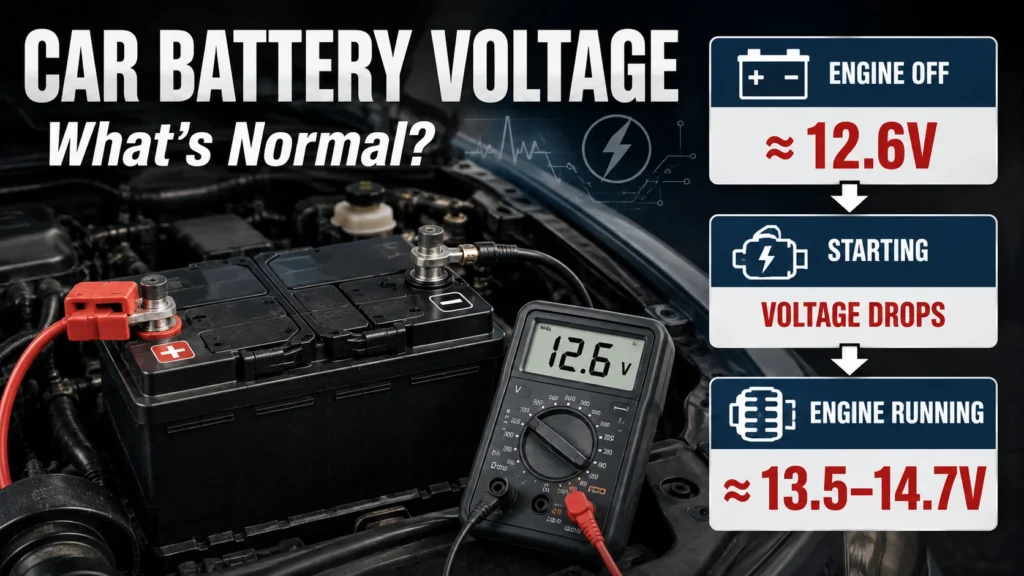
- 12.6 Volts: This is the magic number for a full charge when the engine is off.
- Energy Storage: Batteries use chemical reactions to hold onto power.
- The Big Start: The battery provides the initial burst of energy to the starter motor.
- Alternator Support: The alternator recharges the battery while you drive.
Amperage and Cranking Power
Amperage is just as important as voltage for your car. It tells you how much current can flow at once. Modern cars have lots of gadgets like heated seats and touchscreens. These need a lot of amps to work right. If your battery has low amperage, your gadgets might act weird. You should check your battery rating before adding more electronics.
Cold Cranking Amps (CCA)
Cold weather is really tough on car batteries. That is why we look at Cold Cranking Amps. This rating shows how much power the battery gives at 0ºF. A good battery stays above 7.2 volts during this cold test. Most cars need between 450 and 750 CCA to be safe. Always check your owner’s manual for the right CCA for your car.
- Low Temperatures: Cold weather makes it harder for the battery to create power.
- 7.2 Volt Floor: A battery must stay above this level to crank in the cold.
- Power Range: Bigger engines usually need higher CCA ratings to start up.
Real-World Voltage Ranges and What They Mean
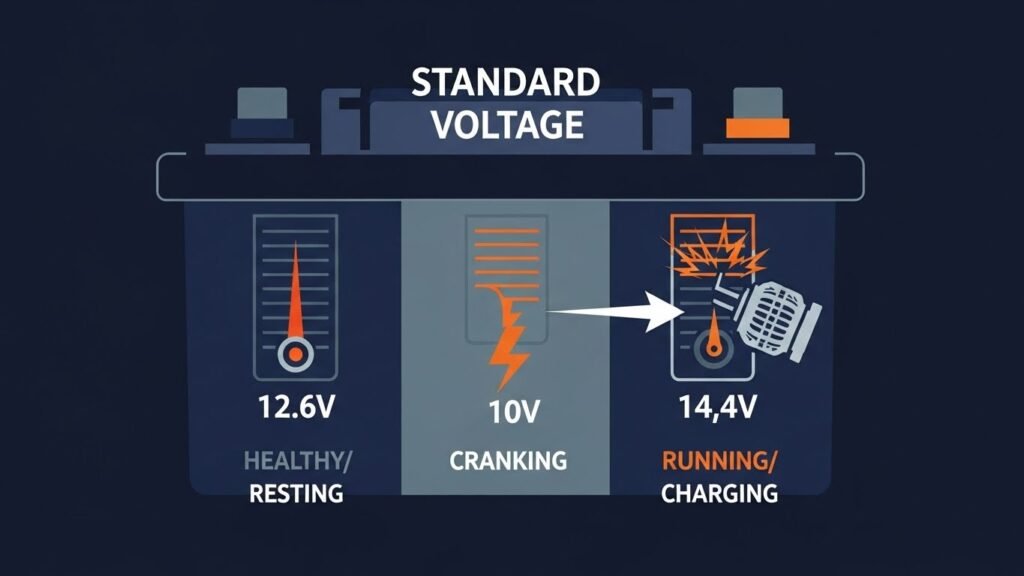
Knowing how many volts is a car battery in different states is key. Your battery voltage changes depending on what the car is doing. It is not just one steady number all day long. You can check it when the car is sleeping or running. Each stage tells a different story about your battery health.
- Resting State: A healthy, fully charged battery sits at 12.6 volts.
- Cranking State: The voltage might drop to 9 or 10 volts when starting.
- Charging State: The alternator pushes the voltage up to 13.5 or 14.7 volts.
- Under Load: Turning on the AC or lights will cause a small voltage drop.
How to Check Your Car Battery Voltage
Checking your battery is a great DIY skill to have. You don’t need to be a pro to do it. Most people use a tool called a multimeter. It is a simple device that reads electrical signals. You can find them at any local auto parts store. Just follow the steps and you will be a pro in no time.
Using a Multimeter (Professional Method)

To start, you need to set your multimeter correctly. Turn the dial to the DCV or DC setting. Make sure it is set to the 20-volt range. This allows the meter to read small changes in voltage. Always make sure your car is completely off before testing. Safety is the most important part of any car job.
- Red Probe: This one goes on the positive (+) battery terminal.
- Black Probe: This one goes on the negative (-) battery terminal.
- Safety Prep: Keep your headlights and radio off for a true reading.
- Read the Screen: A reading of 12.4 to 12.9 volts is usually good news.
- Negative Reading: If you see a minus sign, just swap the probes around.
Performing a Load Test
A load test shows how the battery handles a real job. You will need a friend to help you with this part. Have them sit in the driver’s seat while you watch the meter. Ask them to start the engine while you stay safe. Watch how low the numbers go on the screen. This tells you if the battery has the strength to start.
- The Two-Volt Rule: The voltage should not drop more than two volts.
- 9.5 Volts: If it dips below this number, your battery is likely dying.
- Recovery: A good battery should bounce back quickly after the car starts.
The Headlight Test (Manual Diagnostic)

You can also test the battery without any special tools. This is called the headlight test. Turn your headlights on while the engine is still off. Then have someone start the car for you. Look closely at the brightness of the light beams. It is a quick way to see if things are working.
- Watch the Dimming: If the lights get really dim, the battery is weak.
- Listen to the Start: A slow crank combined with dim lights is bad.
- Visual Clues: This test is great when you are stuck without a meter.
Voltage Abnormalities and Troubleshooting
Sometimes the numbers on your meter will look a bit weird. This usually means something is wrong with the car. It could be the battery or the parts connected to it. You need to know the signs of trouble to fix them. Catching these early can save you a lot of money later. Don’t ignore the warning signs your car gives you.
- Undercharging: This is when the voltage stays below 12 volts while running.
- Overcharging: This is when the voltage goes above 15 volts and hurts the battery.
- Parasitic Draw: This happens when a light or computer stays on all night.
- Dim Lights: Weak headlights are a classic sign of low battery voltage.
- Warning Lights: Keep an eye out for the battery icon on your dashboard.
- Sticky Windows: If your power windows move slowly, check the battery.
Advanced Battery Voltages in Modern Vehicles

Not all car batteries are the same these days. New tech has brought us many different types of power. Some cars use much higher voltage than the old 12-volt style. This helps them save gas and drive on electric power. Knowing how many volts is a car battery depends on the model. Let’s look at the new systems being used now.
Mild Hybrid Electric Vehicles (MHEV)
Mild hybrids are the newest trend in standard car engines. They use a special 48V system to help the gas engine. This system uses a lithium-ion battery and a special starter. It helps the car shut off at stoplights to save fuel. It also captures energy when you step on the brakes. You can’t drive on just electricity, but it is very efficient.
- 48-Volt Power: This system runs accessories and helps the engine start.
- Regenerative Braking: The car turns braking heat back into usable electricity.
- Start-Stop Tech: The engine can turn off safely when you are not moving.
Full Hybrid (FHEV) and Plug-in Hybrid (PHEV)
Full hybrids and plug-in hybrids have even more power. They usually run on 200V to 400V systems. These cars have much larger batteries than a regular sedan. They use either Nickel-Metal Hydride or Lithium-ion cells. Plug-in hybrids can drive for many miles without using gas. They need a lot of voltage to move the whole car.
- High Voltage: These systems range from 200V to 400V for driving.
- Fuel Savings: The electric motor does a lot of the work to save gas.
- Electric Range: PHEV models can drive on pure power for short trips.
Battery Electric Vehicles (BEV)
Electric vehicles are the kings of high voltage power. They don’t have a gas engine at all. They use massive battery packs that can reach 800 volts. For example, the Tesla Model S uses a 400V system. The Porsche Taycan uses an 800V system for super-fast charging. These batteries are made of thousands of small cells.
- Massive Power: BEVs use 360V to 800V to provide instant speed.
- Fast Charging: Higher voltage systems like 800V charge much faster.
- Cell Design: Engineers connect many cells to get the right voltage.
Preventive Maintenance and Professional Service

The best way to handle battery trouble is to prevent it. Regular checkups keep your car running smooth all year. You should check your battery every 6 months or so. Most service centers can do a professional test for you. This goes deeper than just checking the voltage numbers. A little care now prevents a big headache later.
- The 6/6 Rule: Get a battery check every 6 months or 6,000 miles.
- Cranking Test: Pros can check the total capacity of your battery.
- Clean Terminals: Keep the metal parts clean to ensure the power flows.
- Save Money: Testing early prevents damage to your starter or alternator.
- Expert Advice: Mechanics have the best tools to find hidden problems.
| Battery Condition | Resting Voltage |
| 100% Charged | 12.6V – 12.8V |
| 75% Charged | 12.4V |
| 50% Charged | 12.2V |
| 25% Charged | 12.0V |
| Discharged | Below 11.9V |
FAQs
What does it mean if my battery reads 10.5 volts during a charge?
If your battery cannot reach higher than 10.5 volts while being charged, it is a classic sign of a dead cell. Standard 12-volt batteries are made of six individual cells, each providing about 2.1 volts. When one cell short-circuits or fails completely, the total voltage capacity drops by that specific amount, leaving you with a battery that will never fully charge.
Can a battery have a normal voltage reading but still be bad?
Yes, this is a common and frustrating issue known as an “open cell” or a “surface charge” problem. A battery might show 12.6 volts on a multimeter, but the moment you put it under load (like starting the engine), the voltage instantly drops to nearly zero. This happens when internal components are barely touching, providing enough connection for a meter but not enough for high-power flow.
Why does my battery voltage drop slightly overnight?
A small drop of about 0.05 to 0.08 volts overnight is normal due to parasitic draw. Modern vehicles have computers, security alarms, and clocks that stay “awake” to save your settings. This tiny drain is expected, but if you see a drop of 0.5 volts or more, you likely have an electrical leak or a light left on in the glove box.
Is it safe to use a lithium battery in a car designed for lead-acid?
While it is possible, you cannot just swap them without a Battery Management System (BMS). Lithium batteries have different voltage curves and charging requirements. Without a proper regulator, your car’s alternator might overcharge a lithium battery, leading to permanent damage or even a fire hazard.
What is the “surface charge” and how do I remove it?
A surface charge is a fake high-voltage reading that happens right after a battery has been charged or driven. It can make a weak battery look healthy. To remove it for an accurate test, turn your high-beam headlights on for one minute with the engine off, then wait two minutes before taking your final reading.
Can revving the engine help a low-voltage battery?
Revving the engine increases the alternator’s RPM, which in turn increases the voltage output to the battery. While this can provide a temporary boost to help run electronics or charge a very weak battery faster, it is not a permanent fix. If your battery voltage is low because the battery is old, revving the engine will not restore its health.
Why do some luxury cars use 48-volt batteries?
Many modern luxury and high-performance cars use a 48-volt mild-hybrid system to power heavy electrical loads. Things like electric turbochargers, advanced suspension systems, and climate control work much more efficiently at higher voltages. These cars usually still have a 12-volt battery for basic lights and the radio.
Can a bad ground wire cause low voltage readings?
Absolutely. If the ground wire connecting the battery to the car’s frame is loose or corroded, it creates resistance. This resistance “eats” some of the voltage before it reaches your tools or electronics. You might see a perfect 12.6V at the battery terminals but only 11.5V at the fuse box because of a bad ground.
What happens to voltage when a battery freezes?
When a battery’s charge drops, the electrolyte fluid inside becomes mostly water. In freezing temperatures, this water can turn to ice, which expands and can crack the internal lead plates. A frozen battery will show very strange voltage readings and should never be jump-started or charged until it has completely thawed out.
How does battery age specifically change the voltage reading?
As a battery ages, its internal resistance increases due to a process called sulfation. While an old battery might still show 12.6 volts when resting, the high internal resistance prevents it from delivering that power quickly. Think of it like a water tank with a tiny, clogged pipe; the pressure is there, but the flow is gone.
Does a car battery lose voltage faster in the heat or cold?
Batteries actually lose their charge faster in extreme heat. Heat speeds up the chemical reactions inside, causing the battery to self-discharge at a higher rate. However, we notice battery failure more in the cold because the engine is harder to turn over and the battery’s “cranking” ability is reduced.
Can a faulty radio or aftermarket alarm kill my battery voltage?
Aftermarket accessories are a leading cause of parasitic drain. If an alarm system or a new stereo is wired incorrectly, it may never go into “sleep mode.” This causes a constant draw of 1 amp or more, which can take a healthy battery from 12.6V to a “dead” 11.8V in just a single weekend.
What is the difference between a starter battery and a deep cycle battery voltage?
Starter batteries are designed to give a huge burst of 600+ amps for 2 seconds, while deep cycle batteries (used in RVs or boats) provide a steady 5 to 10 amps for hours. A starter battery will be damaged if its voltage drops below 10.5V frequently, but a deep cycle battery is built to handle those deep drops without dying.
Why does my dashboard say 14 volts while I am driving?
When you see 14 volts on your car’s digital display, you are actually looking at the alternator’s output, not the battery’s resting charge. This is a good sign; it means your alternator is successfully pushing power into the system to run the car and recharge the battery for your next start.
Can a battery “leak” voltage through a dirty case?
Yes, this is a real thing called “case leakage.” If the top of your battery is covered in a film of dirt, grease, and moisture, that grime can actually become a conductor. A tiny amount of electricity can crawl across the dirt from the positive to the negative terminal, slowly draining the voltage over several days.
What is the “resting period” for a battery test?
To get the most accurate “how many volts is a car battery” reading, the battery needs to rest. This means the car should be off with no lights or electronics running for at least 4 to 24 hours. This allows the chemicals inside to stabilize and gives you a true reflection of the state of charge.
Why does my voltage drop when I turn on the AC?
The AC compressor and the high-speed cooling fans use a massive amount of electricity. When they kick on, they create a sudden “draw” on the system. If your alternator is healthy, the voltage might dip for a split second and then jump back up to about 14.2V as the regulator adjusts to the new load.
Is 12.2 volts enough to start a modern fuel-injected car?
At 12.2 volts, your battery is only at about a 50% charge. While this might start an older car with a small engine, modern cars with many computers often require a higher voltage to “wake up” the electronics before the engine even turns. You might get a “clicking” sound even though the lights look bright.
Can jump-starting another car damage my battery’s voltage?
If done correctly, it is safe. However, if the other car has a “shorted” battery, it can put a massive strain on your alternator and battery. Always make sure your car is running while jump-starting another to ensure your alternator is handling the heavy lifting rather than draining your own battery to dangerous levels.
Does the size of the battery affect the voltage reading?
No, a tiny lawnmower battery and a massive truck battery are both 12-volt systems. The difference is in the “capacity” and “amperage.” The bigger battery simply has more lead plates, allowing it to maintain that 12.6V for a much longer time under a heavy load compared to the smaller one.