Skip to content
Introduction to Engine Types
When buying a car, one of the most important decisions to make is about the engine type. The engine is the heart of any vehicle, and understanding the differences between the two main engine types — 4‑cylinder and 6‑cylinder — can greatly impact your driving experience.
A 4‑cylinder engine has four cylinders that fuel combustion and power the car. It’s often found in smaller, compact cars, offering fuel efficiency and a smooth ride. On the other hand, a 6‑cylinder engine, also called a V6, has six cylinders and provides more power. V6 engines are common in larger vehicles like SUVs, trucks, and performance cars.
In this article, we’ll dive deep into 4‑cylinder vs 6‑cylinder engines, explore how they work, and help you decide which engine is best for your needs. Let’s start with the basics and build from there.
How 4‑Cylinder and 6‑Cylinder Engines Work

Understanding how these engines work will give you a better idea of why their performance differs so much.
Basic Operation of an Internal Combustion Engine
An internal combustion engine (ICE) works by burning fuel inside cylinders, creating pressure that moves pistons. These pistons are attached to a crankshaft, which converts the pressure into rotational energy, turning the wheels of the car.
- Piston Movement and Engine Output: The piston moves up and down inside the cylinder. When fuel is ignited in the combustion chamber, it forces the piston downward. This power moves through the crankshaft, which turns the car’s wheels.
- Crankshaft Role in Motion Transmission: The crankshaft is responsible for transferring energy from the pistons to the rest of the vehicle’s components.
Differences in 4‑Cylinder and 6‑Cylinder Layouts
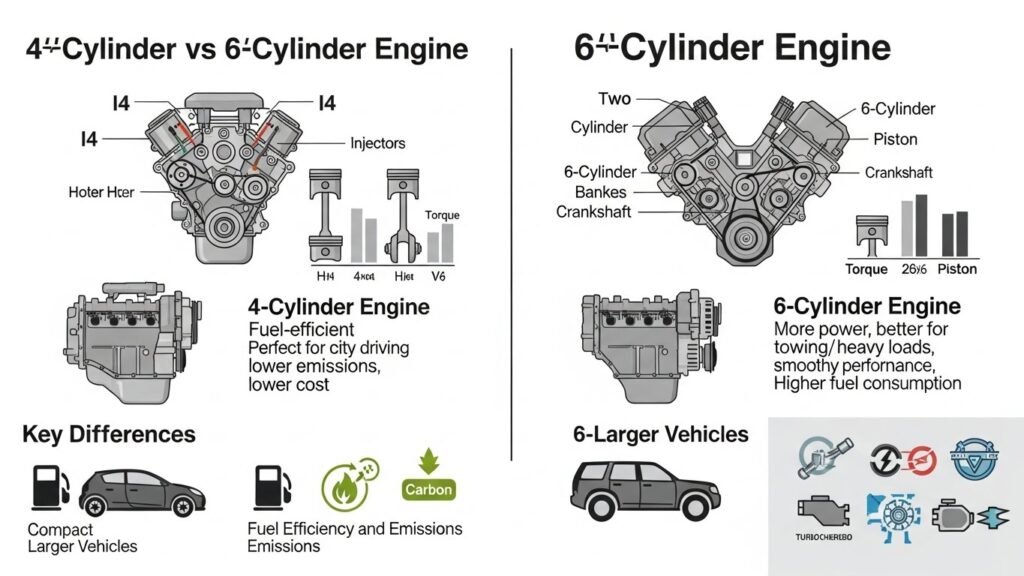
- 4-Cylinder Engines: These engines typically use an inline configuration (I4), meaning all four cylinders are arranged in a straight line. Some 4-cylinders can also be in a boxer configuration (flat‑4), where the cylinders are horizontally opposed.
- 6-Cylinder Engines: V6 engines are the most common 6-cylinder type. In these engines, the cylinders are arranged in two banks that form a “V” shape. The V6 configuration allows for a more compact engine compared to a straight 6-cylinder engine.
Understanding 4‑Cylinder Engines

Design and Structure
A 4‑cylinder engine is designed with fewer components, which makes it simpler and smaller. These engines use four pistons that each undergo the four-stroke cycle (intake, compression, power, exhaust).
- Pistons, Cylinders, and Fuel Injectors: The engine burns fuel in four combustion chambers. The pistons move up and down in the cylinders, generating power. Fuel injectors deliver fuel to these chambers.
- Combustion Process and Power Delivery: When fuel is injected and ignited, it pushes the piston down. The downward motion of the piston drives the crankshaft, powering the vehicle.
Performance and Efficiency
A 4-cylinder engine is known for its fuel efficiency, making it ideal for city driving or daily commuting.
- Fuel Efficiency: 4‑cylinder engines are lighter and consume less fuel than 6‑cylinder engines. This means lower emissions, better gas mileage, and a smaller carbon footprint.
- Power Output and Limitations: While 4‑cylinder engines are efficient, they may struggle when it comes to towing or handling heavy loads. They generally have less horsepower and torque than their 6‑cylinder counterparts.
Pros and Cons
Pros:
- Lower Cost: 4-cylinder engines are cheaper to build, which makes cars with these engines more affordable.
- Fuel-Efficient: They consume less fuel, making them perfect for city driving and longer commutes.
- Compact: Their smaller size makes them easier to park and maneuver in tight spaces.
Cons:
- Lower Power: 4‑cylinder engines may not be suitable for heavy-duty tasks like towing.
- Performance Limitations: They often lack the acceleration power needed for high-speed driving or overtaking on highways.
Exploring 6‑Cylinder Engines (V6)
Design and Structure
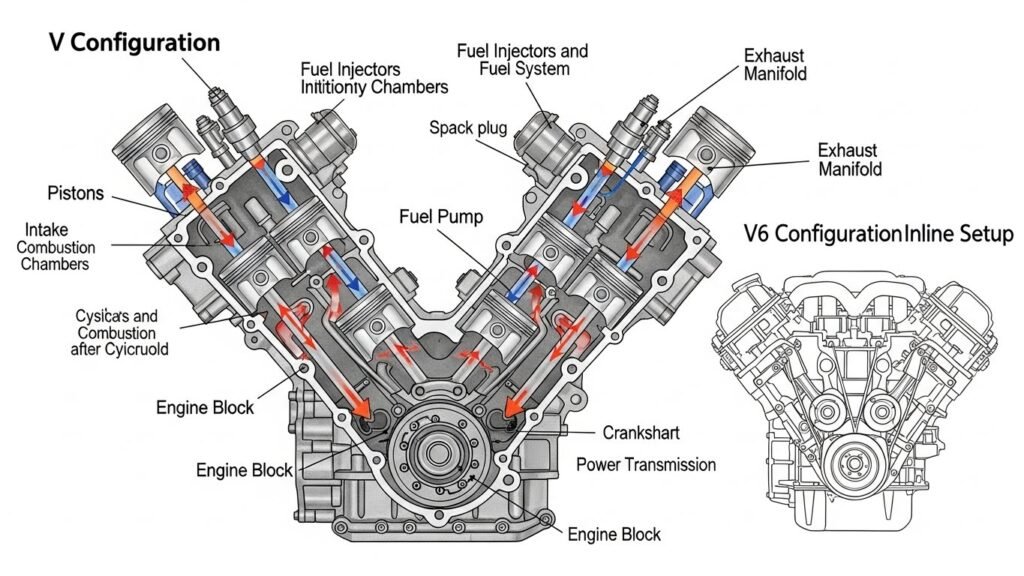
A V6 engine has six cylinders arranged in a V configuration, which makes it more powerful but larger than a 4‑cylinder engine.
- V6 Configuration vs Inline 6-Cylinder Engines: The V-shaped layout allows for more compact packaging compared to an inline six-cylinder engine, which is much longer and bulkier.
- Components and Power Generation: Like a 4‑cylinder engine, a V6 uses pistons, fuel injectors, and a crankshaft. The difference is the increased number of pistons, which means more power is generated in each combustion cycle.
Performance and Efficiency
V6 engines are known for their higher horsepower and better acceleration compared to 4‑cylinder engines. This makes them a top choice for performance cars and vehicles that need to carry heavy loads.
- Greater Power and Torque: A V6 engine offers more torque, which is useful for towing, hill climbing, or overtaking vehicles on the highway.
- Smoother Operation: V6 engines are generally smoother and quieter than 4‑cylinder engines because of the balanced firing order and better vibration reduction.
Pros and Cons
Pros:
- Enhanced Performance: V6 engines provide more horsepower and torque, making them ideal for larger vehicles, sports cars, or towing.
- Smoother Ride: V6 engines are less prone to vibrations, offering a more refined and smooth driving experience.
Cons:
- Higher Fuel Consumption: V6 engines consume more fuel, which reduces their overall fuel efficiency.
- Increased Cost: Vehicles with V6 engines are typically more expensive to purchase and maintain.
Key Differences Between 4‑Cylinder and 6‑Cylinder Engines
Fuel Economy vs. Power
When comparing 4-cylinder vs 6-cylinder, one of the most significant differences is fuel efficiency versus performance.
- 4‑Cylinder Engines: These engines offer better fuel efficiency because of their smaller size and fewer moving parts. They’re ideal for drivers who prioritize gas mileage and lower emissions.
- 6‑Cylinder Engines: V6 engines provide more power, making them better suited for heavy-duty tasks like towing or carrying large loads. However, this power comes at the cost of higher fuel consumption.
Performance, Maintenance, and Costs
- 4‑Cylinder Engines: Because they are simpler, 4-cylinder engines tend to have lower maintenance costs. They’re easier to repair and generally last longer without needing significant work.
- 6‑Cylinder Engines: V6 engines have more parts, making them more complex to maintain. While they are powerful, 6-cylinder engines generally come with higher upkeep costs and are more expensive to repair.
Maintenance and Longevity
4-Cylinder Engine Maintenance
4-cylinder engines are simpler in design, leading to easier and cheaper maintenance. With fewer parts, the likelihood of wear and tear is reduced, making them last longer and requiring less frequent repairs.
6-Cylinder Engine Maintenance
While V6 engines provide more power, they have a more complex design and higher maintenance costs. Repairs tend to be more expensive due to the increased number of parts and complexity.
Noise and Vibration Differences
Vibration Levels in 4-Cylinder Engines
4-cylinder engines are generally more prone to vibrations because of their smaller configuration. These vibrations can become noticeable when accelerating or under heavy load.
How 6-Cylinder Engines Minimize Vibrations
V6 engines are more balanced, resulting in fewer vibrations. The “V” configuration helps reduce engine shake, leading to a smoother and quieter ride, especially at higher speeds.
Choosing the Right Engine: What You Need to Consider
Factors to Consider
Choosing between a 4‑cylinder and 6‑cylinder engine depends on several factors, including your driving habits, vehicle size, and performance needs.
- Type of Driving: If you’re mostly driving in the city, a 4‑cylinder engine may be the best choice for its fuel efficiency. But if you often drive long distances or need to tow, a V6 engine would be a better fit.
- Vehicle Size and Purpose: Smaller vehicles like compact cars work well with 4‑cylinder engines, while larger vehicles like SUVs or trucks often benefit from the power of a V6 engine.
- Performance Needs: If acceleration and towing capacity are important to you, a 6‑cylinder engine will provide the necessary power for such tasks.
4‑Cylinder Engines: Best for Everyday Use
4-cylinder engines are the go-to choice for daily driving. They are ideal for:
- Commuting and City Driving: Their efficiency and low emissions make them perfect for everyday trips.
- Fuel-Efficiency: Save on gas while reducing your environmental impact.
- Cost-Effective: A more affordable vehicle purchase, with cheaper long-term upkeep.
6‑Cylinder Engines: Best for Performance
V6 engines are great for:
- Heavy-Duty Use: If you need to tow or carry large loads.
- Sports Cars: High performance and strong acceleration make them ideal for speed.
- Long-Distance Travel: V6 engines can maintain high speeds for longer durations.
Modern Engine Technologies

Turbocharged 4‑Cylinders vs 6‑Cylinders
One of the key advancements in engine technology is turbocharging. Modern turbocharged 4‑cylinders can provide the power of a larger engine while maintaining the fuel efficiency of a smaller one.
- Turbocharging in 4‑Cylinder Engines: Turbocharging forces more air into the engine, increasing its output without increasing the engine size.
- Modern 6‑Cylinders: Advances in V6 engine design have made them more fuel-efficient, narrowing the gap between 4‑cylinders and 6‑cylinders.
Hybrid and Electric Engines as Alternatives

Hybrid and electric vehicles are becoming increasingly popular as eco-friendly alternatives. These vehicles often combine electric motors with traditional internal combustion engines, offering a cleaner and more energy-efficient option.
- Efficiency Gains: Electric motors are known for their high efficiency and low emissions.
- Environmental Benefits: Hybrid and electric vehicles have a much smaller carbon footprint compared to traditional 4‑cylinder and 6‑cylinder gas engines.
Consumer Perception and Market Trends
Changing Consumer Preferences
As fuel prices rise and environmental awareness grows, many consumers are turning to smaller, more efficient engines, such as 4-cylinder models or even hybrid options. However, V6 engines remain popular for those needing more power or towing capability.
Market Trends in the Automotive Industry
- The automotive industry is seeing a rise in demand for electric and hybrid vehicles as eco-conscious consumers move away from traditional combustion engines.
- Turbocharged 4-cylinder engines are gaining popularity for their balance of performance and fuel efficiency.
Technology Integration in Modern Engines
Modern Engine Technologies in 4-Cylinder Engines
Modern 4-cylinder engines are equipped with technologies such as variable valve timing (VVT), turbocharging, and direct fuel injection, which enhance performance and fuel efficiency.
Advancements in 6-Cylinder Engine Design
6-cylinder engines have also benefited from technological improvements, such as turbocharging and direct injection, making them more fuel-efficient while still delivering powerful performance.
Environmental Impact and Emissions Comparison
CO2 Emissions and Fuel Consumption
When comparing 4-cylinder and 6-cylinder engines, the primary difference lies in their environmental impact. Generally, 4-cylinder engines produce fewer CO2 emissions because they consume less fuel and are smaller in size.
Impact Over Engine Lifespan
- 4-cylinder engines tend to require less fuel over their lifespan, contributing to a smaller carbon footprint.
- 6-cylinder engines, while more powerful, require more fuel, resulting in higher emissions over time.
Conclusion: Final Considerations
4‑Cylinder Engines
- Ideal for city driving and commuting due to their fuel efficiency and lower emissions.
- Perfect for compact cars and budget-conscious drivers who don’t need excessive power.
6‑Cylinder Engines
- Best for performance, towing, and larger vehicles.
- Higher power and smooth ride make them ideal for drivers who need more torque and acceleration.
Choosing between a 4-cylinder and 6-cylinder engine ultimately depends on your driving needs and vehicle requirements. If you prioritize fuel efficiency and lower costs, a 4‑cylinder engine is the right choice. But for performance, power, and smooth driving, a 6‑cylinder engine will be a better fit.
FAQs
How does engine size affect fuel economy?
Engine size plays a significant role in fuel economy. A smaller engine, like a 4-cylinder, typically consumes less fuel, making it more fuel-efficient. Larger engines, such as a 6-cylinder, require more fuel to produce greater power, thus lowering fuel efficiency. However, advancements like turbocharging can improve the fuel efficiency of larger engines.
Can a 6-cylinder engine be more fuel-efficient than a 4-cylinder?
While 6-cylinder engines are generally less fuel-efficient than 4-cylinder engines, modern technology has made it possible for 6-cylinders to achieve better fuel efficiency in some cases. Turbocharged 6-cylinder engines, for example, can offer more power without significantly compromising fuel efficiency.
Do 4-cylinder engines last longer than 6-cylinder engines?
Generally, 4-cylinder engines tend to last longer because they have fewer moving parts and are less complex. This simplicity leads to lower wear and tear. However, proper maintenance can ensure that both 4-cylinder and 6-cylinder engines last for many years. Regular oil changes, timely repairs, and proper care are crucial for extending engine lifespan.
Are 6-cylinder engines suitable for city driving?
While 6-cylinder engines provide more power, they are not necessarily the best choice for city driving due to their lower fuel efficiency. In city environments, a 4-cylinder engine is more practical because of its better fuel economy and smaller size, which makes it easier to maneuver in tight spaces.
What are the benefits of turbocharged 4-cylinder engines?
Turbocharged 4-cylinder engines offer the best of both worlds: they deliver the fuel efficiency of a 4-cylinder engine while boosting power output closer to that of a larger engine. This makes them ideal for drivers who want better acceleration and performance without sacrificing too much fuel economy.
Which engine type is better for sports cars?
For sports cars, a 6-cylinder engine is typically the better option. The higher power output and smoother performance of a V6 engine make it ideal for high-speed driving and fast acceleration. However, some sports cars are now using turbocharged 4-cylinder engines to achieve a balance between performance and fuel economy.
Do 6-cylinder engines cost more to maintain?
Yes, 6-cylinder engines generally cost more to maintain due to their complexity. They have more parts, and some of those parts are more expensive to replace or repair. Additionally, the labor involved in working on a V6 engine is often more time-consuming than a 4-cylinder engine, which can increase repair costs.
Is a 4-cylinder engine enough for a family car?
A 4-cylinder engine is usually more than enough for family cars, especially for those who primarily use the car for commuting, running errands, and family trips. It provides a balance of adequate power and excellent fuel efficiency, making it a popular choice for mid-sized sedans, hatchbacks, and compact SUVs.
Can a 6-cylinder engine tow heavy loads?
Yes, 6-cylinder engines are better suited for towing heavy loads compared to 4-cylinder engines. They provide the additional torque and horsepower needed to haul trailers, boats, or heavy equipment. A 6-cylinder engine’s greater power makes it ideal for vehicles like trucks and large SUVs used for towing.
What kind of engine is better for long trips?
For long trips, a 6-cylinder engine is often better due to its enhanced power and smoother performance on highways. It allows for better acceleration, overtaking, and handling at higher speeds. Additionally, the extra power can reduce engine strain during long hours of driving, especially when carrying heavy loads or traveling at high speeds.
Do 4-cylinder engines require less maintenance?
4-cylinder engines tend to require less maintenance than 6-cylinder engines because they are simpler and have fewer components. They are generally less complex to work on and have fewer things that can go wrong. Regular maintenance like oil changes, air filter replacement, and tire rotations can keep a 4-cylinder engine running efficiently for a long time.